Take your pick and print out any or all of these:


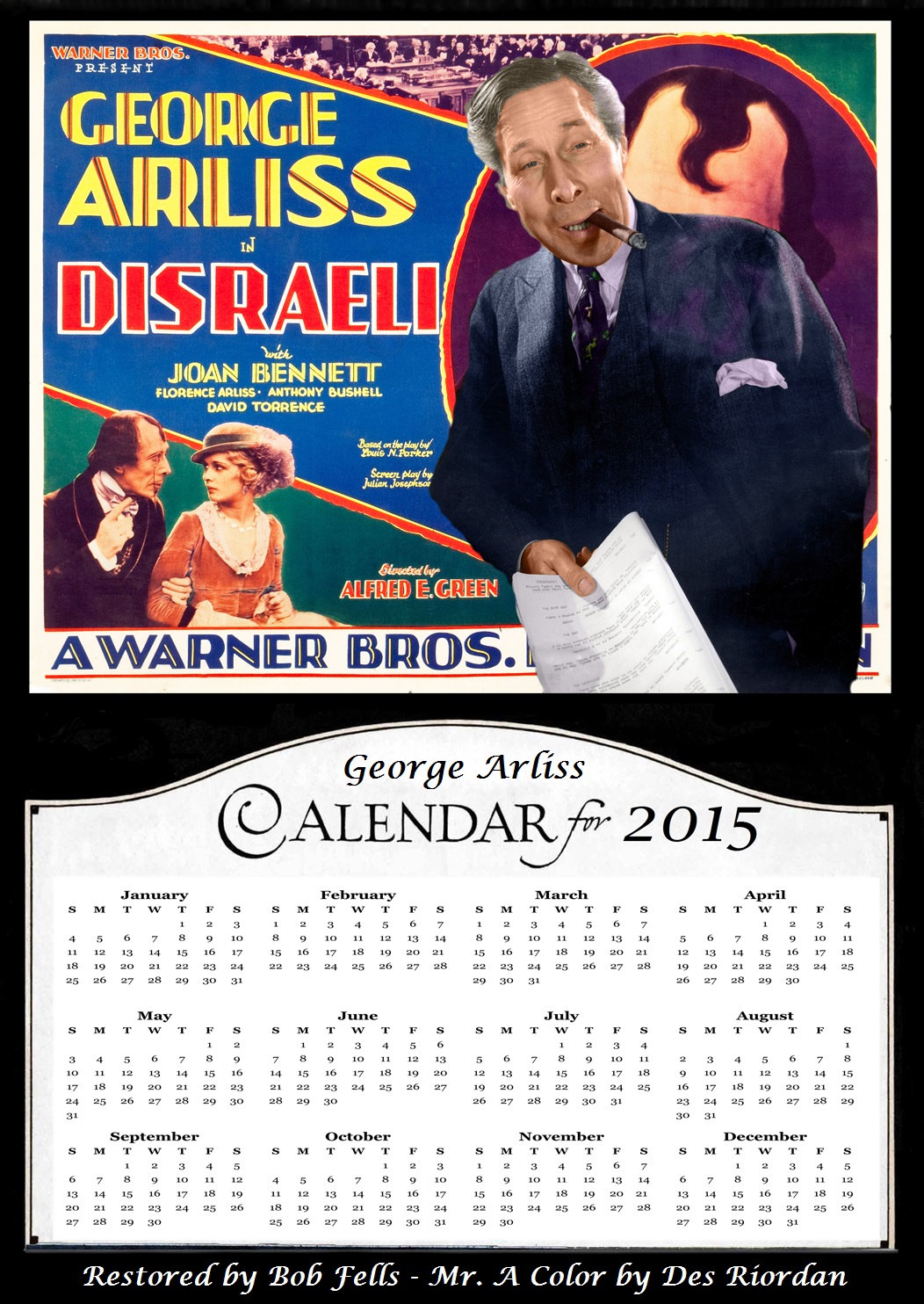
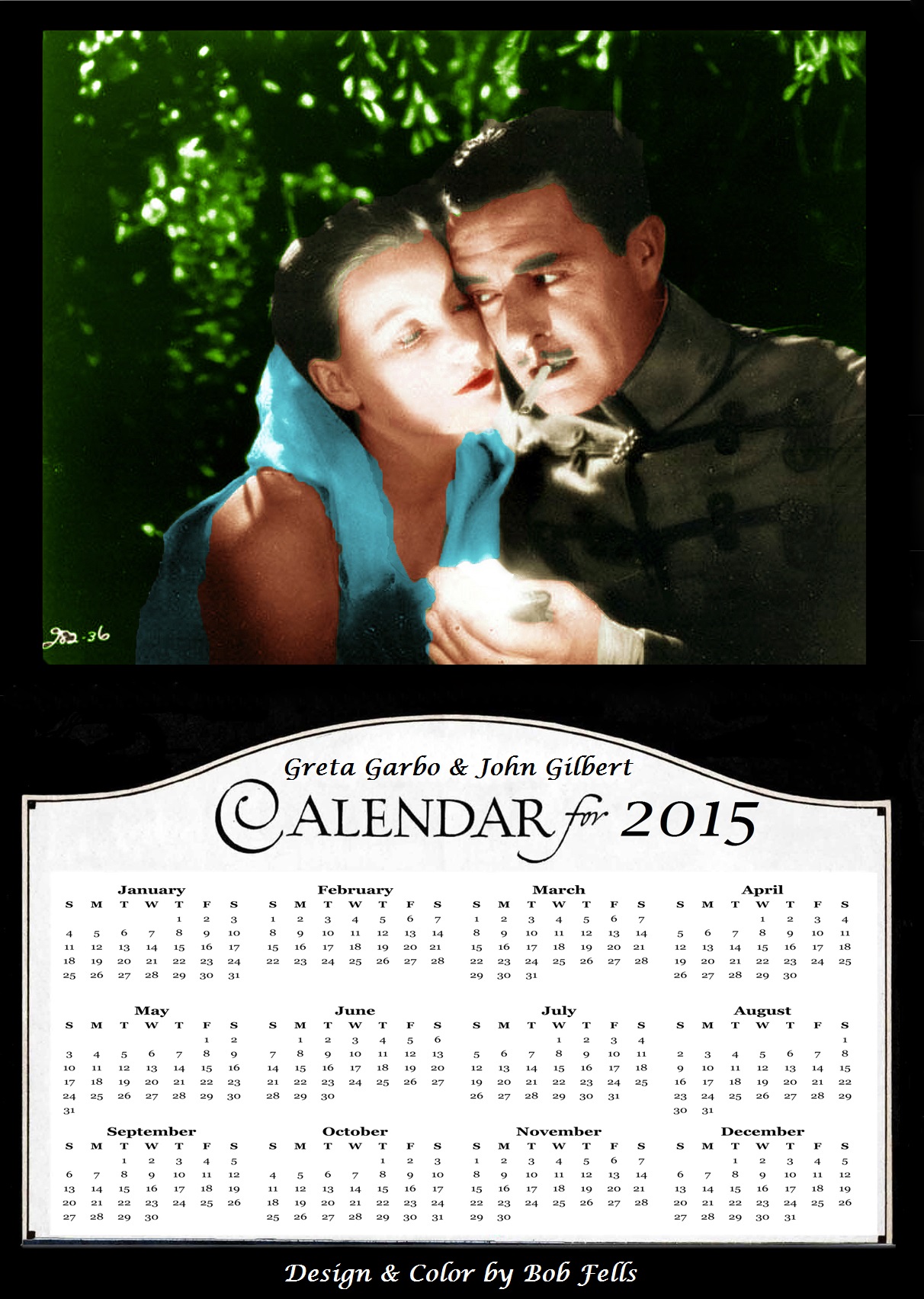


From left to right: Al Jolson & Rin Tin Tin, Richard Barthelmess & Mary Astor, Clara Bow, Will Rogers & Myrna Loy, and Rudolph Valentino.

There are a number of talented modern-day artists who have turned their skills to the Classic Horror Films of Hollywood’s Golden Age. These individuals have made their works available on the Internet so what follows is a Halloween roundup with credit given where it is properly deserved.
Robert Semler offers a few of the 1,000 Faces of Lon Chaney Sr.:
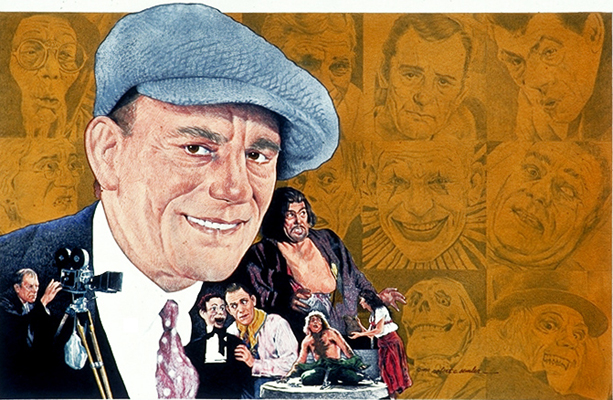
Chaney’s THE HUNCHBACK OF NOTRE DAME (1923) by Robert Semler:

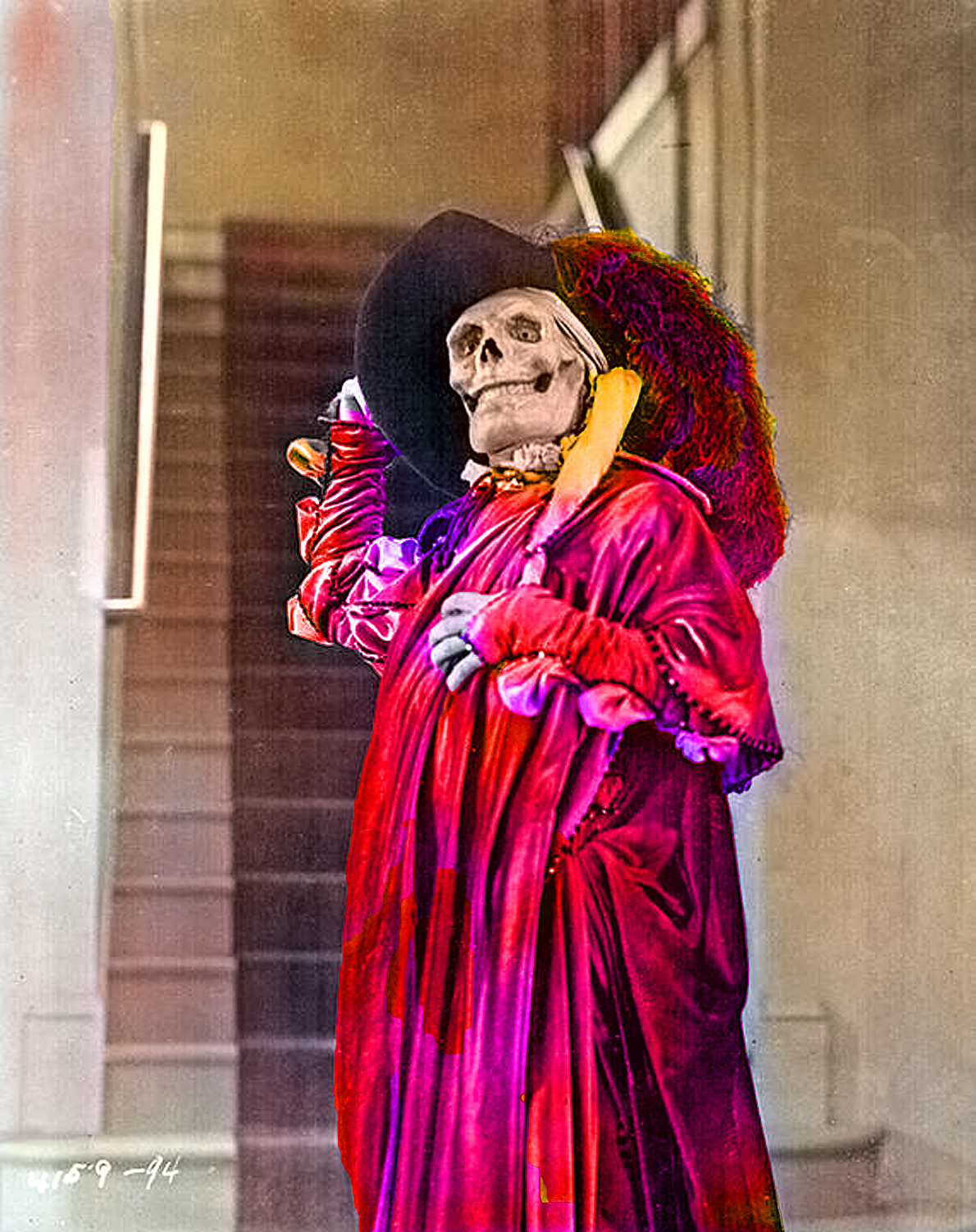
THE PHANTOM OF THE OPERA (1925) by Robert Semler:

The lamentably long-lost LONDON AFTER MIDNIGHT (1927) by Robert Semler:
Another artist, Daniel Horne, painted this exquisite portrait of THE PHANTOM:

Daniel Horne gives us LONDON AFTER MIDNIGHT:

Moving into the 1930s, Boris Karloff as the Frankenstein Monster by Daniel Horne:

Mr. Horne also sculptures. Here is Karloff again in two works as Ardath Bey aka THE MUMMY (1932):


The Monster again in sculpture by Daniel Horne:
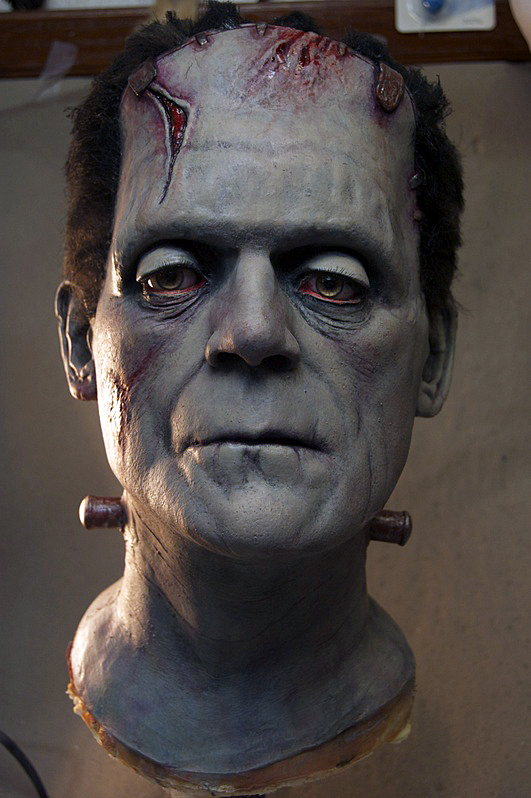
Everybody’s favorite Halloween couple, Karloff and Elsa Lancaster in THE BRIDE OF FRANKENSTEIN (1935) by Daniel Horne:

An exquisite painting by Daniel Horne of the BRIDE herself:

It just wouldn’t seem like Halloween without Bela Lugosi. From THE MARK OF THE VAMPIRE (1935) by Daniel Horne:

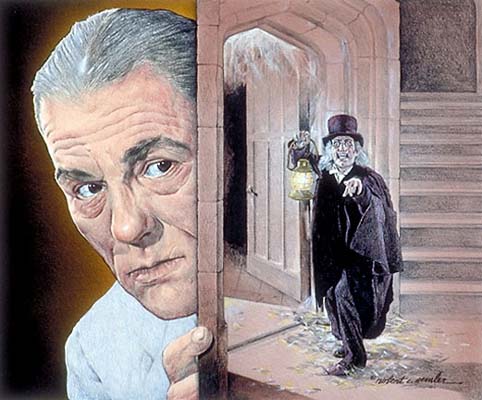
One of my All-Time Favorites – Henry Hull as THE WEREWOLF OF LONDON (1935) by Daniel Horne:

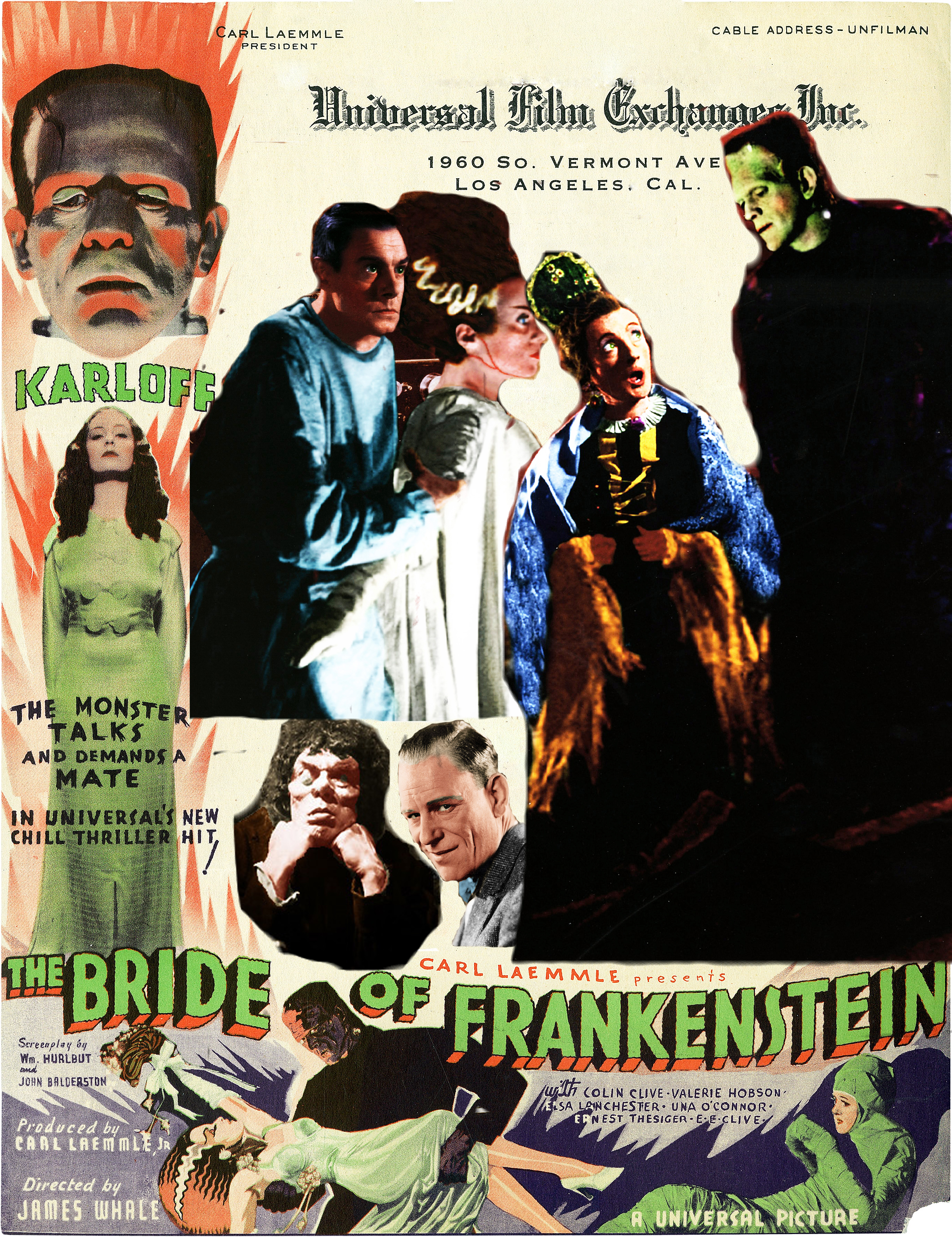
Finally, here is your blogmeister’s attempt at an artistic potpouri of images from our favorite ghouls!

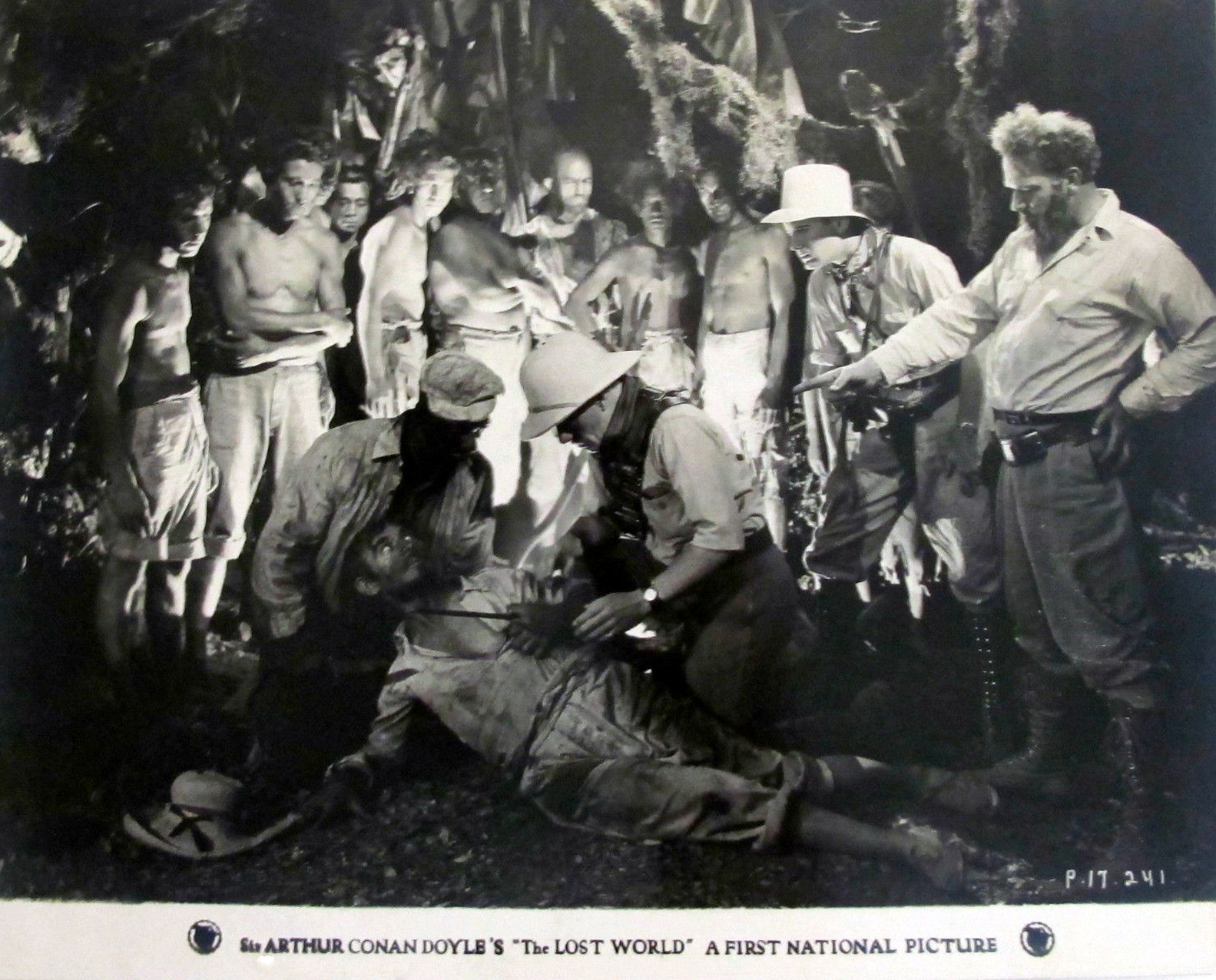
We can’t equal our recent post here where we provided the complete continuity script for LONDON AFTER MIDNIGHT (1927), perhaps the most famous “lost film” of all time. However, we’re not being too shabby by providing the script for the granddaddy of all dinosaur films —

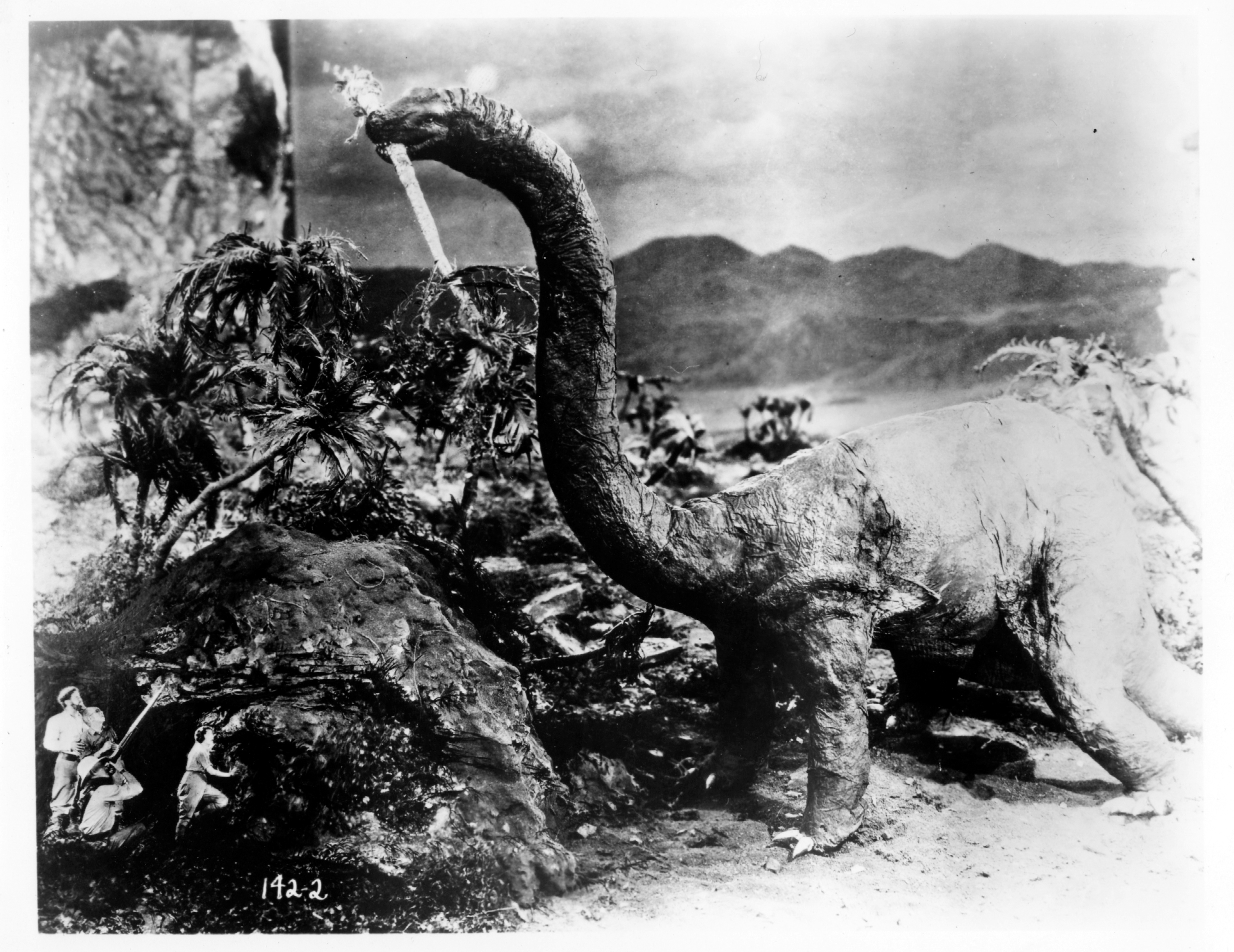
THE LOST WORLD was based on the best-selling 1912 novel by Sir Arthur Conan Doyle. A corking good adventure yarn, this 1925 film version ran ten reels and was booked at special “road shows” prior to its general release. But for decades, the only surviving version was a truncated 16mm edition that ran about half the length, or 50 minutes, of the original.

You know you’re dealing with a prestige film when a special “Photoplay Edition” of the novel is published with photos from the movie. Here is a worn but surviving dustjacket showing the romantic couple Bessie Love and Lloyd Hughes:

This glass slide was projected onto gigantic screens of movie palaces of the day as an advertisement. Perhaps we’re jaded now, but at the time audiences were amazed to see humans and dinosaurs together:

An original color lobby card with Bessie Love and Lloyd Hughes:

The film offered comedy relief from these characters that, even in 1925, was considered the weakest part of the movie:

A love triangle with Lewis Stone (later “Judge Hardy” in Mickey Rooney’s ANDY HARDY films) playing Bessie Love’s fiance. In the 1920s, Stone was a popular leading man and certainly a better actor than Mr. Hughes!

A bearded Wallace Beery on the right played the fiesty Professor Challenger, leader of the expedition to a mysterious plateu in the South American jungles to prove his theory that dinosaurs still exist:
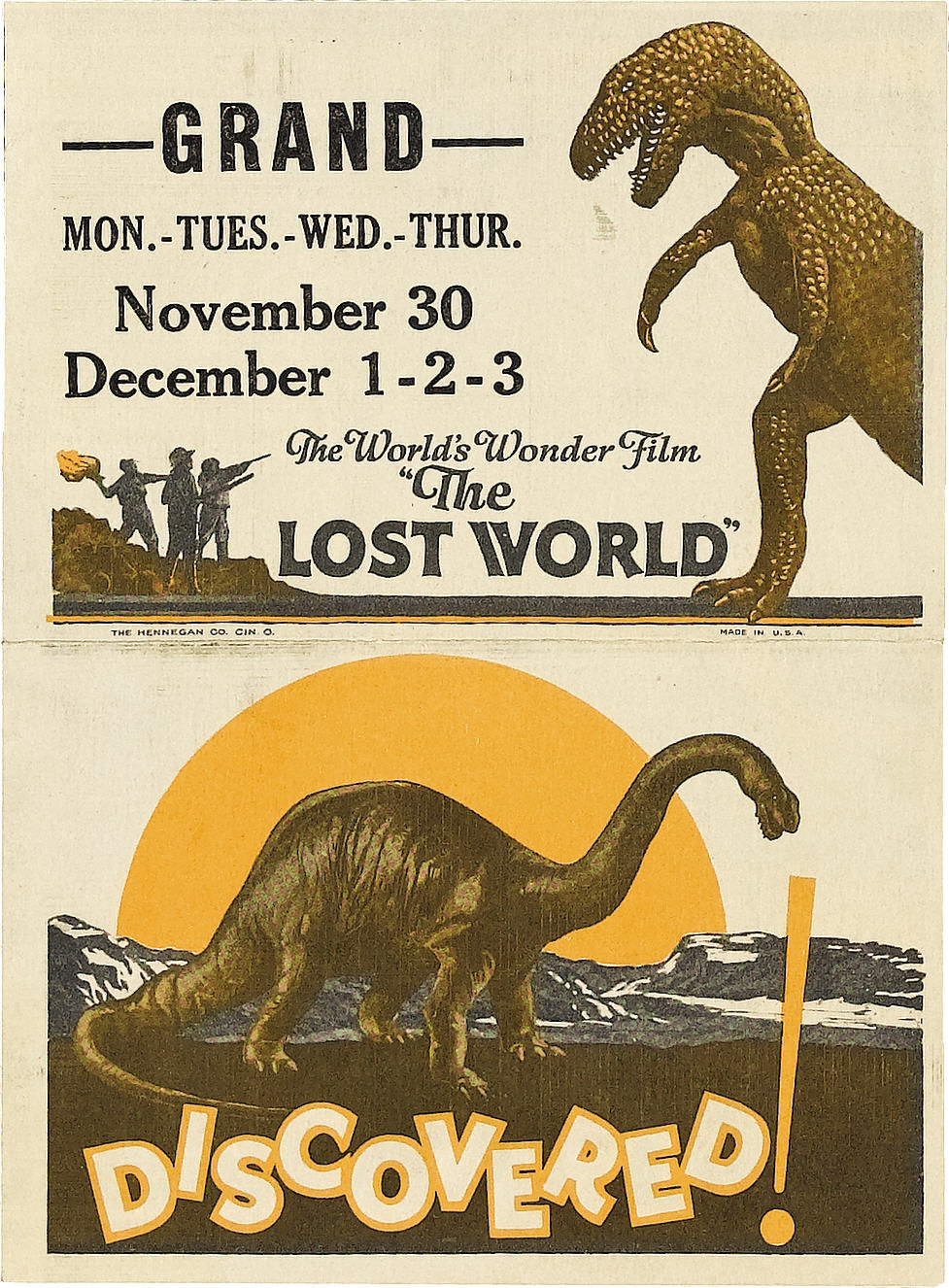
Two sides of a movie “herald” to alert the town to the forthcoming attraction:
The special effects work by Willis O’Brien won much praise with the monsters even appearing to breathe. O’Brien would later animate KING KONG and SON OF KONG (both 1933) and MIGHTY JOE YOUNG (1949). O’Brien’s protege, Ray Harryhausen, brought a new generation of monsters to screen life beginning in the 1950s.
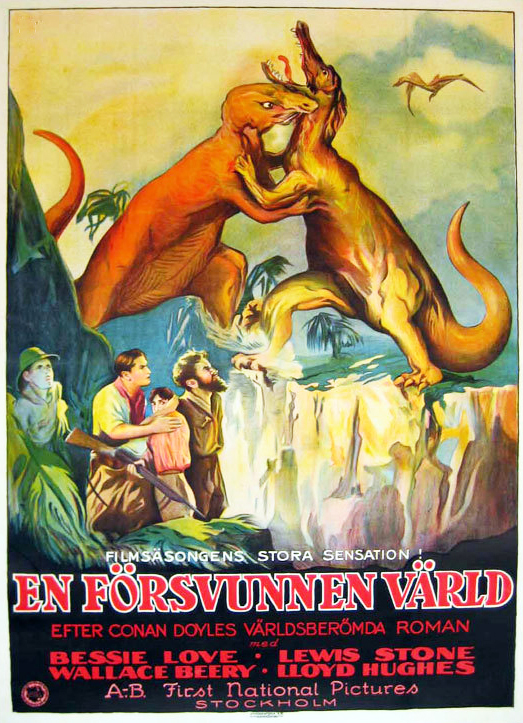
A vintage Swedish poster. THE LOST WORLD became an international hit!
Restored editions of THE LOST WORLD have been available on DVD for several years now, and a Blu-ray version is apparently in the works. But alas, there is much missing footage gone from the film since its 1925 release. However, you can “see” the complete film by reading through the script here:
LOST WORLD 1925_Complete Script

Who knew that all these years the Library of Congress in Washington, D.C. held a shot-by-shot cutting continuity made from viewing an actual print of LONDON AFTER MIDNIGHT? This Lon Chaney Sr. vampire tale is perhaps the most famous – and most eagerly sought – lost silent film. The last known print was destroyed in a vault fire in 1967, and intensive searching of the world’s film archives has so far failed to locate another print.
But now you can “see” LONDON AFTER MIDNIGHT simply by reading this 38-page document (it’s a quick read) and using an average amount of your imagination. We are supplying you with a series of photos and lobby cards below to assist you. Enjoy!
Click here:
London After Midnight LOC Script copy

Lon Chaney plays Professor Burke, a detective/hypnotist who is investigating the “suicide” of Roger Balfour:

There are strange goings-on in the old Bafour Mansion, and some mighty strange creatures too:
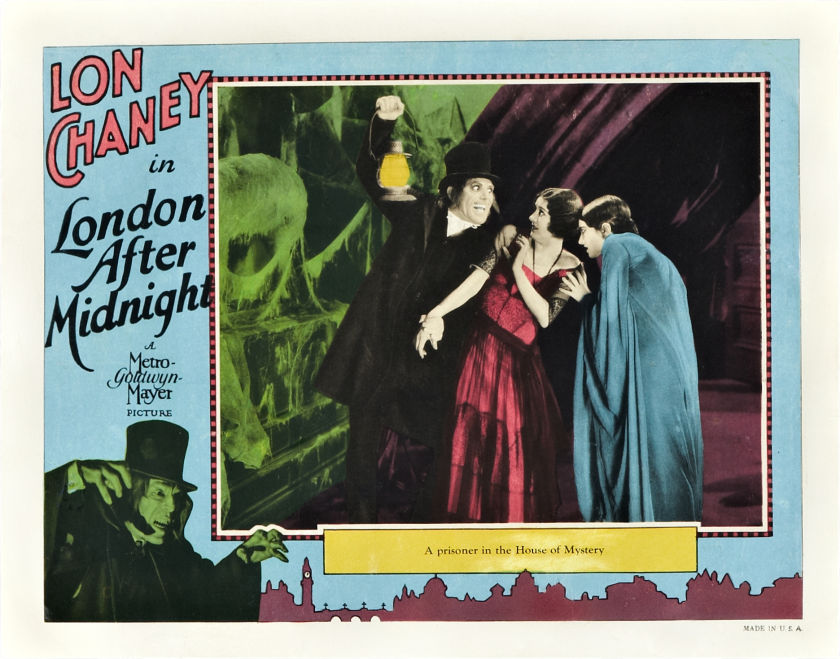
A curious inhabitant seems to have supernatural powers:
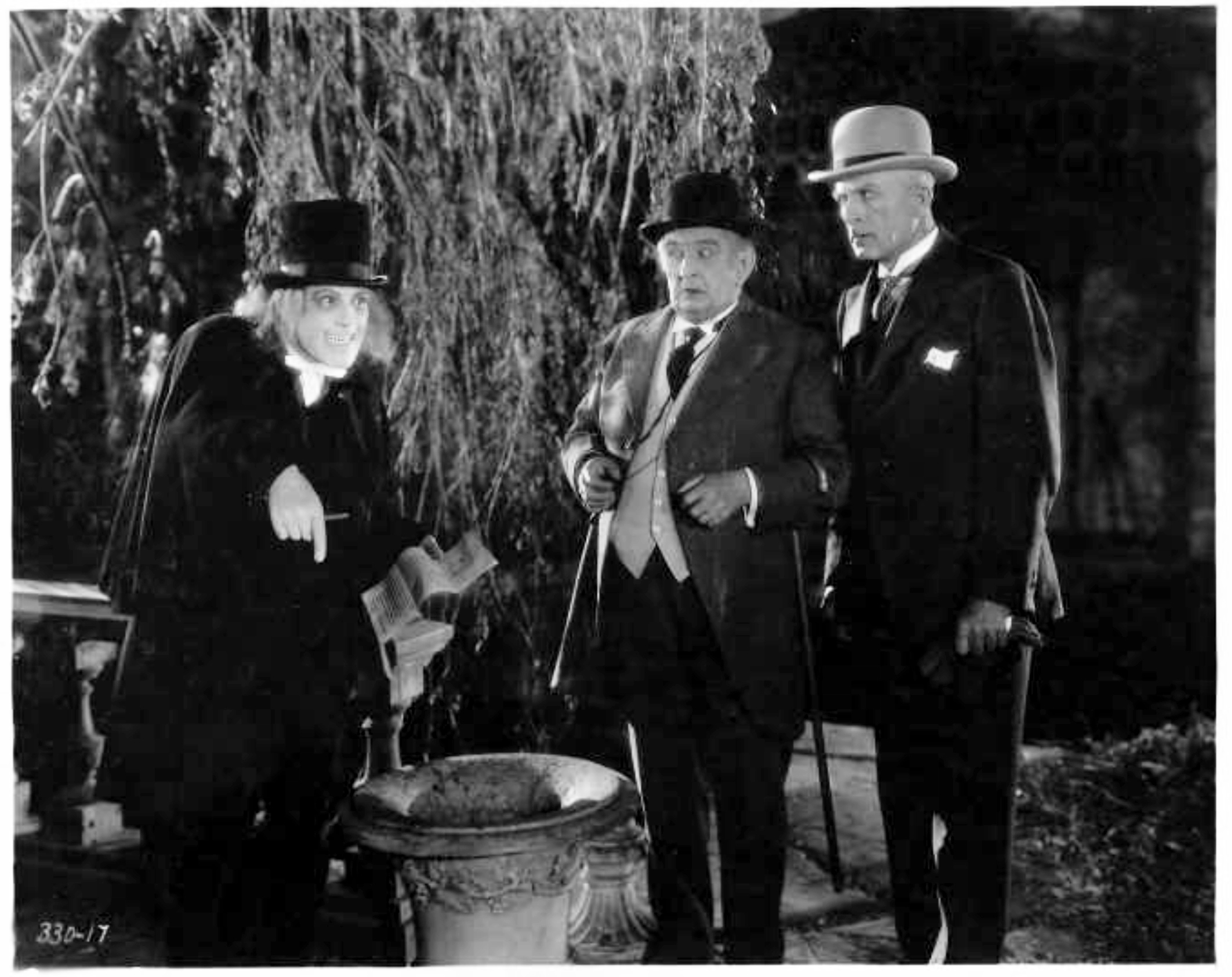
Burke questions the various suspects and uses hypnotism too:

Looks like it’s going to be a long night at the Balfour Mansion:

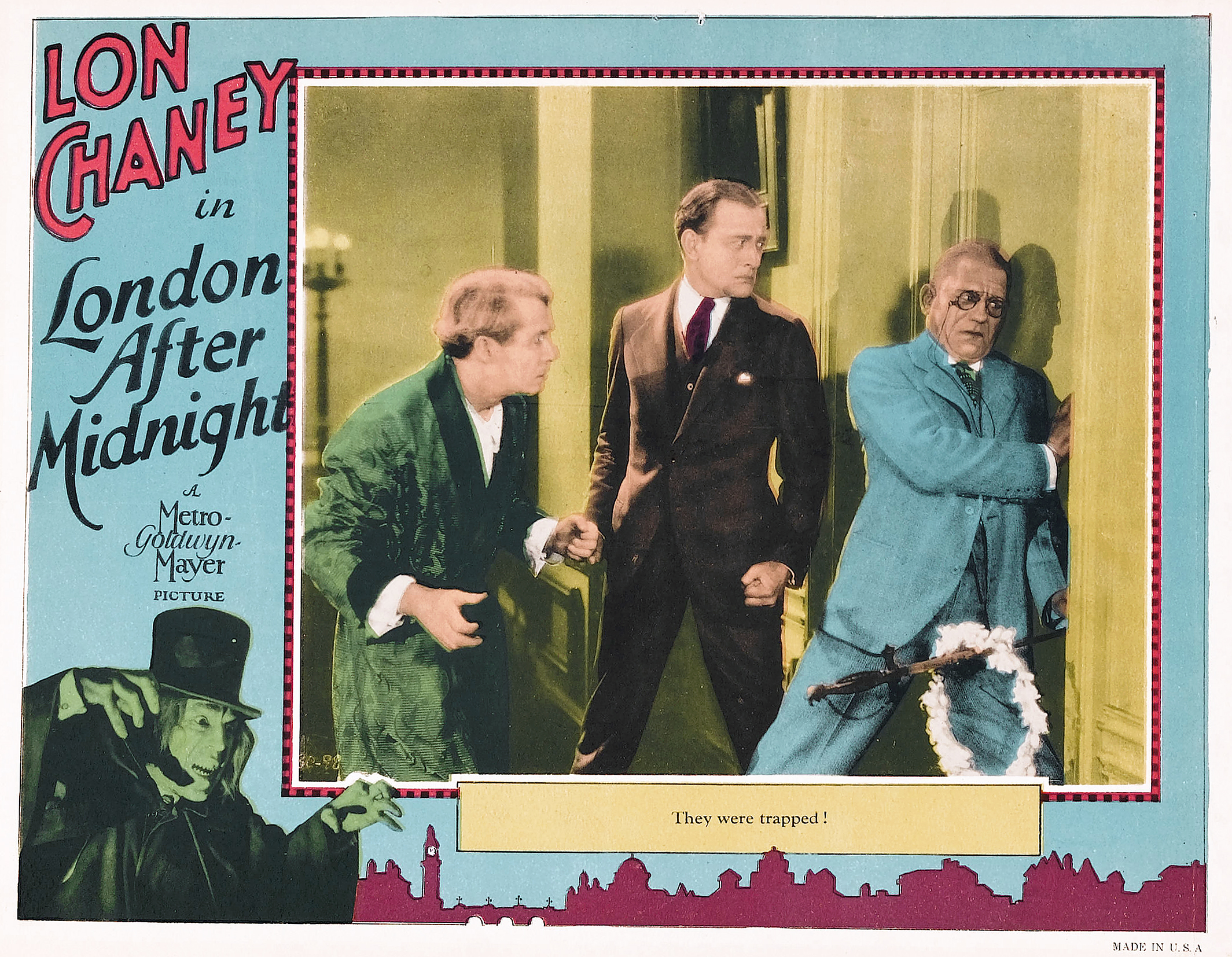
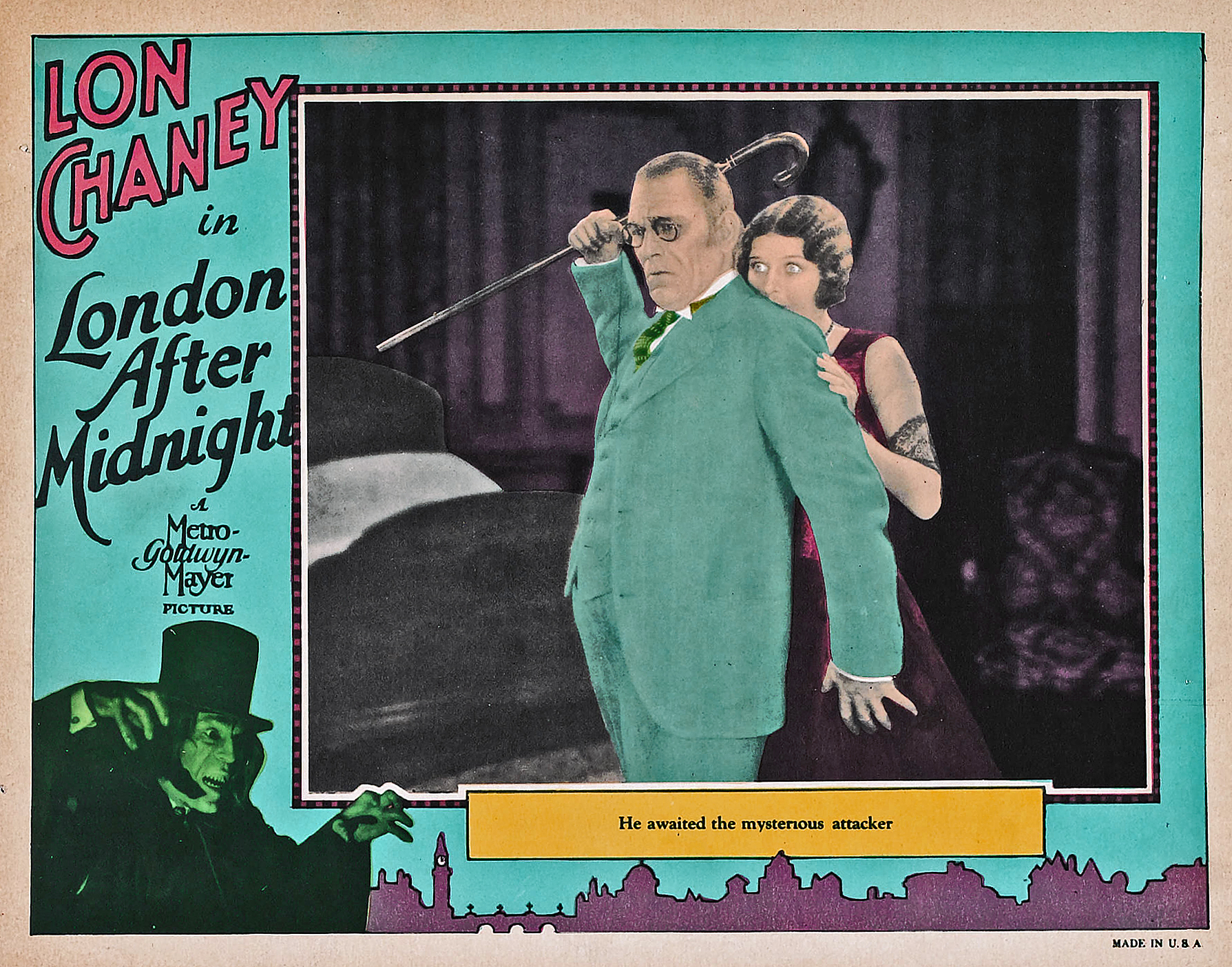
Burke eventually proves that Bafour’s death was murder and collars the killer:
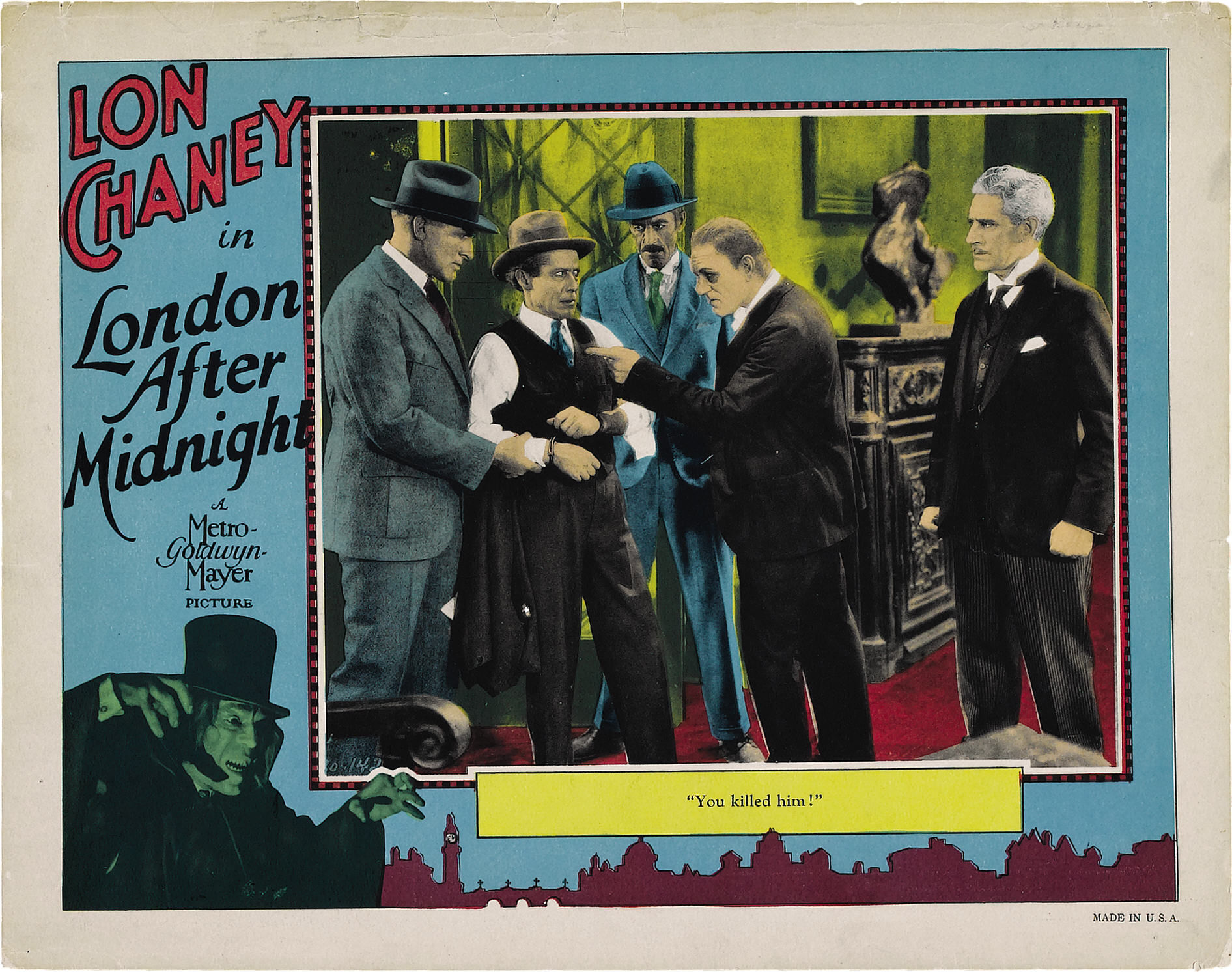
But what about those strange creatures? We suggest you read the script if you’re not able to see the movie!

Conrad Veidt (1893-1943) was a legendary German film star who first gained attention as Cesare, the somnambulist killer in THE CABINET OF DR. CALIGARI (1919):

Today Conny seems best remembered for one of his last films, CASABLANCA (1942). As the Nazi villain Major Strasser, Conny was fourth billed behind Humphrey Bogart, Ingrid Bergman, Paul Henried, and Claude Rains, but he was the highest paid actor on the film:

Visiting film star Constance Talmadge seems to strike the same pose as Conny on the set of THE BELOVED ROGUE (1927), Veidt’s first American film. He played France’s King Louis XI to John Barrymore’s Francois Villon:
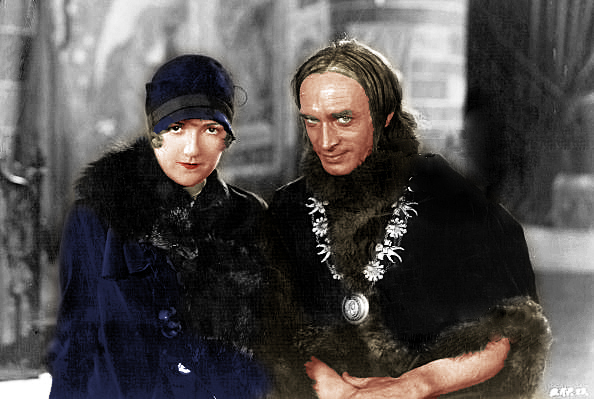
Conny starred in several films for Universal in the closing days of the silent film era. Here makeup artist extraordinaire Jack Pierce, who later made up Boris Karloff as the Frankenstein Monster and Lon Chaney, Jr., as the Wolfman, applies finishing touches to Veidt for THE MAN WHO LAUGHS (1928):

Back in Germany by 1930, Conny effortlessly transitioned to sound films speaking in his native language:

By 1933, Conny was making films in Britain as well as Germany and worked hard to master English. Here Veidt sits with pal Peter Lorre as they work on F.P.1 (Floating Platform 1), a science-fiction tale that anticipated aircraft carriers. Filmed in three languages, Conny played the hero in the English-language version, but not in the German or French versions. Lorre appeared only in the German version:

Conny poses for his bust by sculptor Felix Weiss in Germany, circa 1935. With the rise of Hitler and the Nazi Party, Germany became an “unhealthy” place for Veidt to live. He listed himself as a Jew although he wasn’t. However, his wife Lily was Jewish so they decided to relocate to Britain in the mid 1930s:

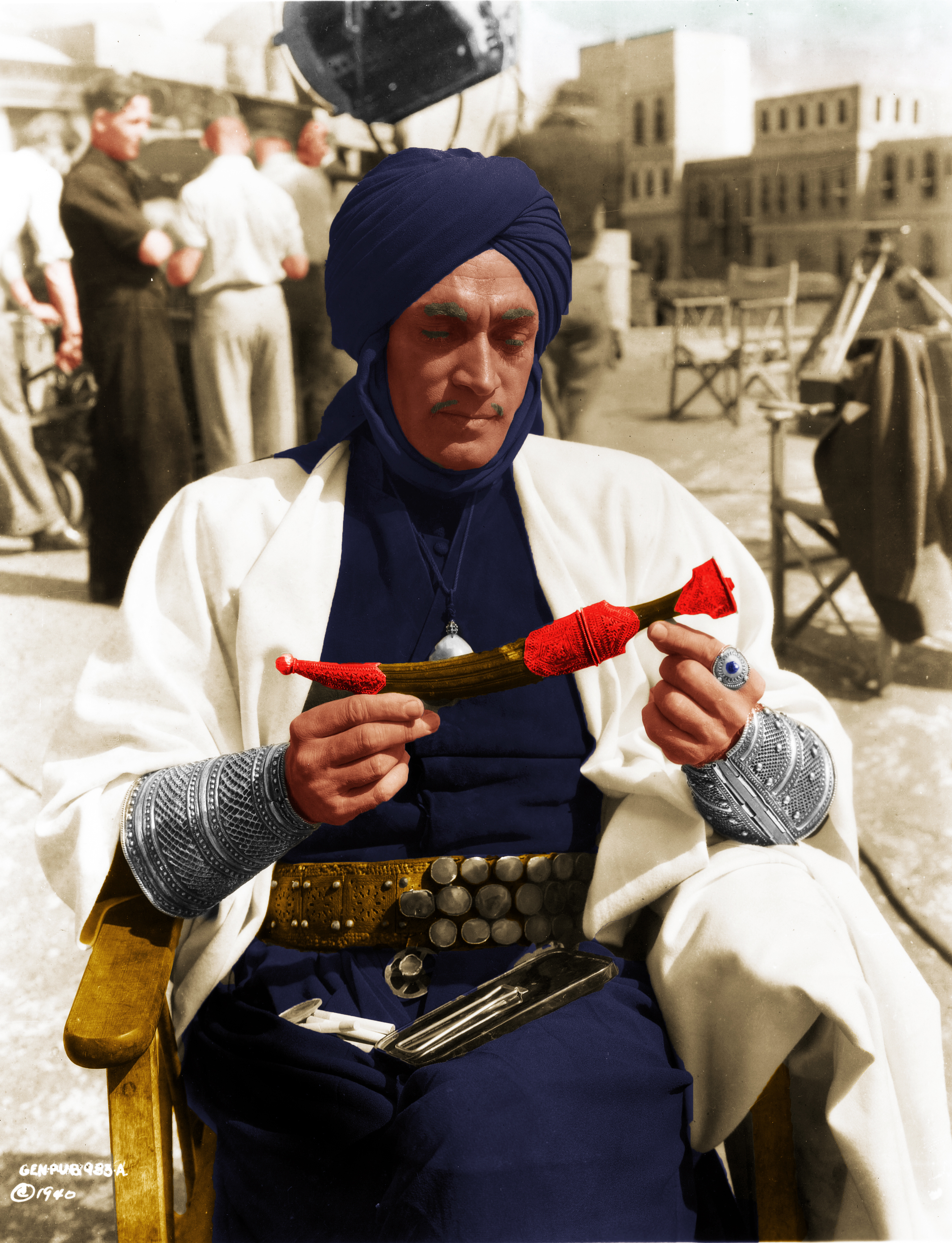
THE THIEF OF BAGDAD (1940) would be Conny’s only Technicolor film but he looks terrific in it. Here he examines an ornate dagger and its scabbard:
Conny as the villainous vizir Jaffar, commands the sky and wind in THE THIEF OF BAGDAD:

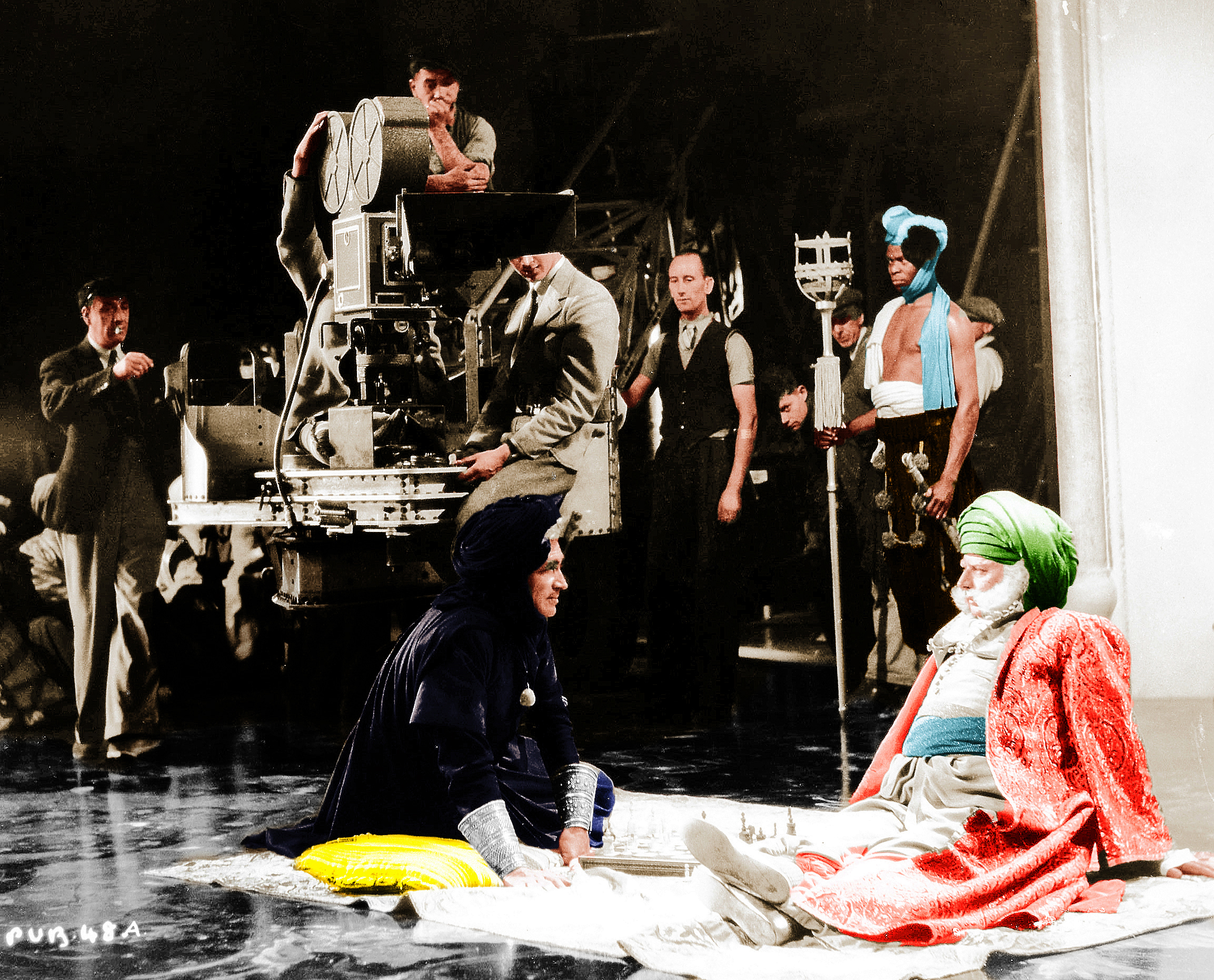
This production photo from THE THIEF OF BAGDAD shows Conny on the left on the floor. The massive Technicolor camera holds three rolls of film that were photographed simultaneously through one lens. A prism split the image into three that was photographed on each of the three rolls sensitive to red, blue and yellow respectively:
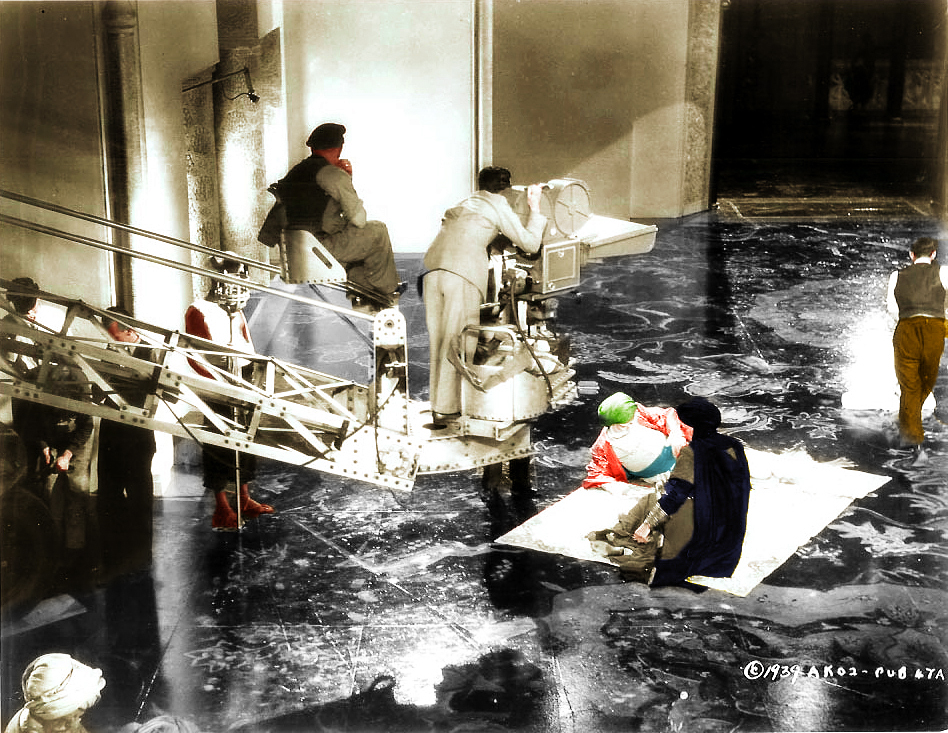
Filming the same scene from a back angle view. The camera is mounted on a crane to create a moving dolly shot:
A stunning portrait of the evil Jaffar:

Back in America by 1940, Conny donates much of his salary to the British and U.S. war effort, and adds radio broadcasting to his activities. Here on April 19, 1942, he reenacts his role in the 1941 MGM film, A WOMAN’S FACE on Screen Guild Theater. The stars who appeared on this show donated their fee to the Motion Picture Relief Fund:
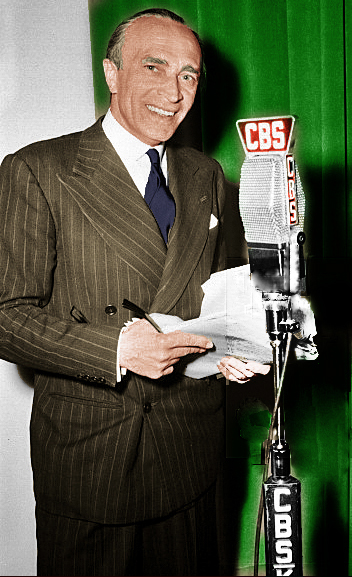
Listen to Conny on the actual live broadcast of April 19, 1942, with co-stars Bette Davis and Warren William:
American audiences weren’t too sure how to pronounce Conny’s last name so someone at one of the studios thought up this helpful rhyme: “Women Fight for Conrad Veidt.”
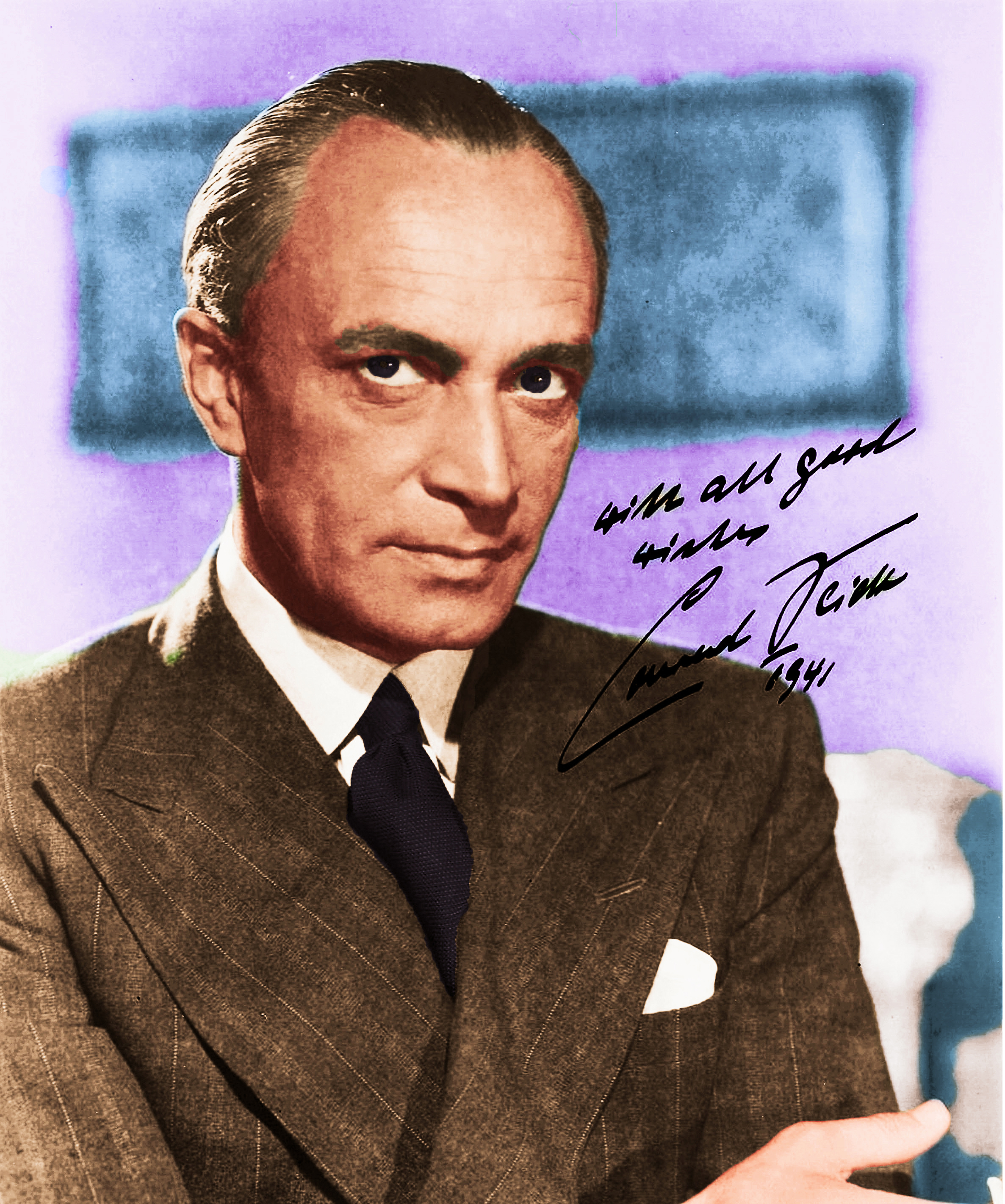
Conrad Veidt would be surprised to know that his films are popular with new generations of the 21st century. Most of his top films are available on DVD, and a growing number on Blu-ray including THE CABINET OF DR. CALIGARI, DIFFERENT FROM THE OTHERS (a pioneering film on homosexuality), WAXWORKS, THE BELOVED ROGUE, THE MAN WHO LAUGHS, THE THIEF OF BAGDAD, ESCAPE, A WOMAN’S FACEand CASABLANCA. But Conny held no exalted view of himself: when invited to write his autobiography, he dismissed the suggestion by stating, “Who would be interested in my life? I’m just an actor.”
Rin Tin Tin and Betty Compson as the Spirit of Liberty circa 1925:

Pastiche compliments of Yours Truly.
Film stars with their pets have always attracted attention and it’s rare that a major celebrity of the screen would decline an opportunity to pose with a four-legged friend. Sometimes the pet was as famous as the pet parent. Here are a galaxy of vintage stars from the Golden Age of Hollywood who seem only too happy to be upstaged.
First, Anna May Wong shows off her dachshund circa 1938:

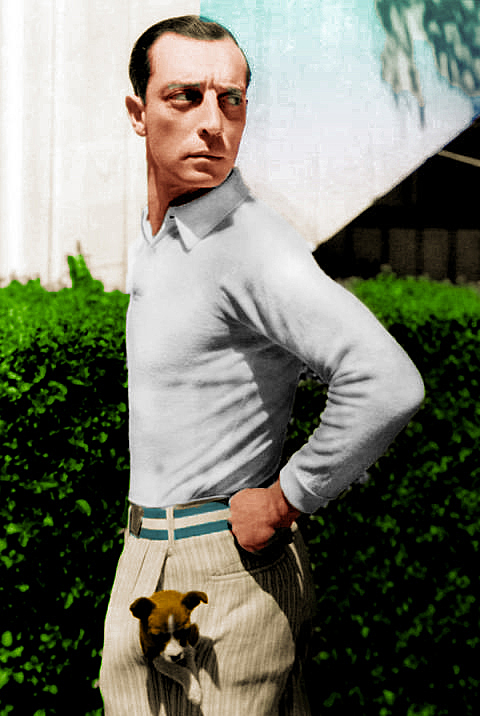
Buster Keaton wants to be sure he can always find his canine pal circa 1930:
John Barrymore shared some inspired comic moments with this St. Bernard at the beginning of MOBY DICK (1930):

Bette Davis seems entranced by this dog as she waits between filming scenes circa 1937:

Douglas Fairbanks Sr.evidently considers this German Shepherd his equal, circa 1920:

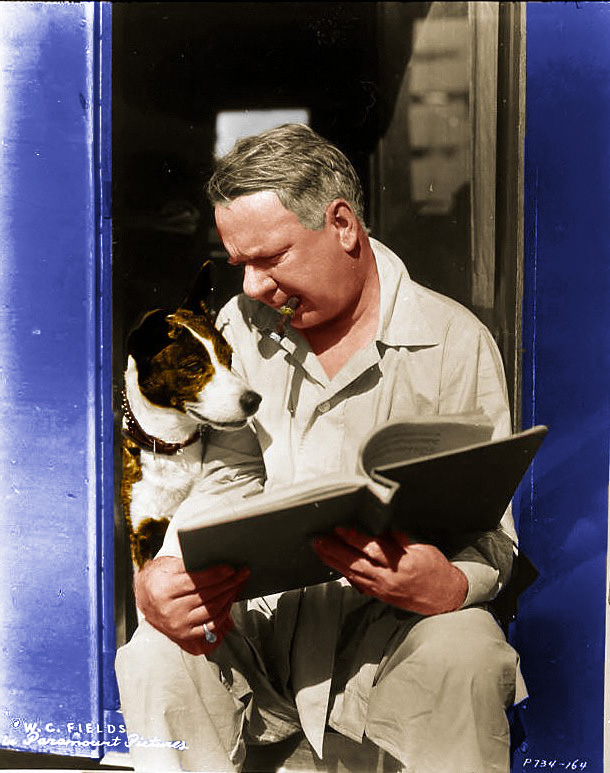
W.C. Fields famously observed that “any man who hates kids and dogs can’t be all bad” but he got along nicely with his co-star in IT’S A GIFT (1934):
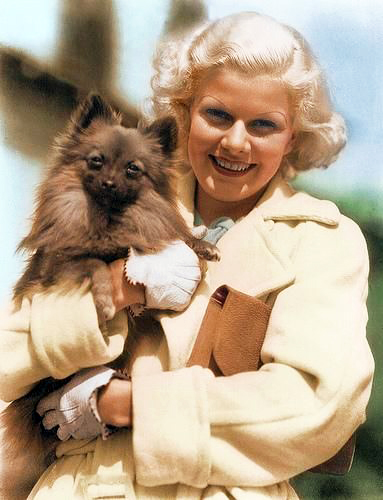
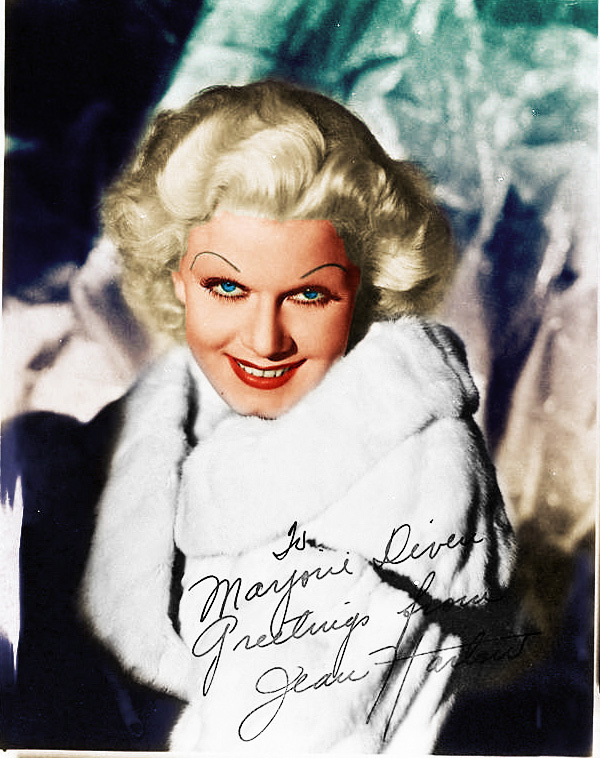
Jean Harlow with one of her many dogs, circa 1935:
Rudolph Valentino inspired much grieving with his untimely death in August 1926. But none grieved more than his dog who was adopted by Rudy’s brother, Alberto. Regardless, the dog pined away for his master until his own passing some years later:

Warner Oland, famous as Charlie Chan, doted on his schnauzer Raggedy Ann and was a proud papa when she had this litter:

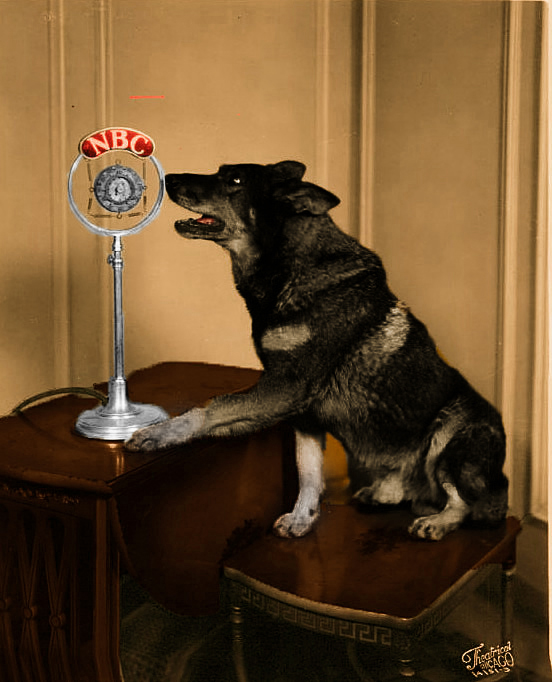
Star meets Star: Al Jolson meets Rin Tin Tin on the Warner Bros. lot in 1928:

Carole Lombard and friend in 1932:

Soviet director Sergei Eisenstein wants to chat with Rin Tin Tin during his 1929 visit to the United States:

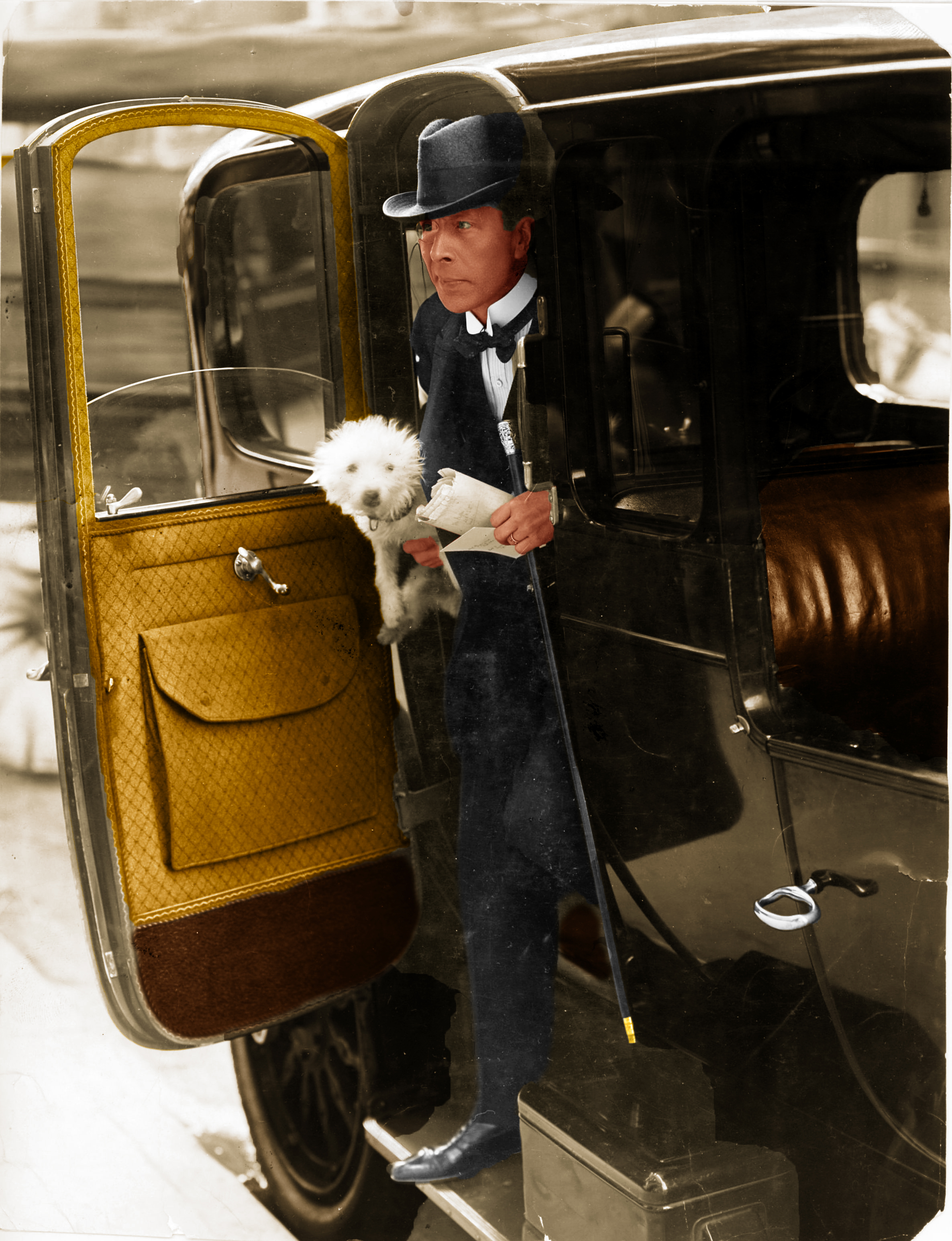
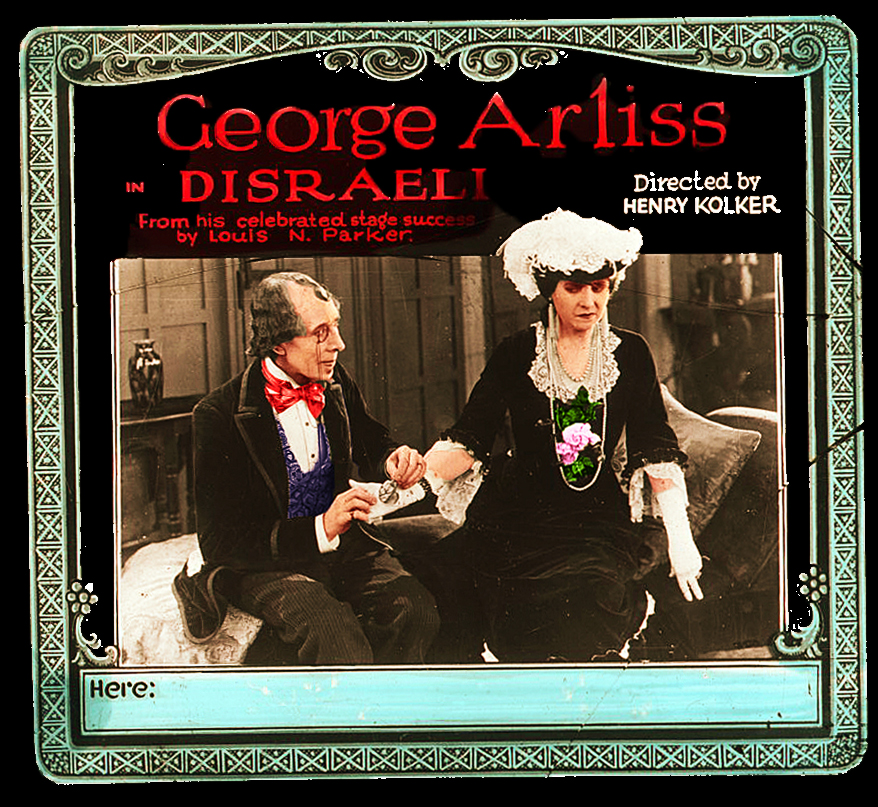
George Arliss seems perplexed as he juggles his wife’s dog and business papers, circa 1925:
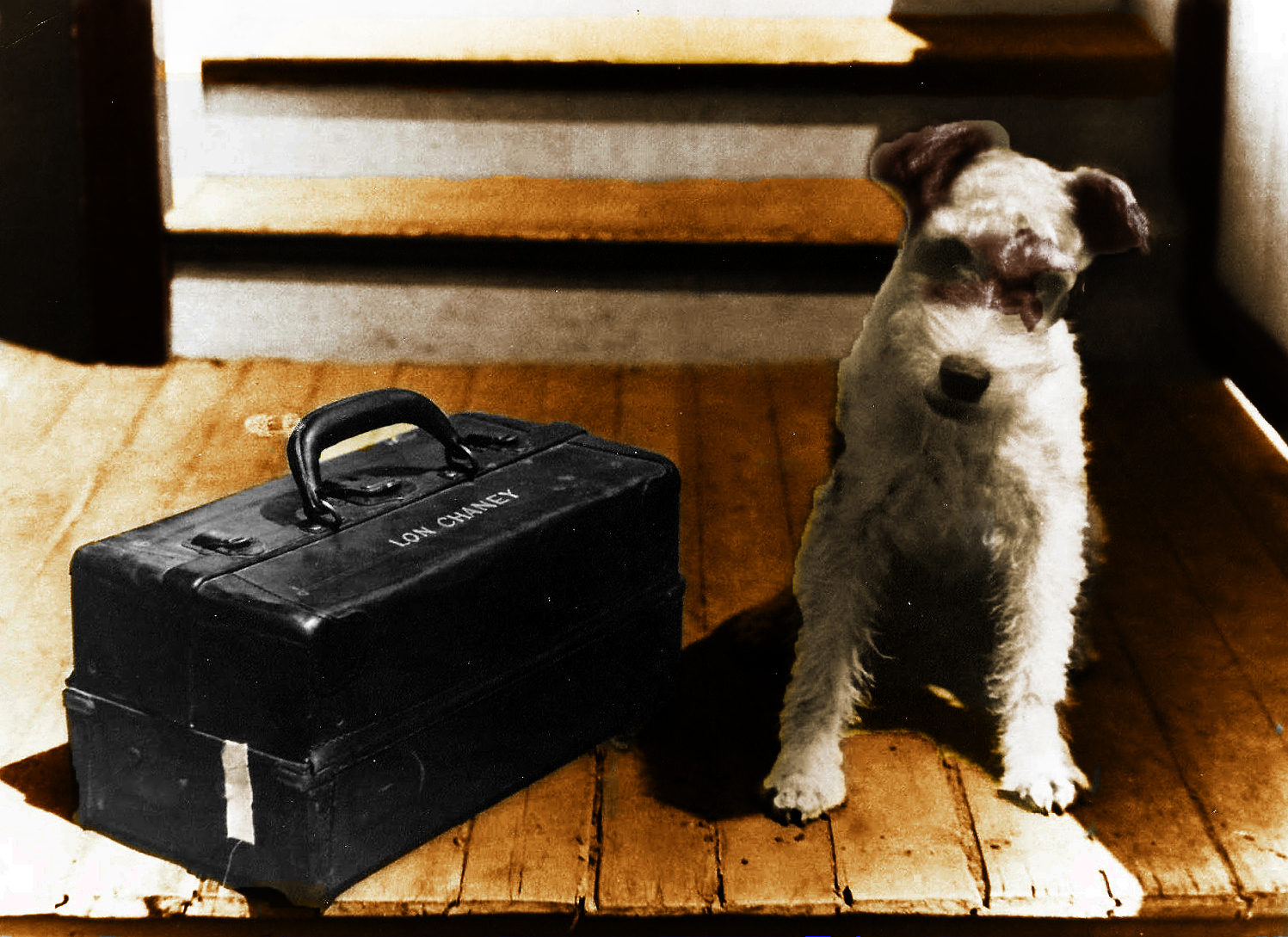
Finally, a poignant photo commemorating the passing of Lon Chaney, the Man of 1,000 Faces, who left us much too soon in 1930 at the age of 47. The photo shows two of Lon’s most precious possessions – his makeup case and his dog:
As the Great Depression took its toll in the early 1930s, film studios on both sides of the Atlantic came up with new marketing ideas to stem the tide of declining box office revenues. An idea that found favor with millions of cigarette smokers of that era were little premiums, about half the size of a typical baseball trading card, of prominent movie stars of the day. Each card was included in a pack of cigarettes and displayed a small but elegant drawing in color and a surprisingly frank biographical sketch reciting the star’s real name, humble origins and previous marriages.

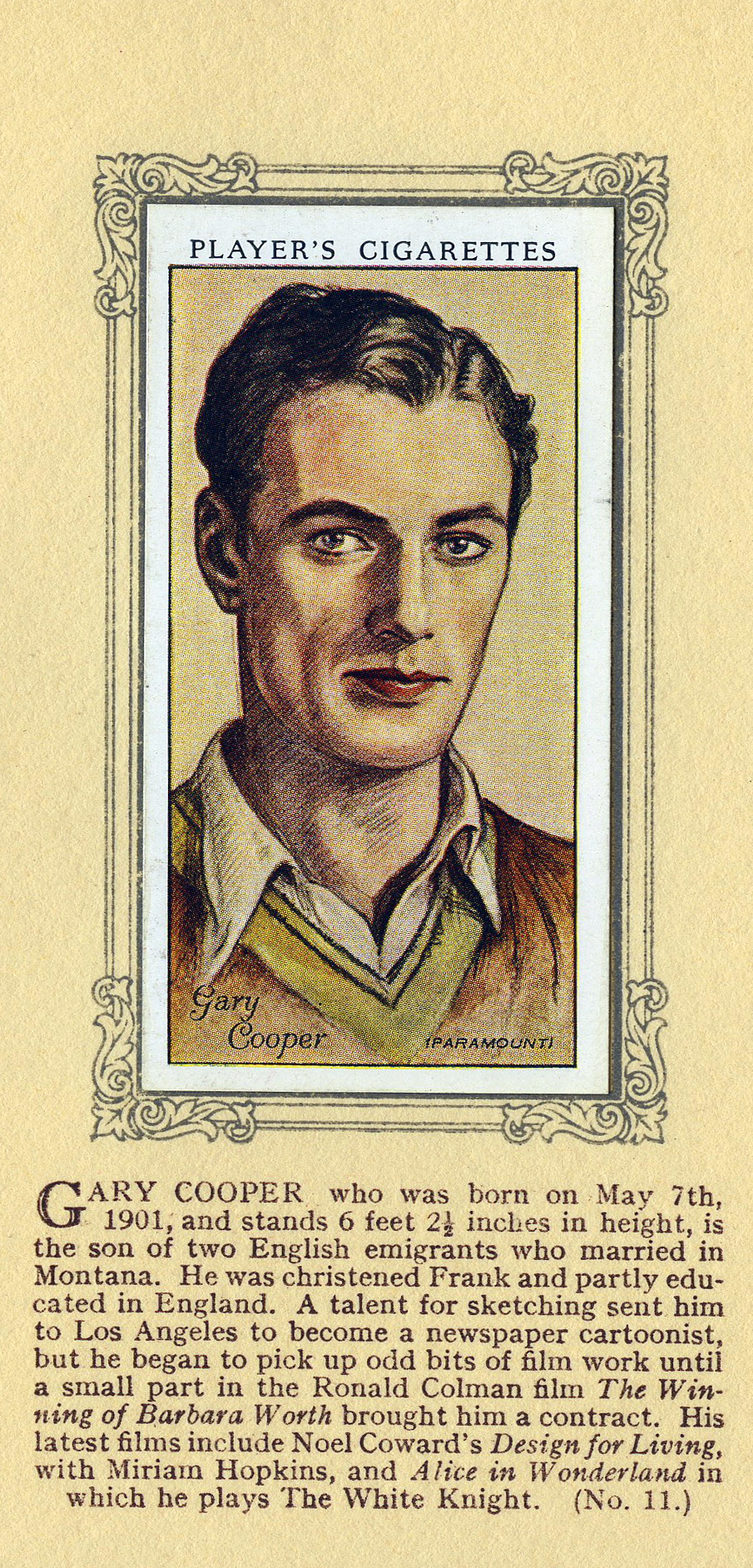
The cards were meant to be collectors’ items and indeed many people did just that. The cards displayed here were printed by the British tobacconist John Player as part of its 1933 series. A special book was available by which fans could mount these cards as they would with a typical photo album.
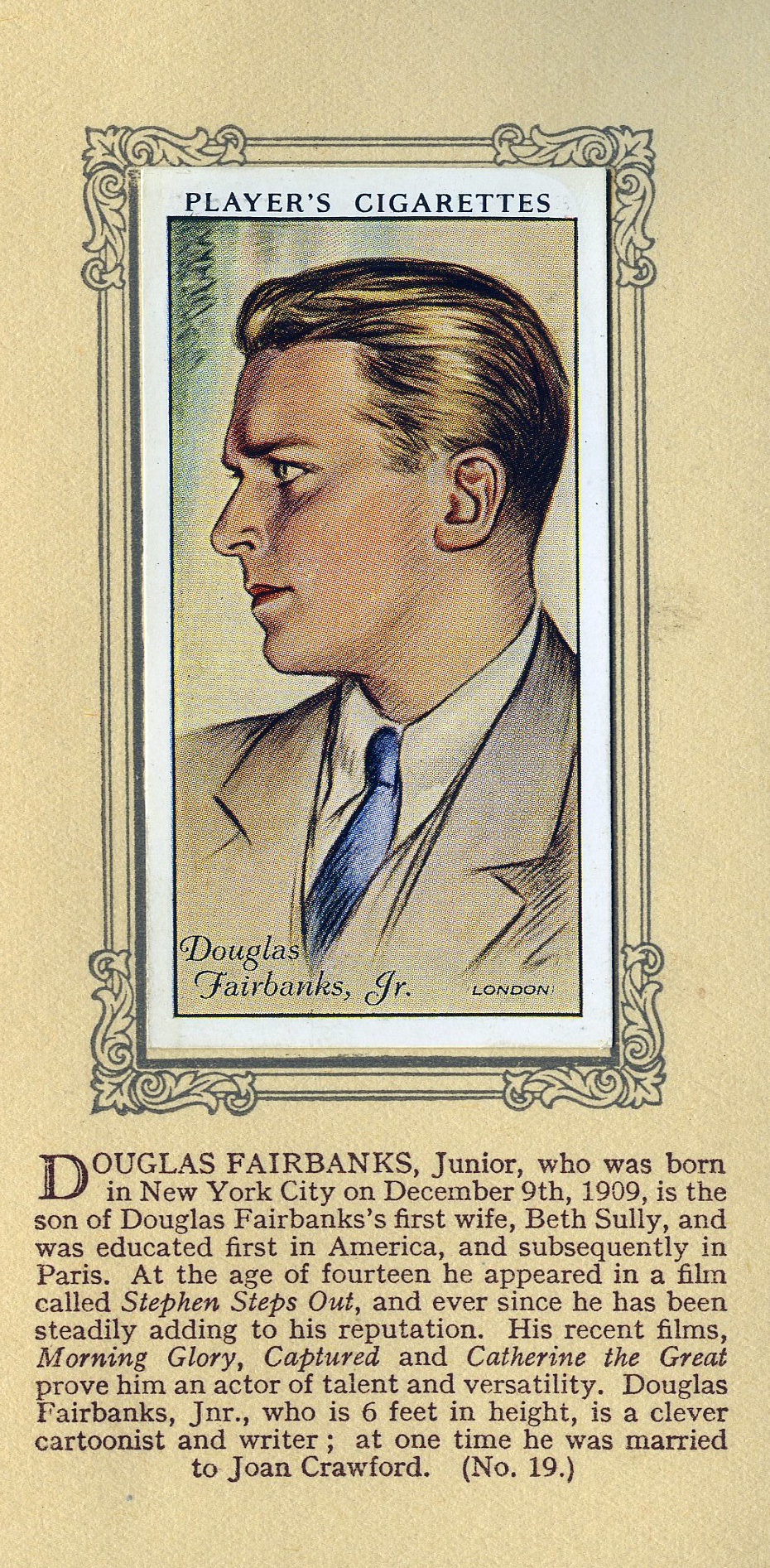
Although talking pictures had brought many new personalities to the public’s attention, the stars included in this post had been well-established silent film stars and extended their popularity for many years and even decades thereafter.

Gary Cooper so successfully straddled the generations from the 1920s through the end of the 1950s that many of his younger fans were unaware that he was once a silent film heartthrob.
As the bio notes, Jean Harlow first attracted attention in silent films and appeared in several films with Laurel and Hardy.

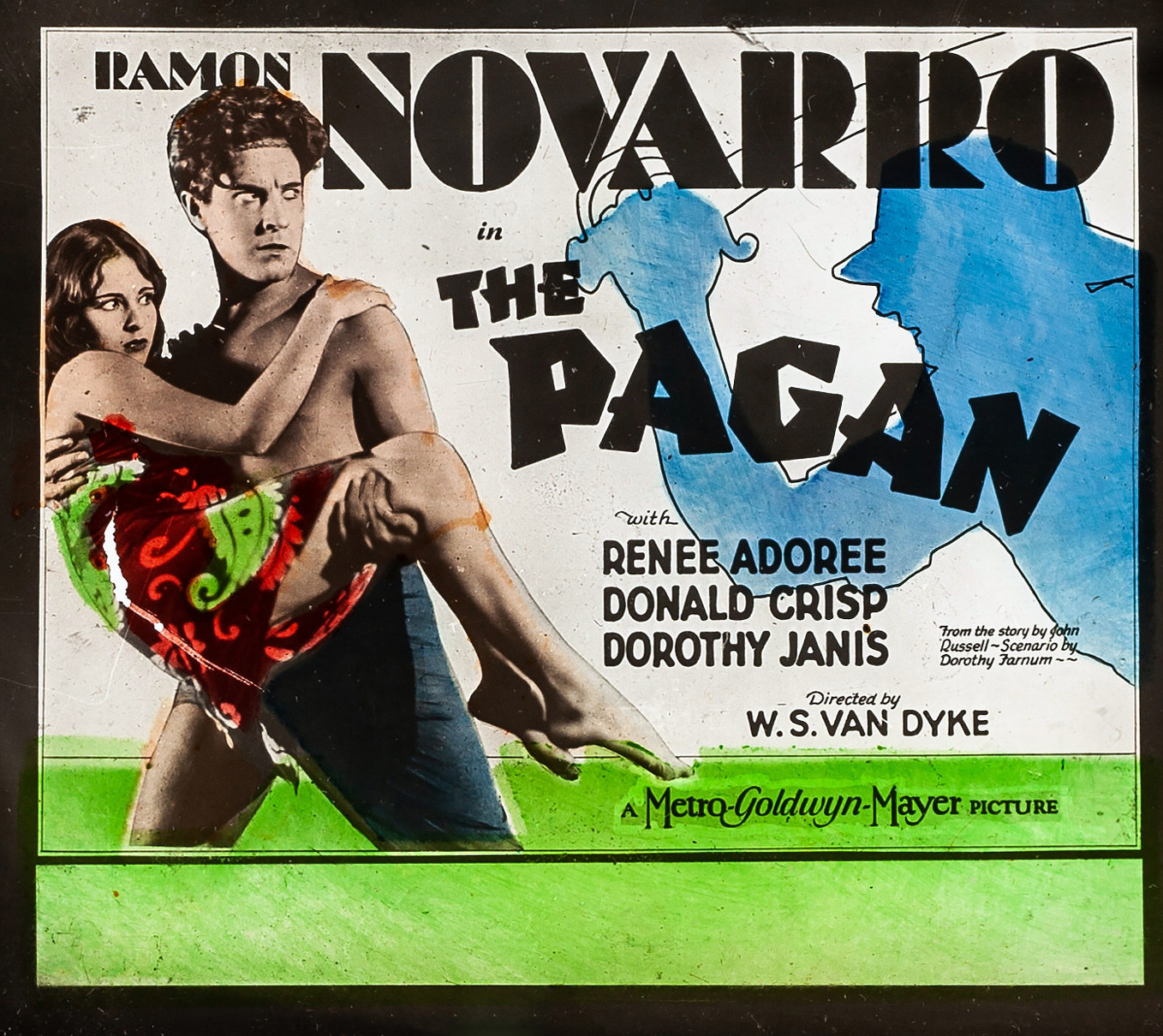
Ramon Novarro was Ben-Hur to movie fans from 1925 until Charlton Heston took over the role in the 1959 remake.

Norma Shearer had quite a following by the late 1920s but her screen personality adopted to talkies effortlessly and she continued as a top star until she chose to retire in 1942.

William Haines gained popularity as a wisecracking boy-next-door type of character. In time he became more interested in a career as an interior decorator. Indeed, many of his former co-stars hired him to remodel their homes. His career as a leading man must have seem like it was in another lifetime because for decades he was known as “Billy Haines, Decorator to the Stars.”

Carole Lombard first attracted attention in the silent film comedies of Mack Sennett in the late 1920s. With sound she proved herself as both a dramatic actress and as a comedienne. Her tragic death in a 1942 plane crash while selling War Bonds has tended to obscure her fine films.
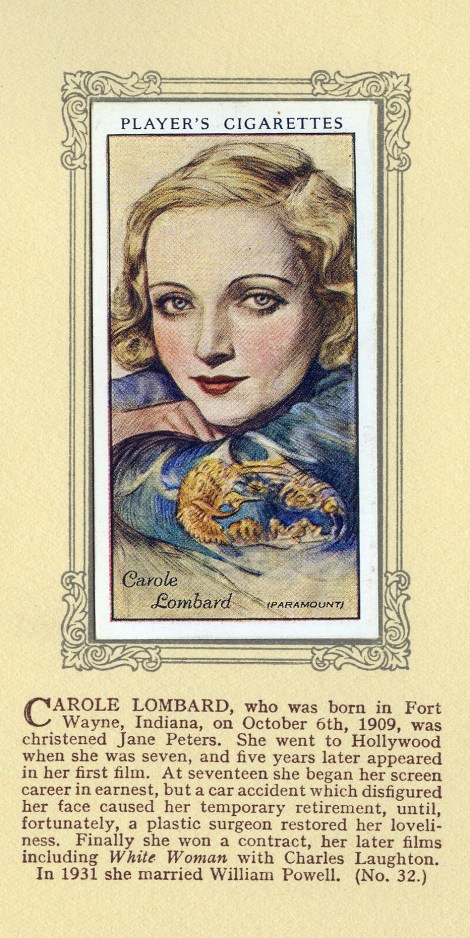
Jack Holt was a rugged type who seemed convincing simply because he actually lived the life of many characters he played. He was always an audience favorite from the silent era up through the early 1950s.

June 11, 1939: the British colony in Hollywood prepare to broadcast their welcome to the King and Queen of Great Britain on their first visit to the United States. From left to right are Greer Garson, Leslie Howard, George Sanders in the rear having a smoke, Vivien Leigh hiding her smoke under her script, Brian Aherne, Ronald Colman, and Basil Rathbone:
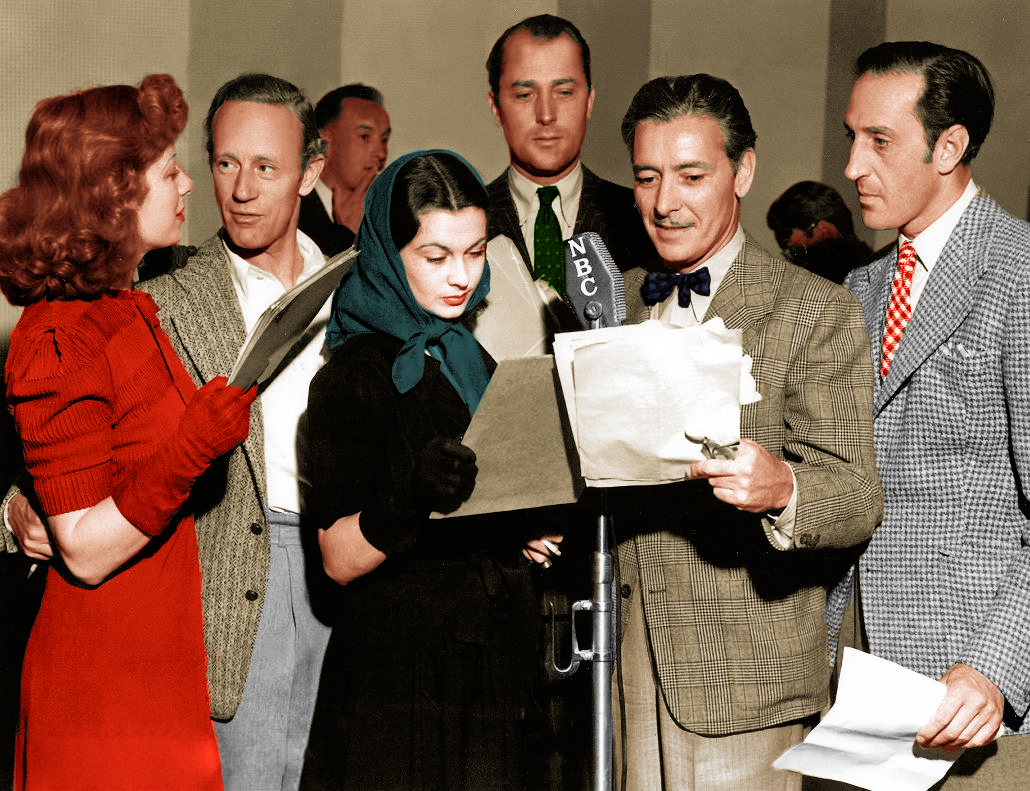
It is was said that Ronald Colman’s voice was so beautiful that he could attract a crowd just by reading the phone book. Experience the “velvet voice” in this stunning radio performance from 1945:
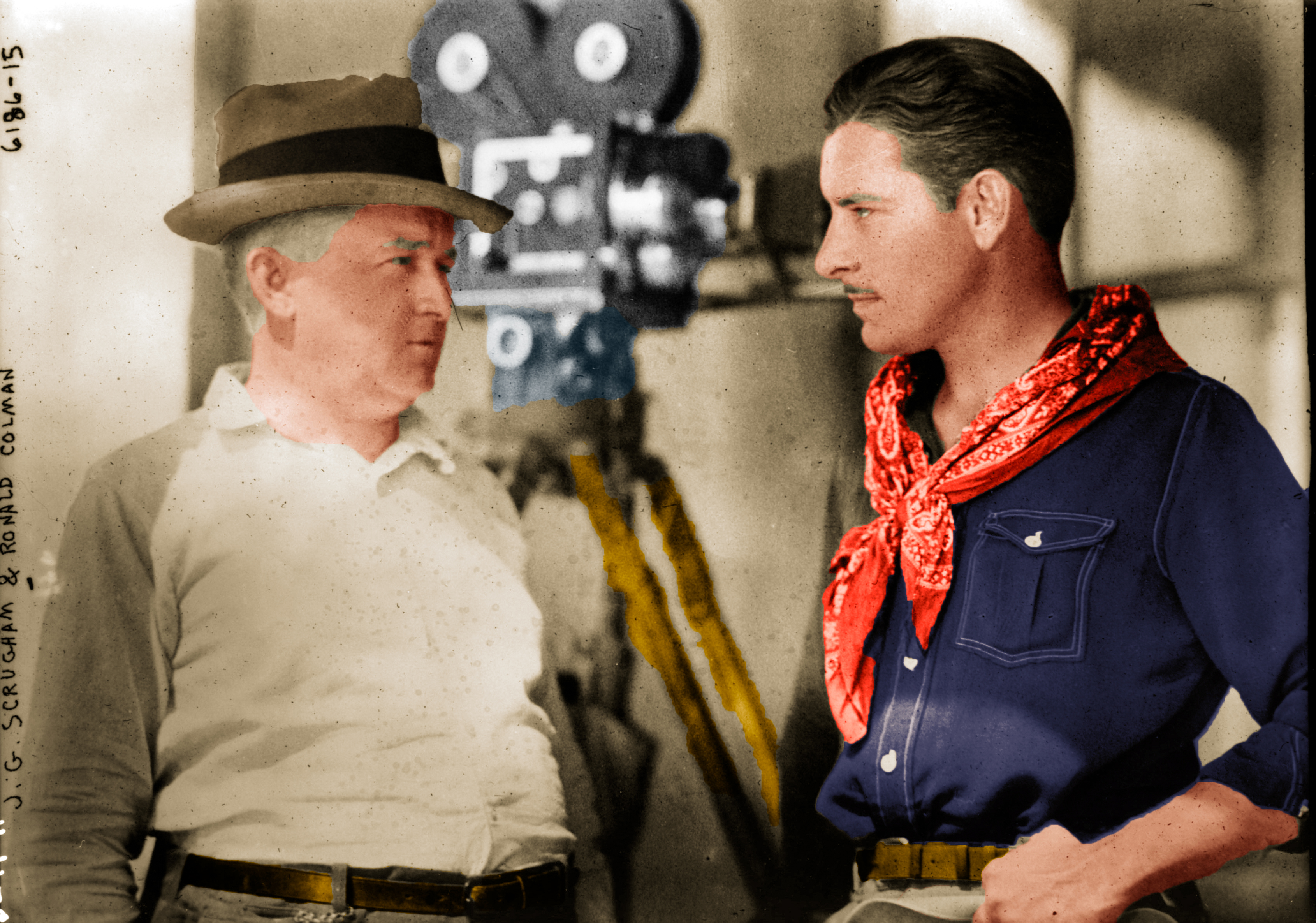
Before sound films became popular, Ronnie was a top star of the silent screen. Here he chats with cinematographer J.C. Scrugram on the set of THE WINNING OF BARBARA WORTH (1925):
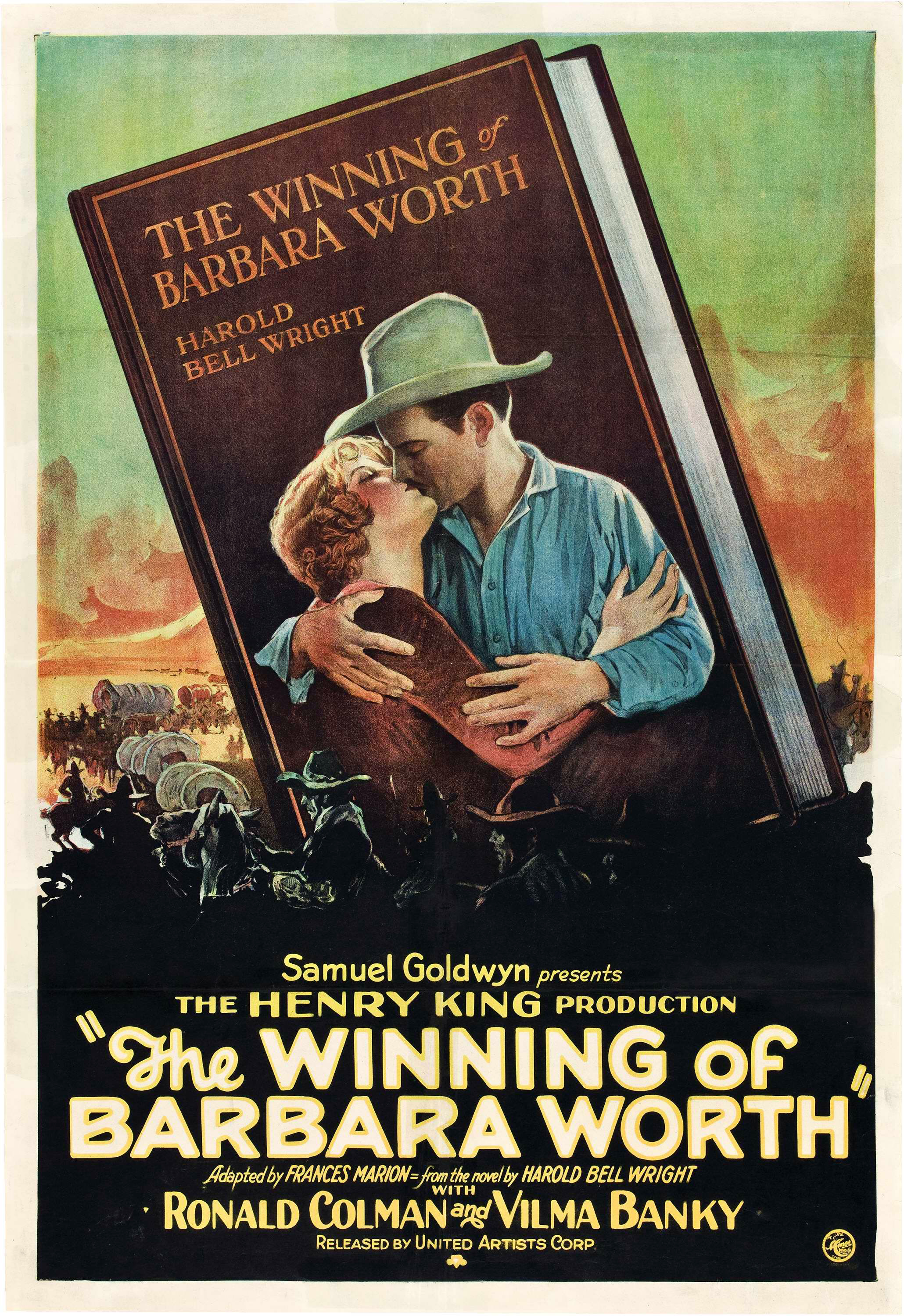
BARBARA WORTH was not only a big hit for Ronnie, but made a star of Hungarian actress Vilma Banky in her American film debut. Not billed on this poster, the film was also a breakthrough for a lanky young actor named Gary Cooper:
This is a restored image from a newspaper supplement advertising BEAU GESTE (1926), a film that took Ronald Colman from star to superstar:
 />
/>
Producer Sam Goldwyn starred Ronnie and Vilma Banky in a series of romantic swashbucklers during the mid-1920s just prior to the arrival of talkies. One of their best is THE NIGHT OF LOVE (1927), here they pose for the ever-present photographer (color transfer by Jeffrey Allan):

A scene from THE TWO LOVERS (1928), the fifth and final Colman-Banky teaming:

A top silent film had its own theme song available on records and on sheet music. Here is the striking cover for THE MAGIC FLAME (1927):
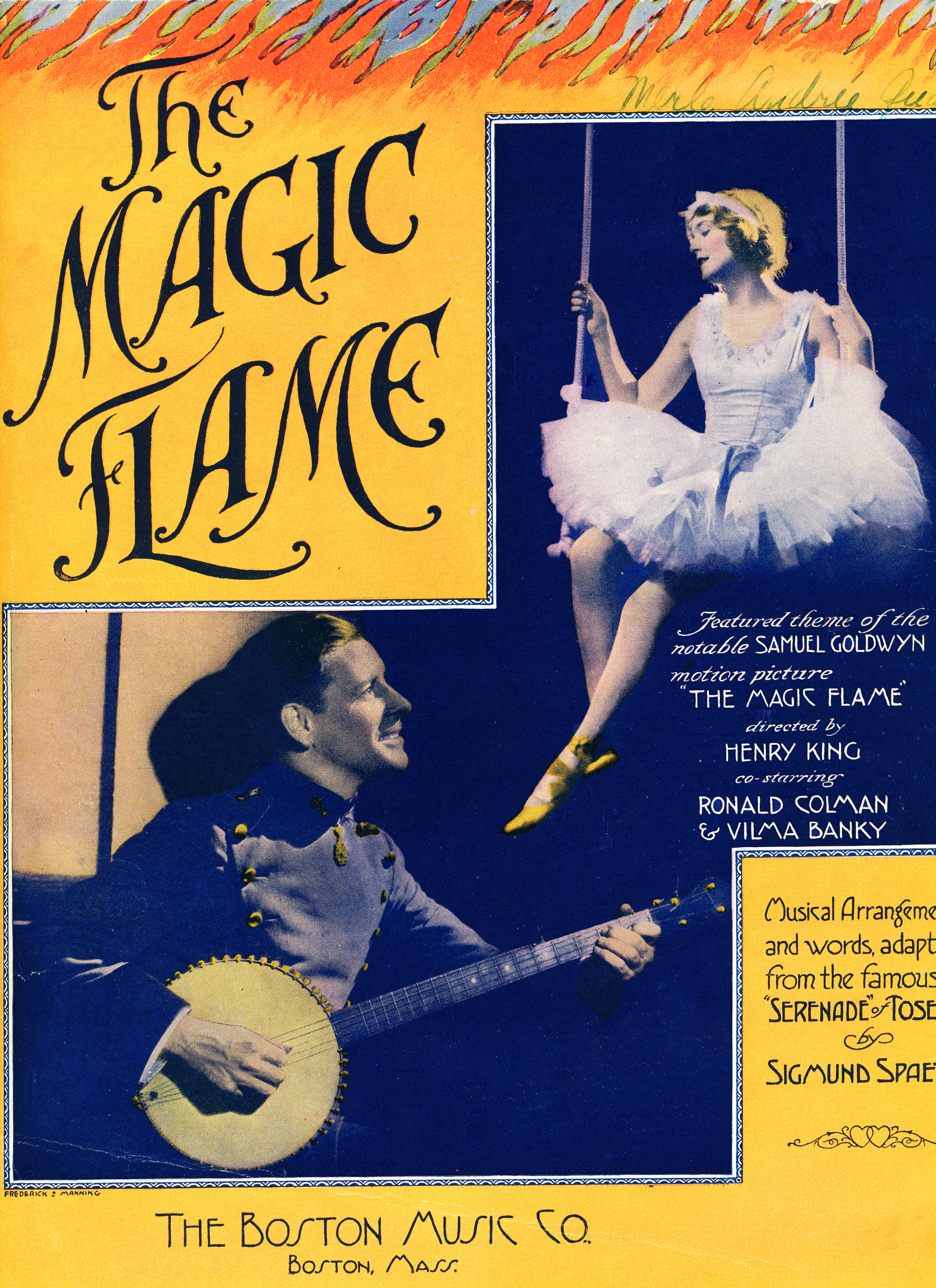
An unusual aspect of THE MAGIC FLAME is seeing Ronnie as a clown. Here he is unrecognizable under his makeup:

A striking image of Ronnie as he prepared to go his own way with the arrival of the talkies in 1929. Nobody could know then that his best films were ahead of him: A TALE OF TWO CITIES (1935). LOST HORIZON and THE PRISONER OF ZENDA (both 1937), RANDOM HARVEST and THE TALK OF THE TOWN (both 1942), and A DOUBLE LIFE (1948), for which Ronnie won the Best Actor Academy Award. Eventually, Ronnie focused more on radio and television where his work was always highly rated.

We chose today for this post because February 9th is Ronald Colman’s birthday (1891). His best films, both silent and sound, are readily available now on official DVD releases and much of his radio work can be heard over the Internet. We suspect that Ronnie would be pleased that he continues to have an audience in the 21st century!

















 OLD HOLLYWOOD IN COLOR