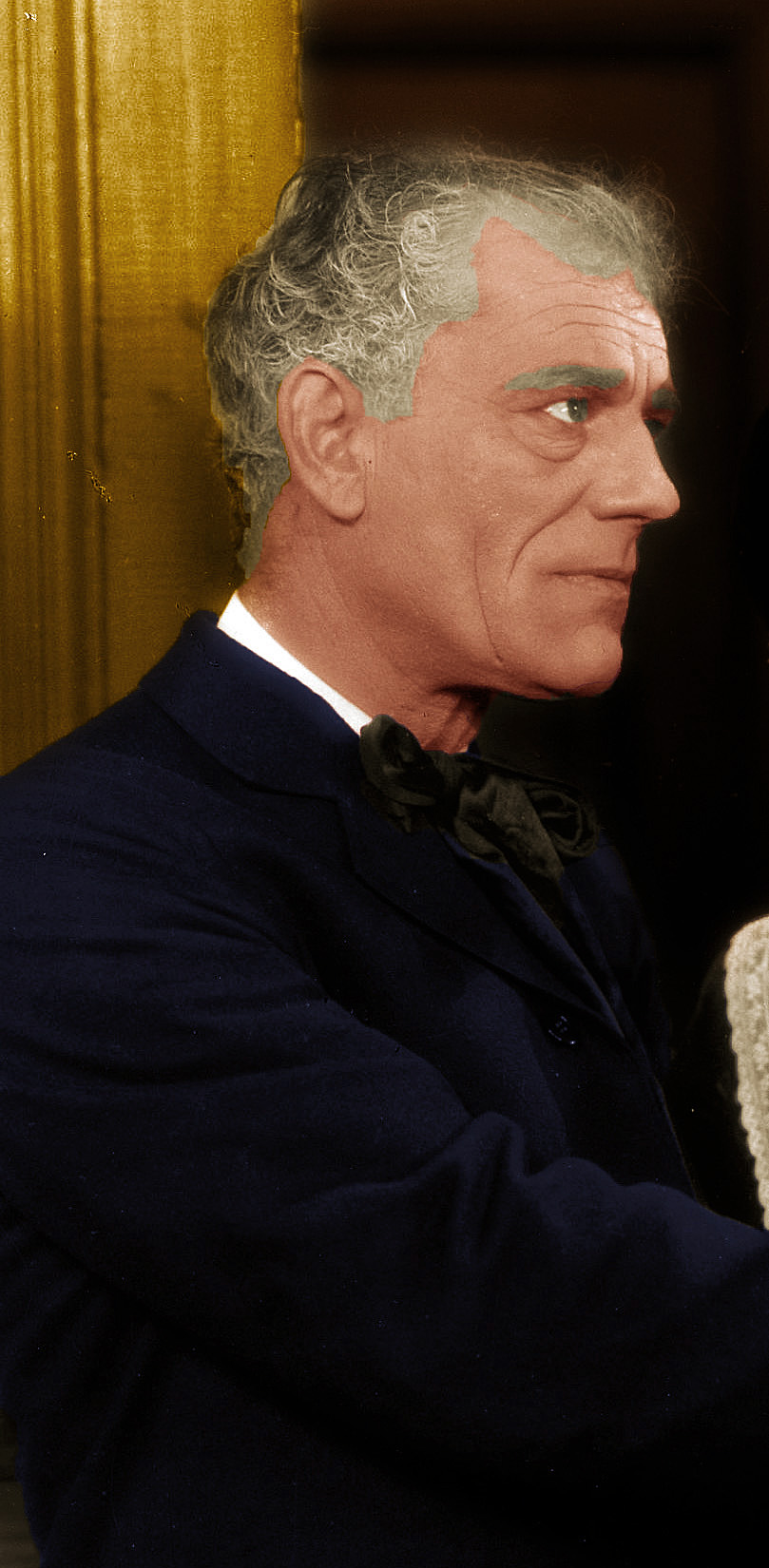
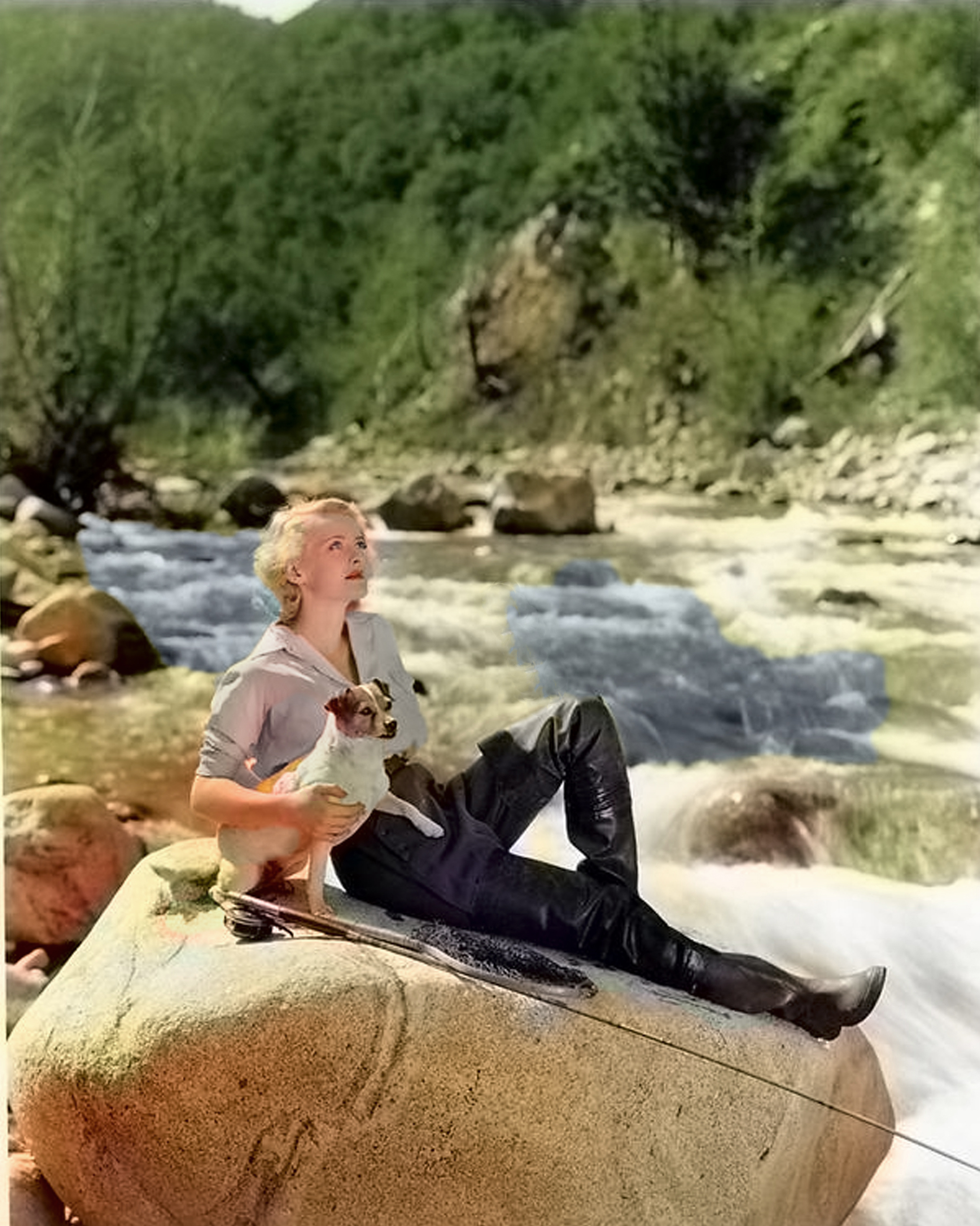
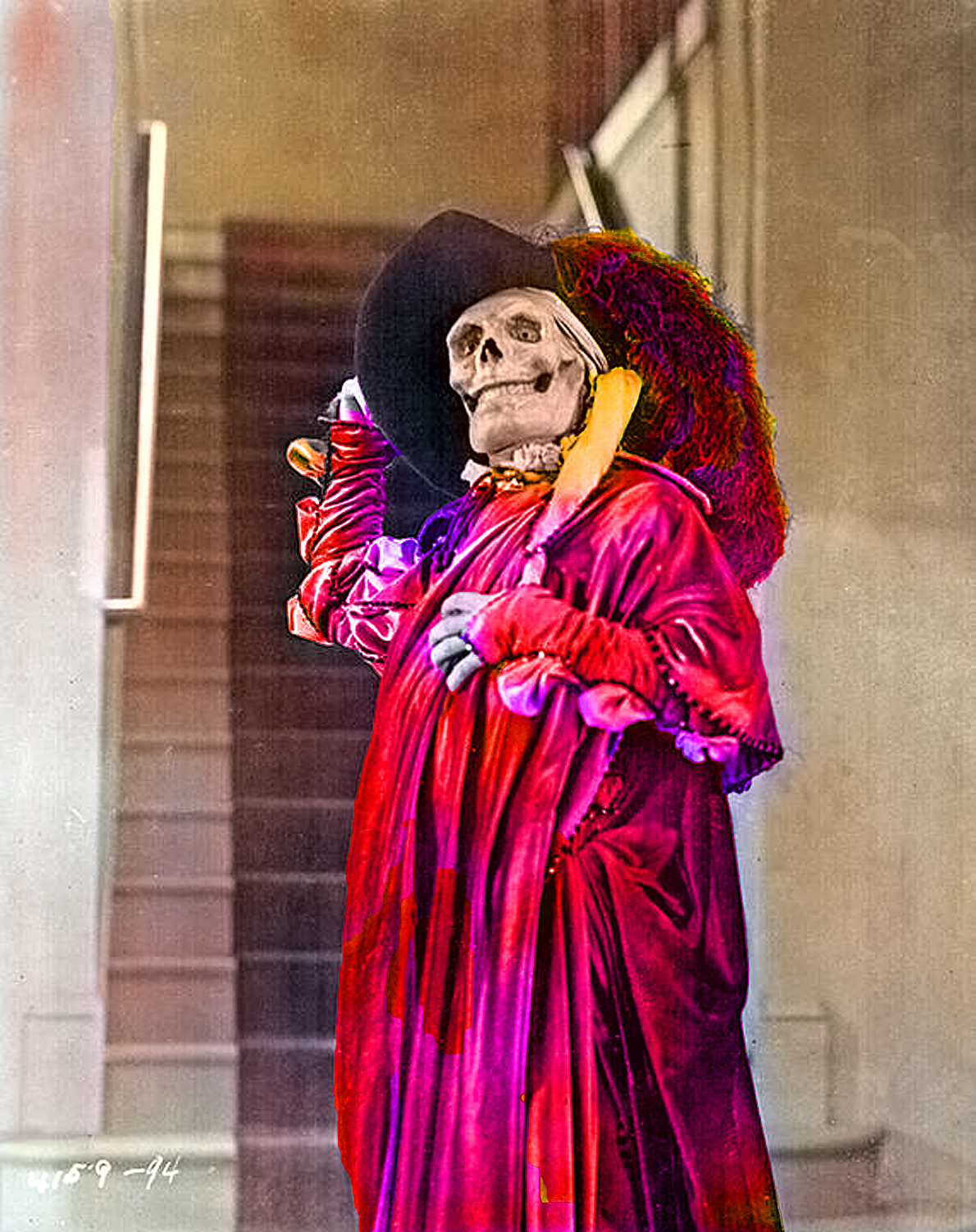
“The color goes kind of crazy.”

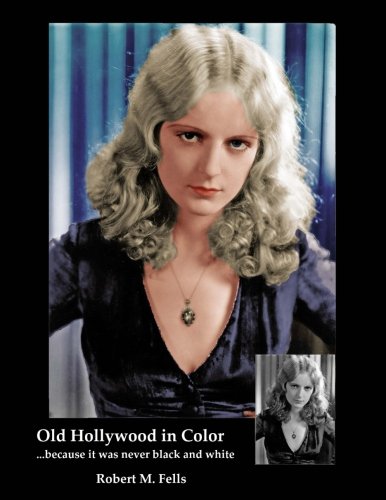
This comment has been attributed to Carole Lombard after seeing herself in a color film. Black and white photography was long considered the coin of the realm and the highest praise was reserved for natural looking skin tones – even though nobody walked round in real life with gray skin. Perhaps we have always been mentally colorizing black and white photos in our imagination without realizing it. Color photography has always had to meet a higher standard because the images are supposed to look “natural” in a way that black and white has never been expected to.

In old Hollywood of the 1920s and 30s, genuine color photographs of celebrities were rare and many stars in fact were never photographed in color. Fortunately, digital software of the 21st century can be used to remedy this situation and the following portraits are examples.

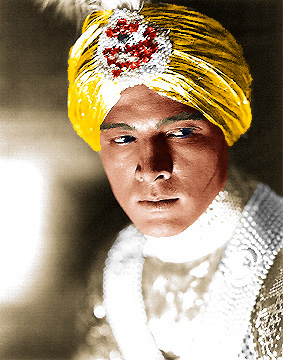
Rudolph Valentino was the first romantic star to combine love and death, not that this was his intention. We devote a chapter to Rudy so for the moment let’s just say that Valentino became an iconic figure beyond his brief lifespan by appealing to the two most powerful forces in life. This photo was taken with a deliberate soft focus, which was quite popular in the 20s:

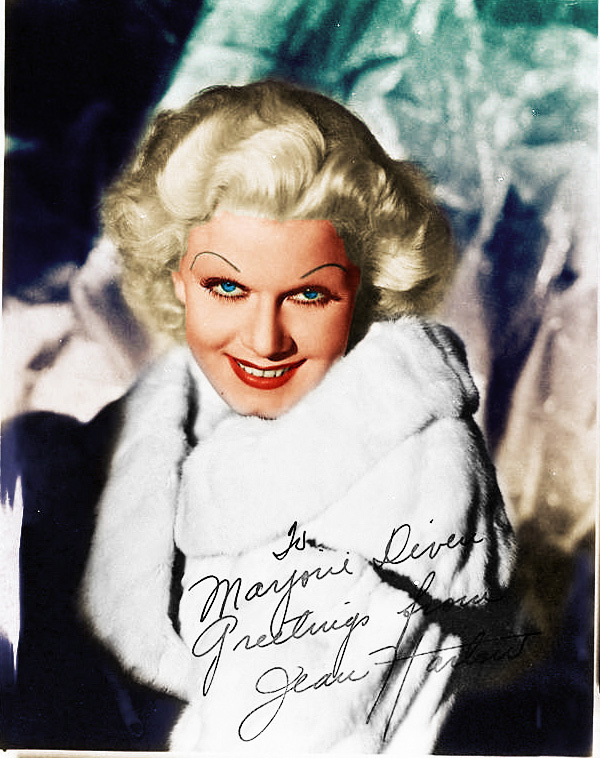
Speaking of which, Jean Harlow had the added benefit of sound films to create an indelible impression on the public. Like Valentino, Jean’s early death at the age of 26 established her as a legend she never could have imagined:
Humphrey Bogart made his first color film in middle age, but we present a more youthful Bogie in 1937:

Charlie Chaplin never appeared in a color film although his career spanned from 1914 to 1957. Here is a youthful Chaplin at the beginning of his phenomenal career, circa 1915:

Our colorized photo are only as good as the b/w source and this is a case in point. Photos from the 1920s had a variety of textures and “crystal clarity” was usually not one of them. Here is the genuinely charming Betty Bronson who was Peter Pan for a generation of movie-goers thanks to her 1924 hit film. She also played the title role in CINDERELLA (1925), the Blessed Virgin Mary in BEN-HUR (1925), and Al Jolson’s romantic interest in THE SINGING FOOL (1928). Her star faded thereafter but she continued to grace films with her presence well into old age:

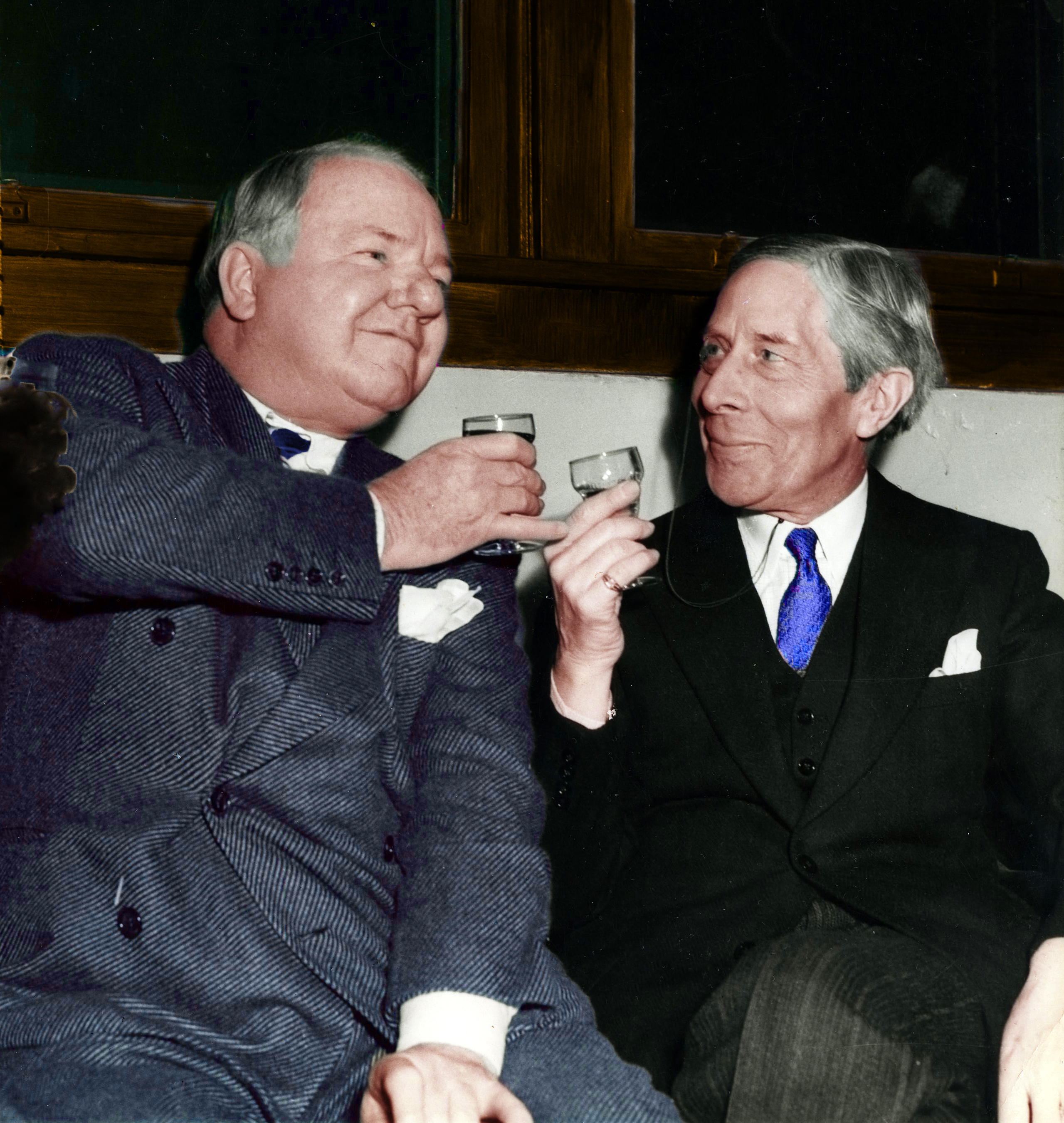
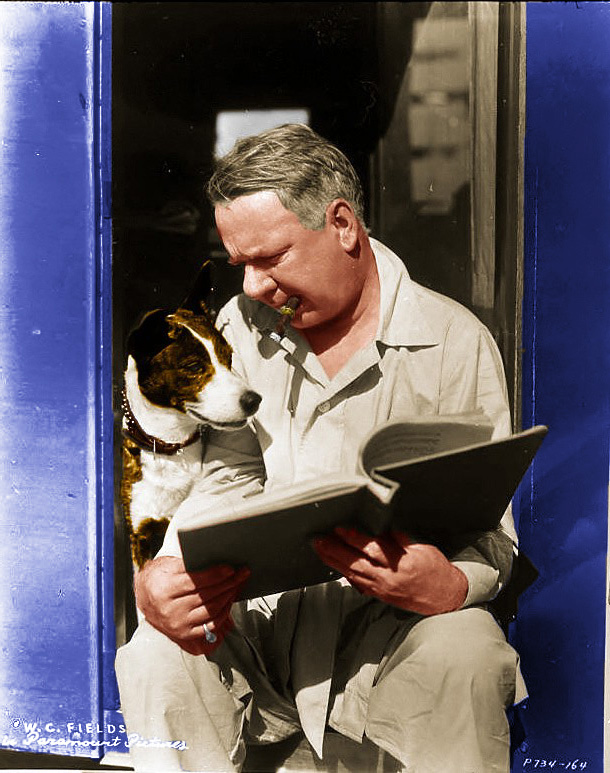
W.C. Fields supposedly “hated” children and dogs but the facts were different. Here he seems to be reviewing his script with one of his co-stars on the set of IT’S A GIFT (1934):
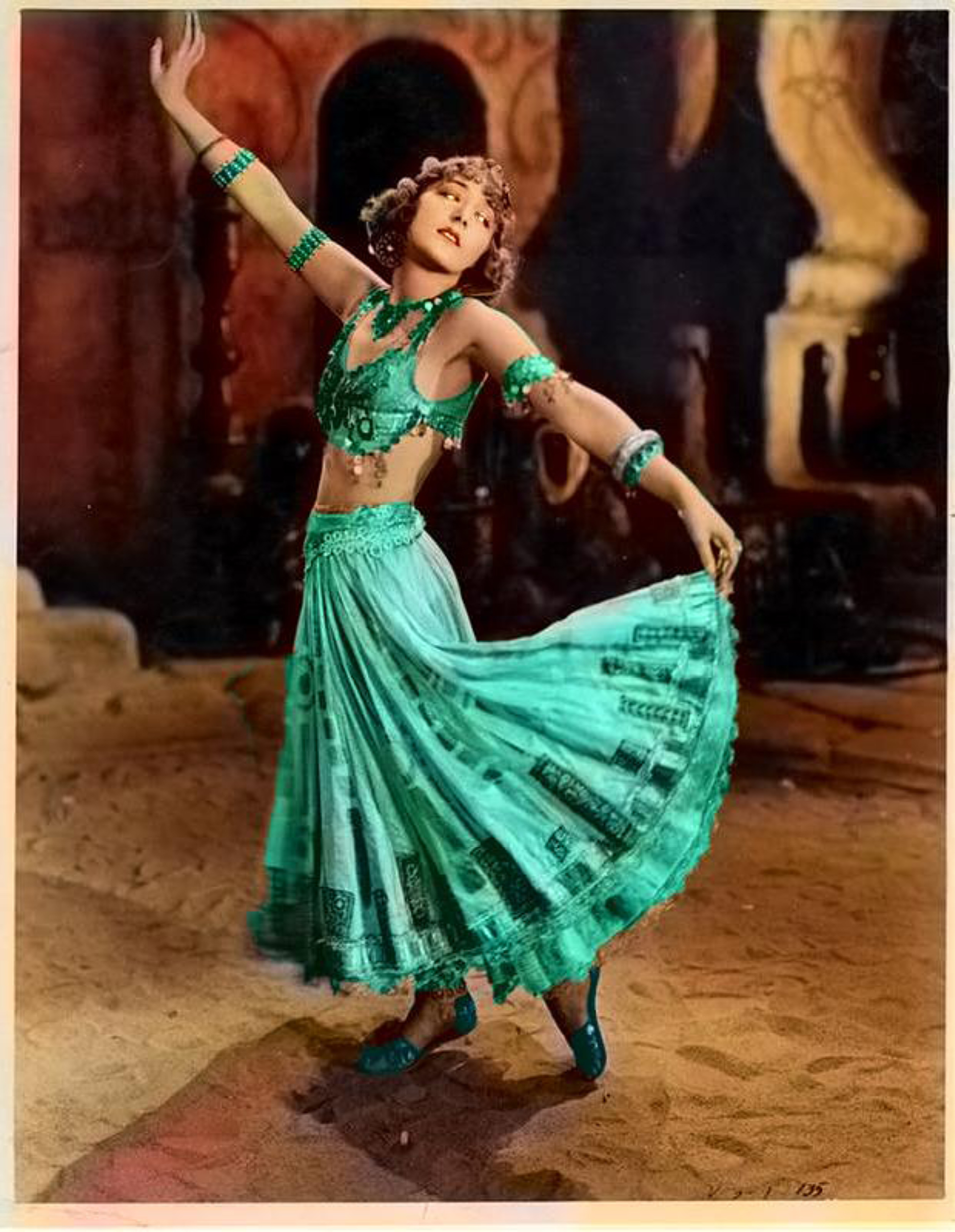
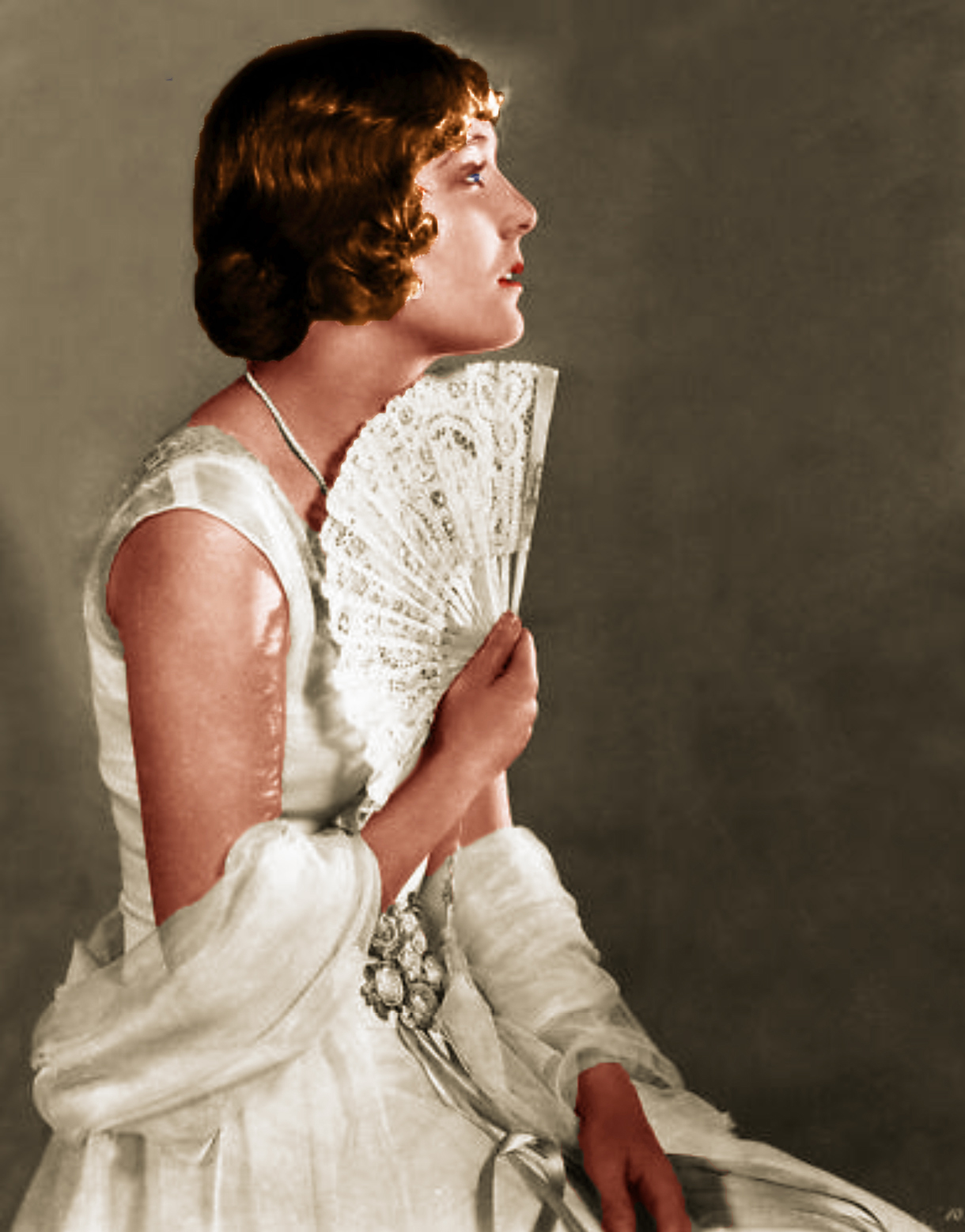
Hungarian beauty Vilma Banky played a variety of leading ladies on the silent screen – a fiesty American cowgirl in THE WINNING OF BARBARA WORTH (1925), a Russian heiress in THE EAGLE (1925), and a fiery senorita in TWO LOVERS (1928). But when sound arrived, Vilma’s thick accent proved a liability and she used her celebrity status to make a fortune selling real estate:
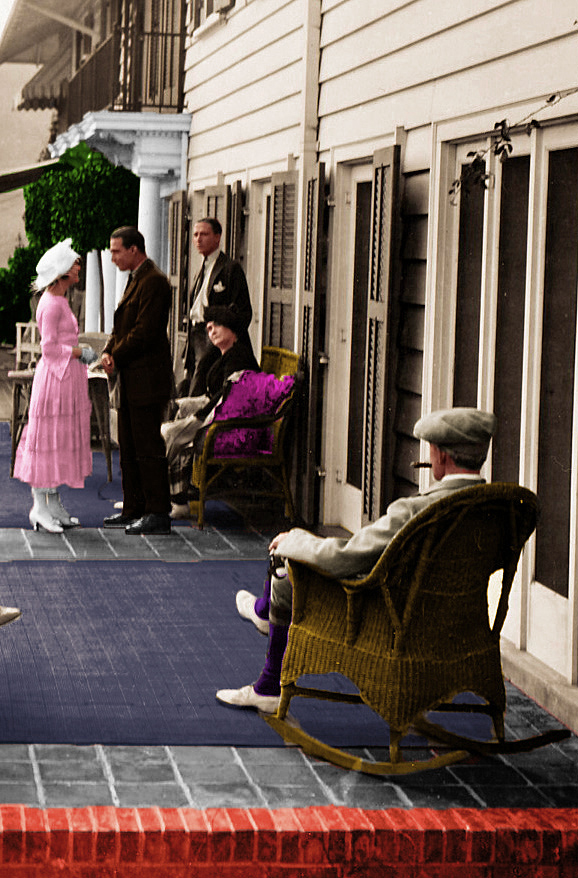
The transition from silent to sound films in the late 20s had a widely varying effect on the careers of film stars. Here are Mary Astor and John Gilbert at a movie premiere in 1935. Both became popular during the silent era, Gilbert actually becoming a superstar. Astor had transitioned by 1935 to leading roles in the talkies while Gilbert was unemployed and died a few months later:

Mary Astor again, with hunk Clark Gable in RED DUST (1932). Were this film made a few years earlier, say in 1929, John Gilbert might have been Astor’s co-star because Gable was then an unknown actor:

John Barrymore was Hamlet to theater-goers of the 20s and he moonlighted by filming big budget swashbucklers such as DON JUAN (1926) and THE BELOVED ROGUE (1927). He made an effortless transition to sound films but his alcohol-fueled lifestyle caught up with him. Here he is on the comeback trail in 1938:

German beauty Camilla Horn made quite an impression in Murnau’s FAUST (1926) so Hollywood beckoned. She made two films with John Barrymore then resumed her career in Germany just as sound was arriving:
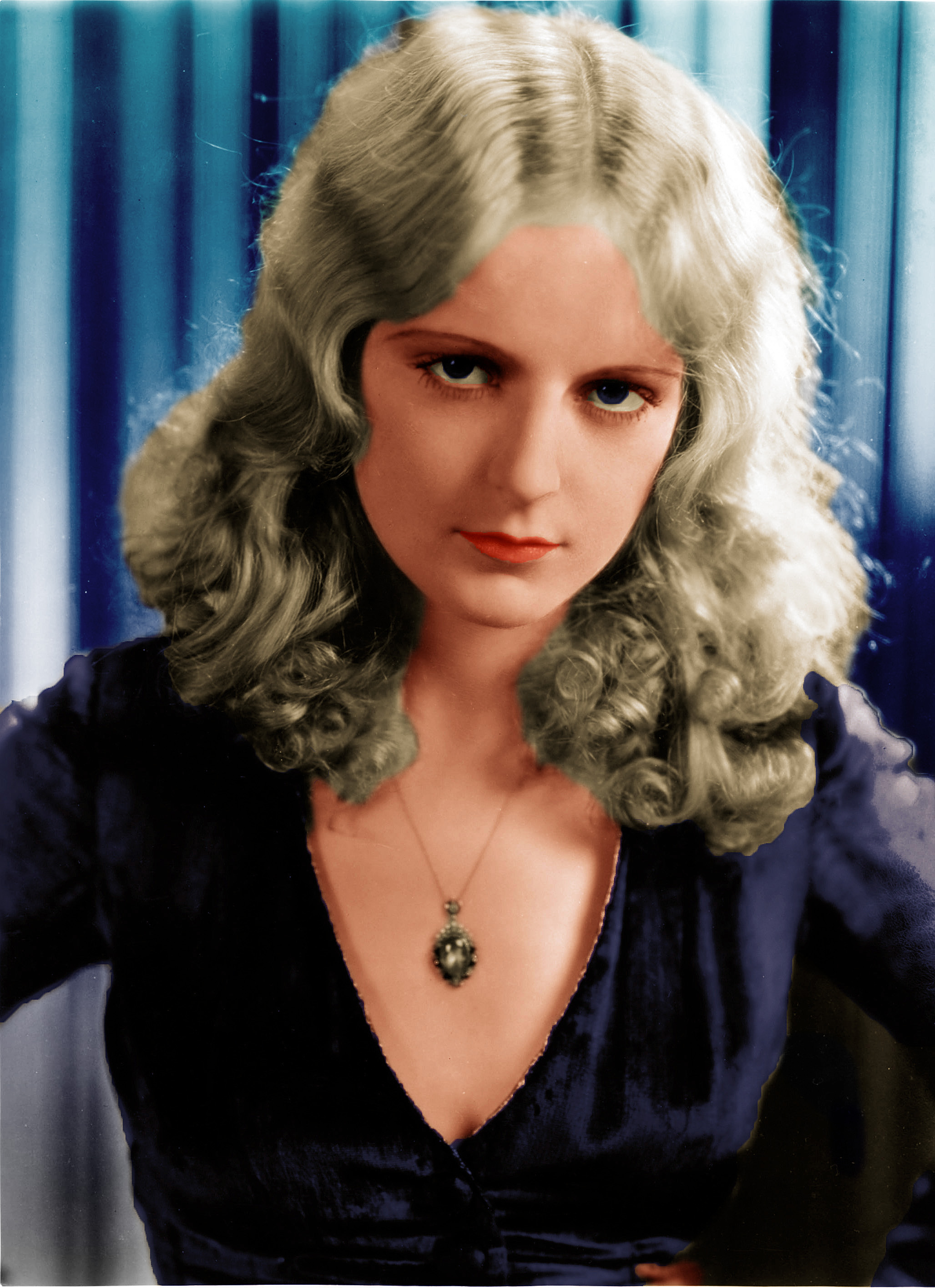
Unrecognizable, this is John Barrymore as the “King of Fools” in THE BELOVED ROGUE (1927). In case viewers doubted that the Great Profile was really beneath that makeup, the film shows him removing it:

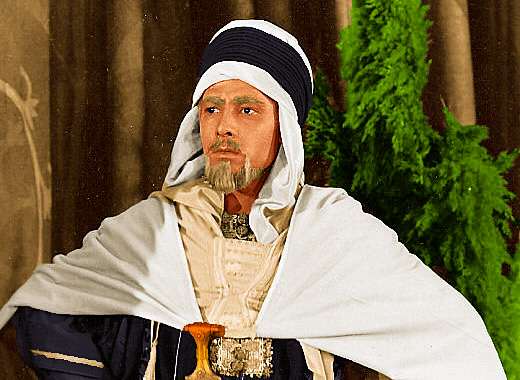
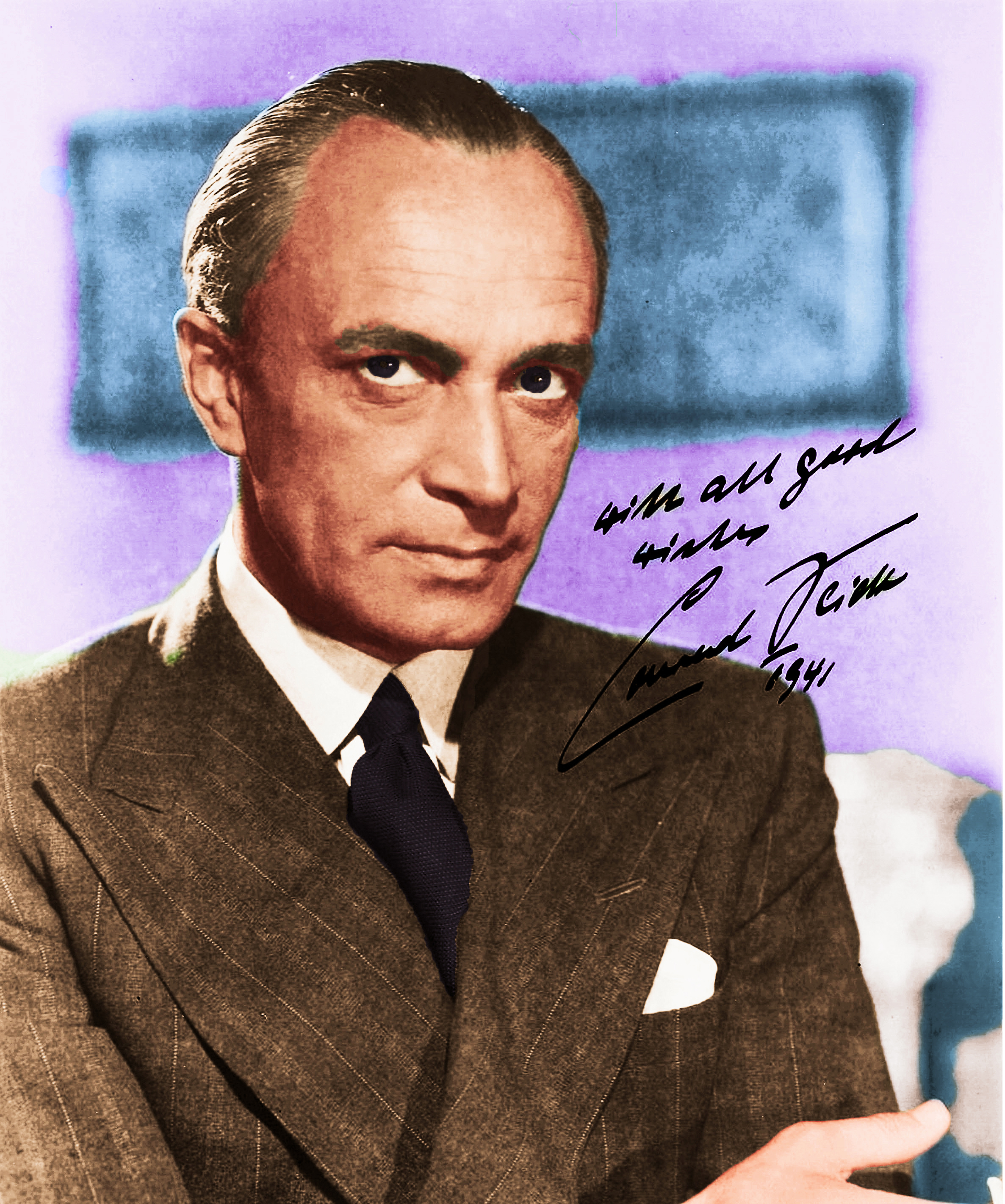
Conrad Veidt was another German film star of the 20s who was brought to Hollywood to co-star with John Barrymore in THE BELOVED ROGUE. Veidt returned to Germany with the advent of sound films but within a few years fled Nazi Germany, first to Britain, then resumed his career in America by 1940. Best known today for two films that bookend his career, THE CABINET OF DR. CALIGARI (1919) and CASABLANCA (1942), Veidt died of heart failure while playing golf in 1943:

Judy Garland was no stranger to color films beginning in 1939 with THE WIZARD OF OZ. But here she is part of an unusual trio with Irving Berlin playing and singing his songs with Judy, while MGM boss Louis B. Mayer seems to be enjoying the private concert:
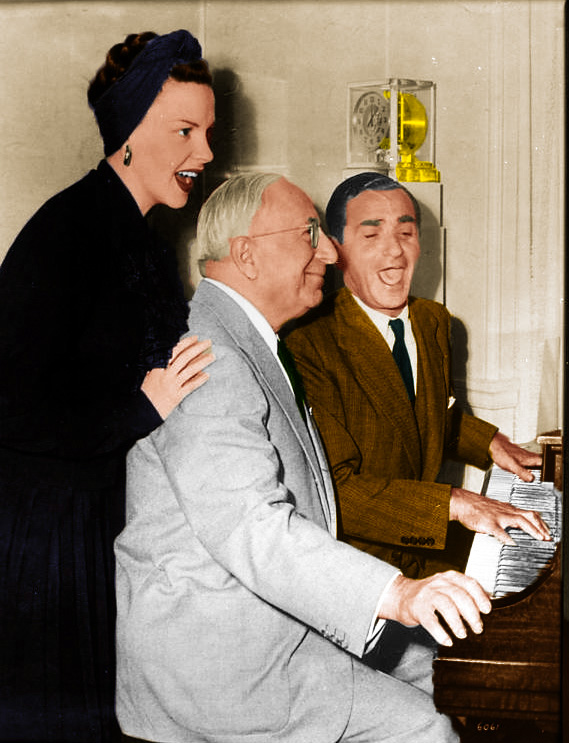
Russ Colombo was Bing Crosby’s rival in the early 30s, with hit records, a radio show, and the promising start of a film career. But his life was cut short in a bizarre accident with an antique pistol in 1934:

Talk about ill-fated, if Helen Chandler and Ramon Novarro seem to be looking forward to their future, they won’t like what they see. From DAYBREAK (1931):
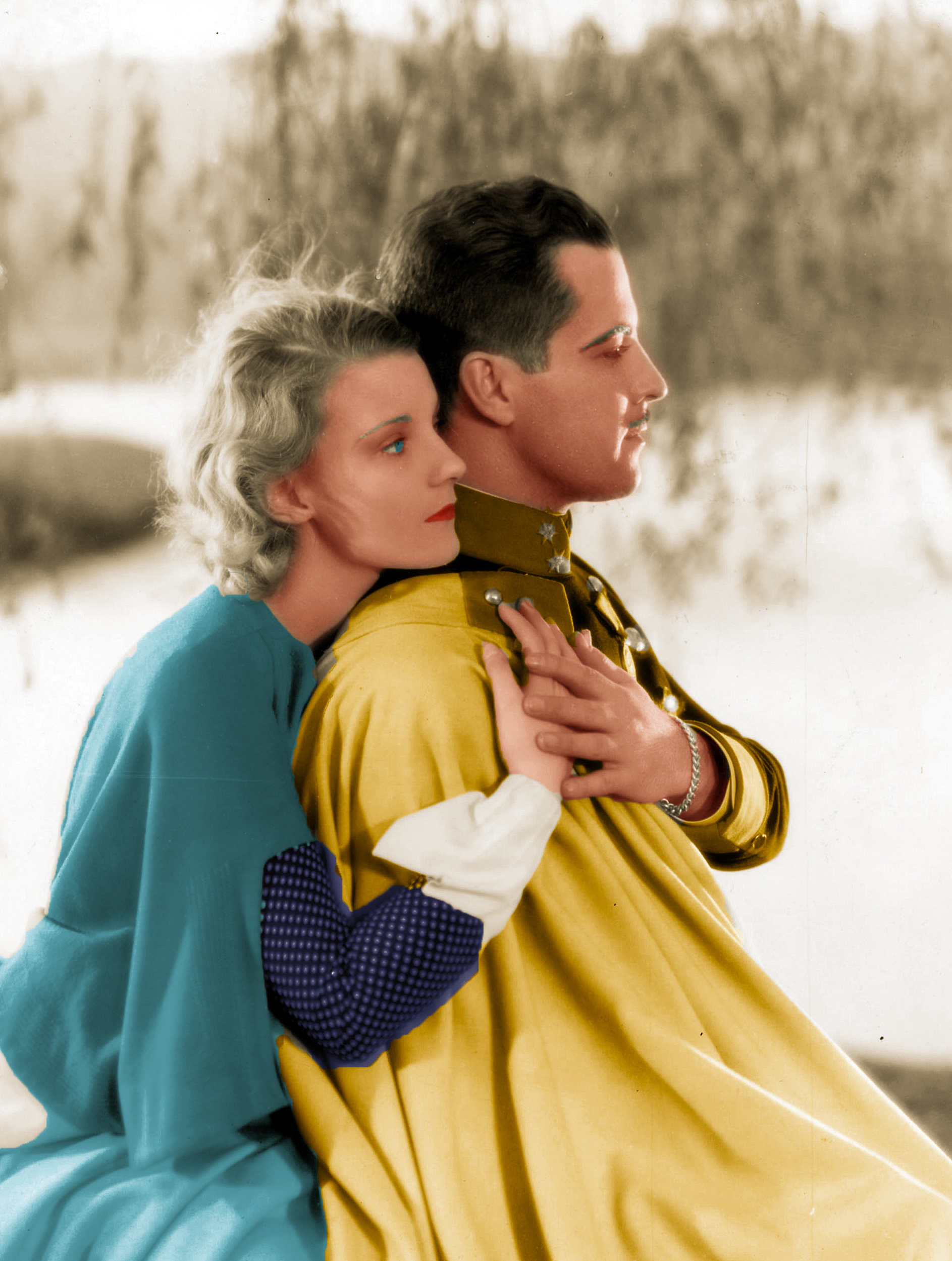
This is a genuine original color photo – Harry Carey began making films with D.W. Griffith in 1913 and then starred in westerns for the next 30 years. Still going strong in 1941, with co-star Betty Field in THE SHEPHERD OF THE HILLS:

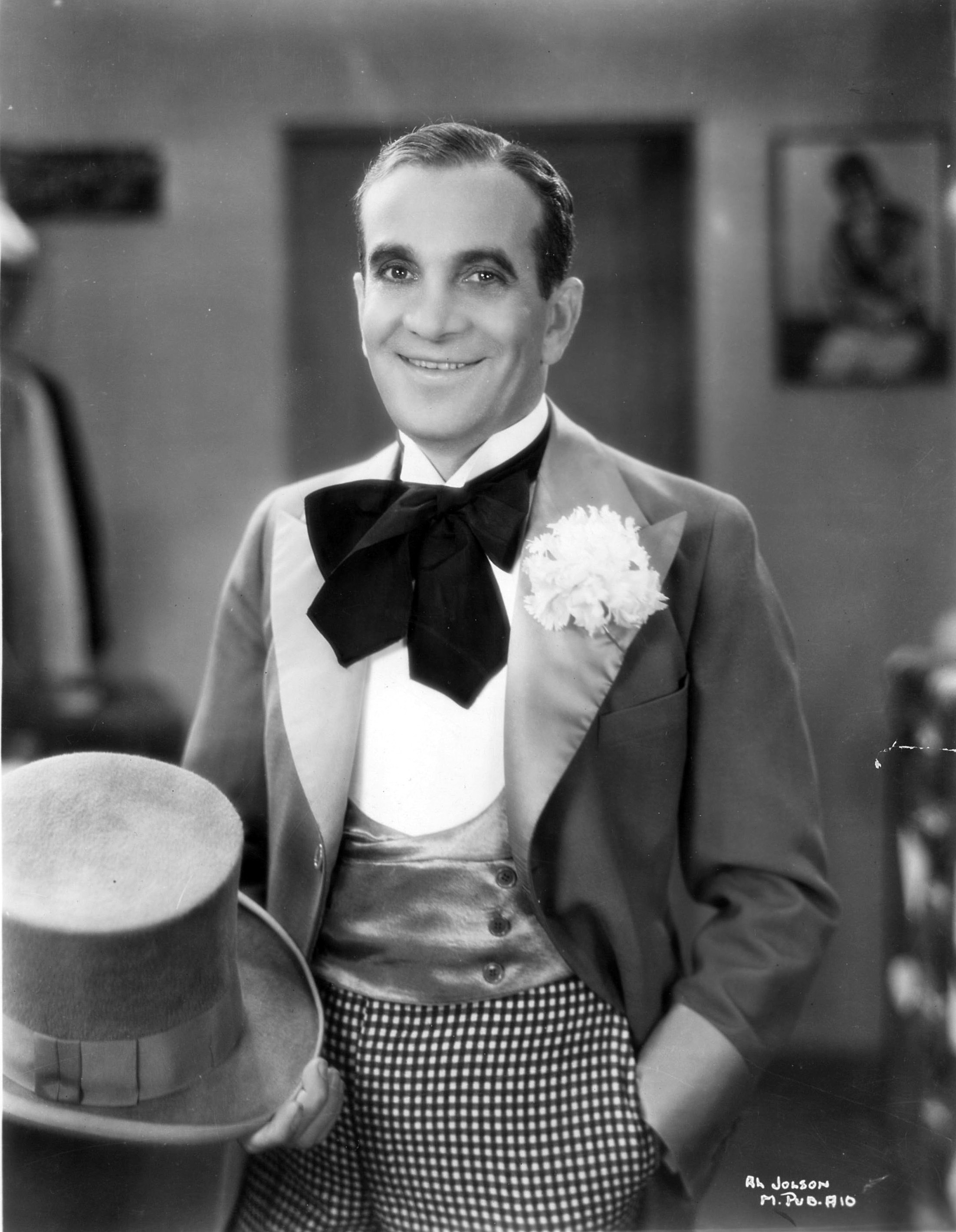
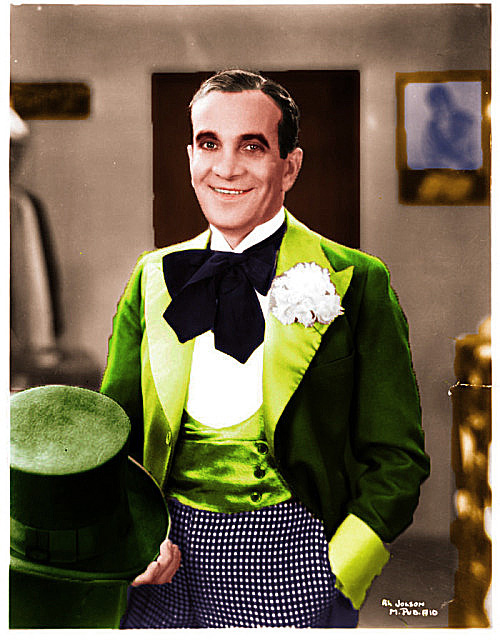
An unusually dapper Al Jolson circa 1933:

Silent superstar and film producer Douglas Fairbanks tried his luck with talkies but his heart wasn’t really in it. His co-star here, Edward Everett Horton, would enjoy an extraordinarily long career in talkies. From REACHING FOR THE MOON (1931):

John Gilbert again, looking confident and assured in 1933. He refused to let MGM buy out his million dollar contract and MGM seemed unable – some say unwilling – to find good films for him:
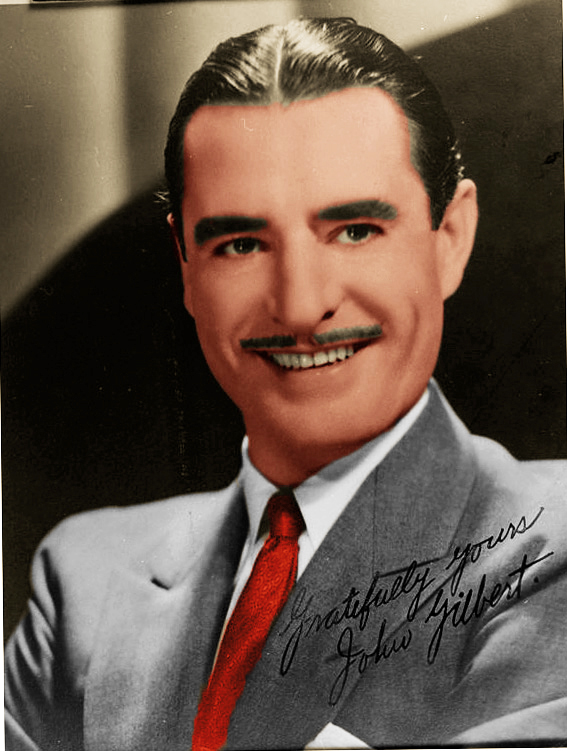
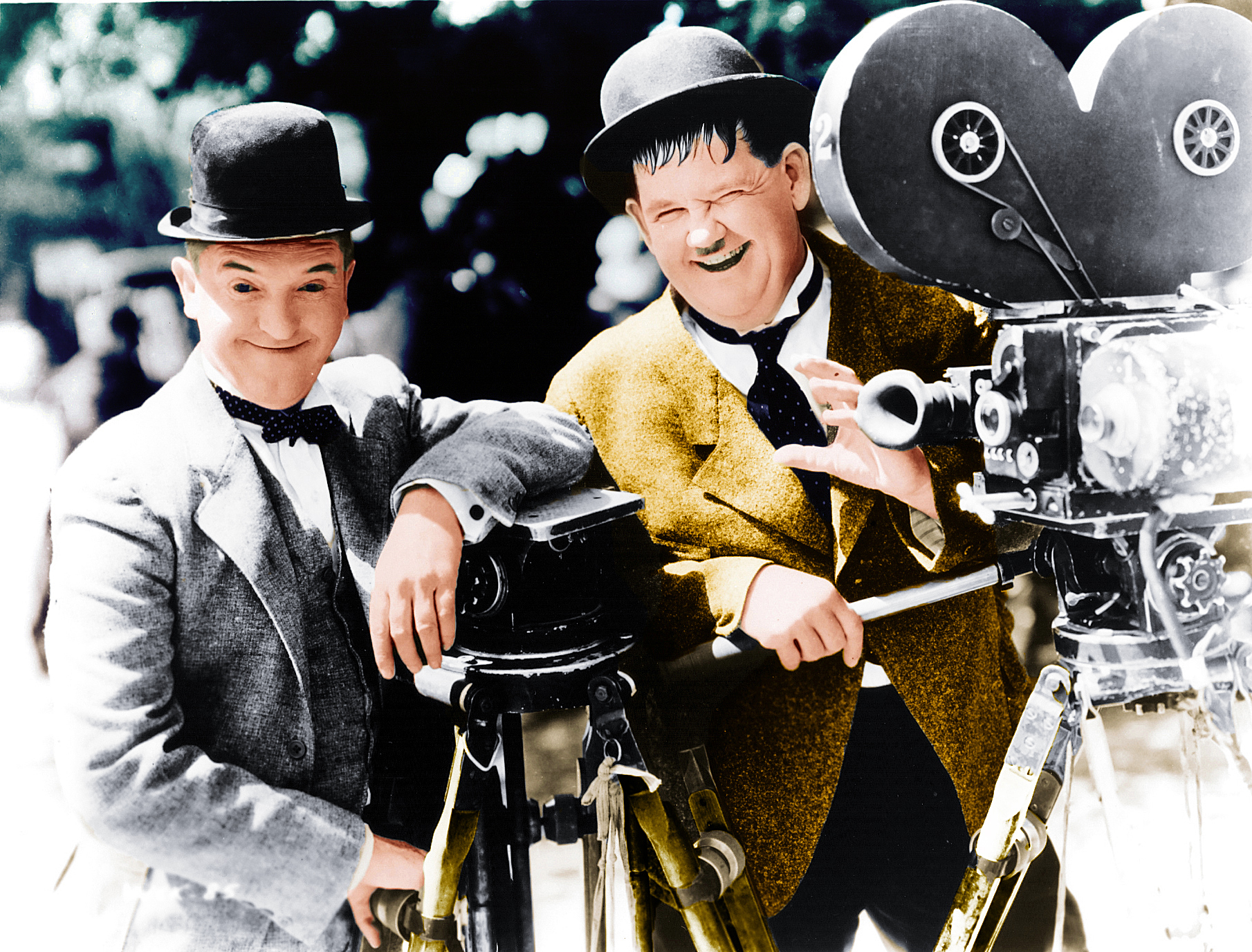
Stan Laurel and Oliver Hardy both had long careers in silent films before producer Hal Roach teamed them in 1927. While they are remembered for their hit sound films such as SONS OF THE DESERT (1933), personally I think their silent films contain their best work:

Sometimes silent film villains made effective talkie heroes. Warner Oland is a case in point having played a variety of bad guys including his specialty of Asian characters, then played Charlie Chan in 22 talkies:

Lillian Gish lived to be 99 years old and wealthy even though her film stardom ended with the silent era. Described as sweet and virginal, her films continue to be praised today, not only the blockbusters such as THE BIRTH OF A NATION (1915), but smaller films as well such as the rural romance, TRUE HEART SUSIE (1919). Here is Gish in an uncharacteristic pose, circa 1919:

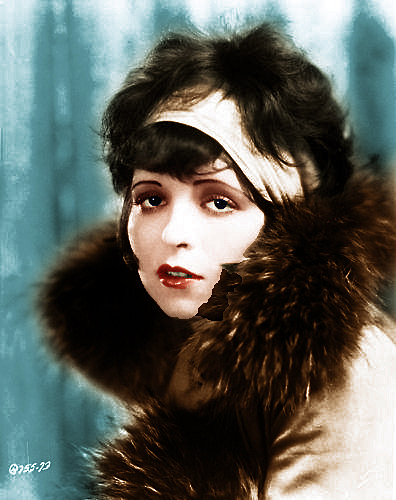
If Lillian Gish projected virginity, then Clara Bow projected something entirely different. She was called the “It Girl” and everybody knew what “It” referred to. Clara Bow circa 1927:
Published in: on September 11, 2011 at 10:08 PM  Comments (6)  

On the Set with …


The original Rin Tin Tin (1918-1932) lived a more adventurous life than most people. As a puppy he was found among the rubble of a bombed-out kennel in France in September 1918 by American airman Lee Duncan. After the First World War ended that November, Duncan arranged to bring the pup back to the states when his own deployment ended. Duncan named the German Shepherd after a French clown and was impressed by the dog’s intelligence and his ability to follow complex direction. Hollywood seemed a logical outlet for the talented canine but none of the studios were interested – at first:
Dog films were popular in the early 1920s and no pooch was more popular than Strongheart, another German Shepherd. But anti-German prejudice in the United States ran high due to the war so public relations experts came up with a novel idea – henceforth German Shepherds would be called Police Dogs. Rinty’s big break came in 1922 while Duncan was watching a film crew working with another dog who was supposed to portray a wolf. The dog wouldn’t follow directions so Duncan stepped forward and assured the harried director that Rinty could handle the bit. Legend claims that Rinty was letter-perfect in this first, albeit uncredited, movie role.


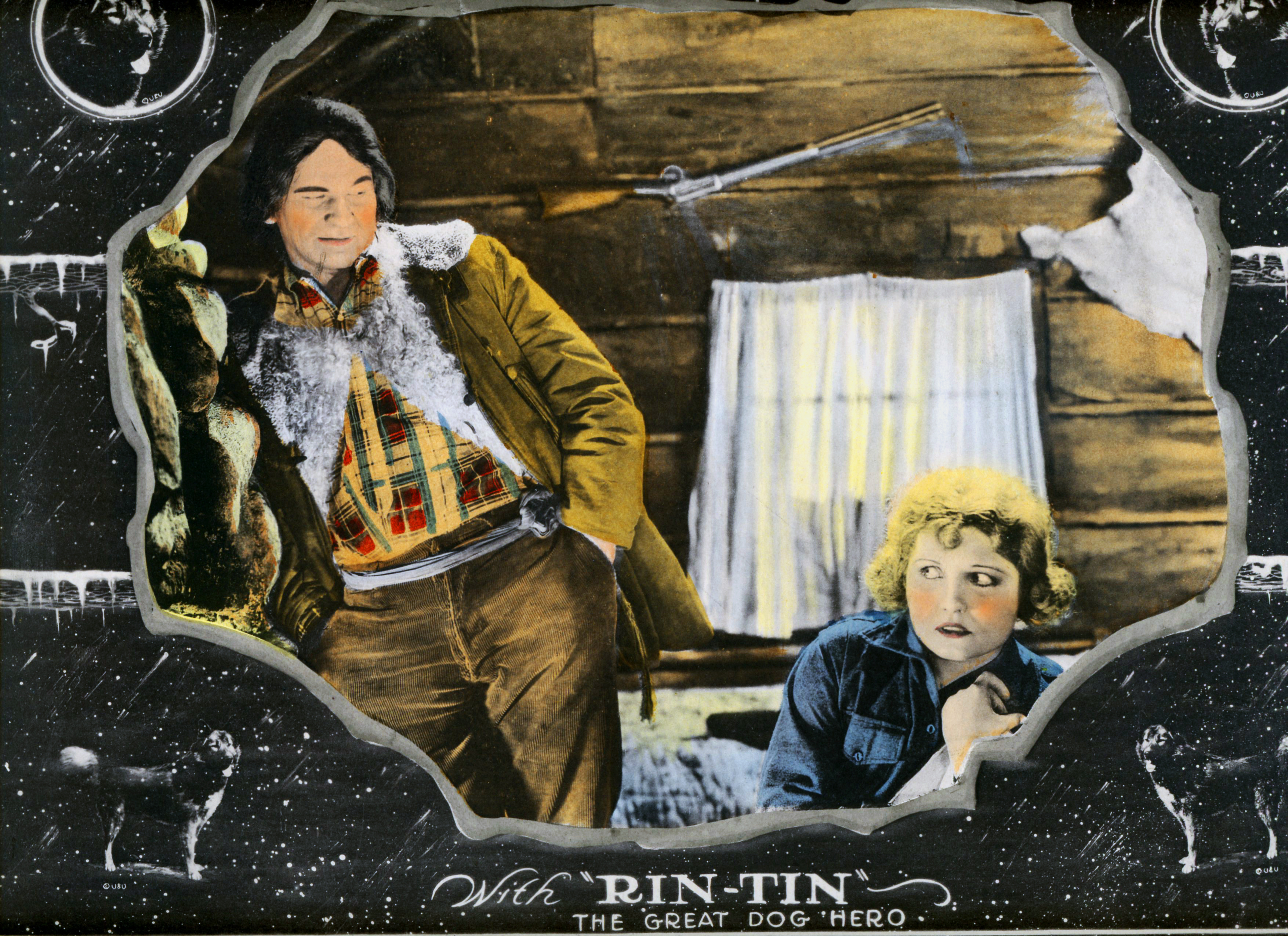
Rin Tin Tin achieved his first screen credit in MAN FROM HELL’S RIVER (1922), in fact he is the only performer credited in the lobby card above.
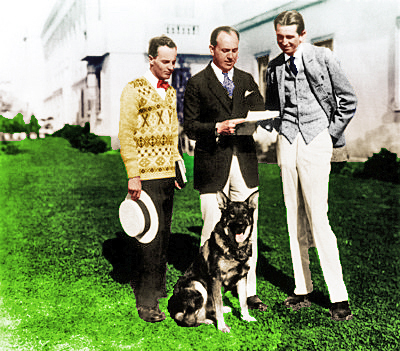
A small but up-and-coming studio, Warner Brothers (later abbreviated to “Bros.”), noted both the popularity of the Strongheart films and the relatively low expense to make them. Here is writer and future movie mogul Darryl Zanuck (note he is holding a book), studio boss Jack Warner (apparently reading a contract), Lee Duncan, and Rinty himself as arrangements are made to star Rinty in his first film:

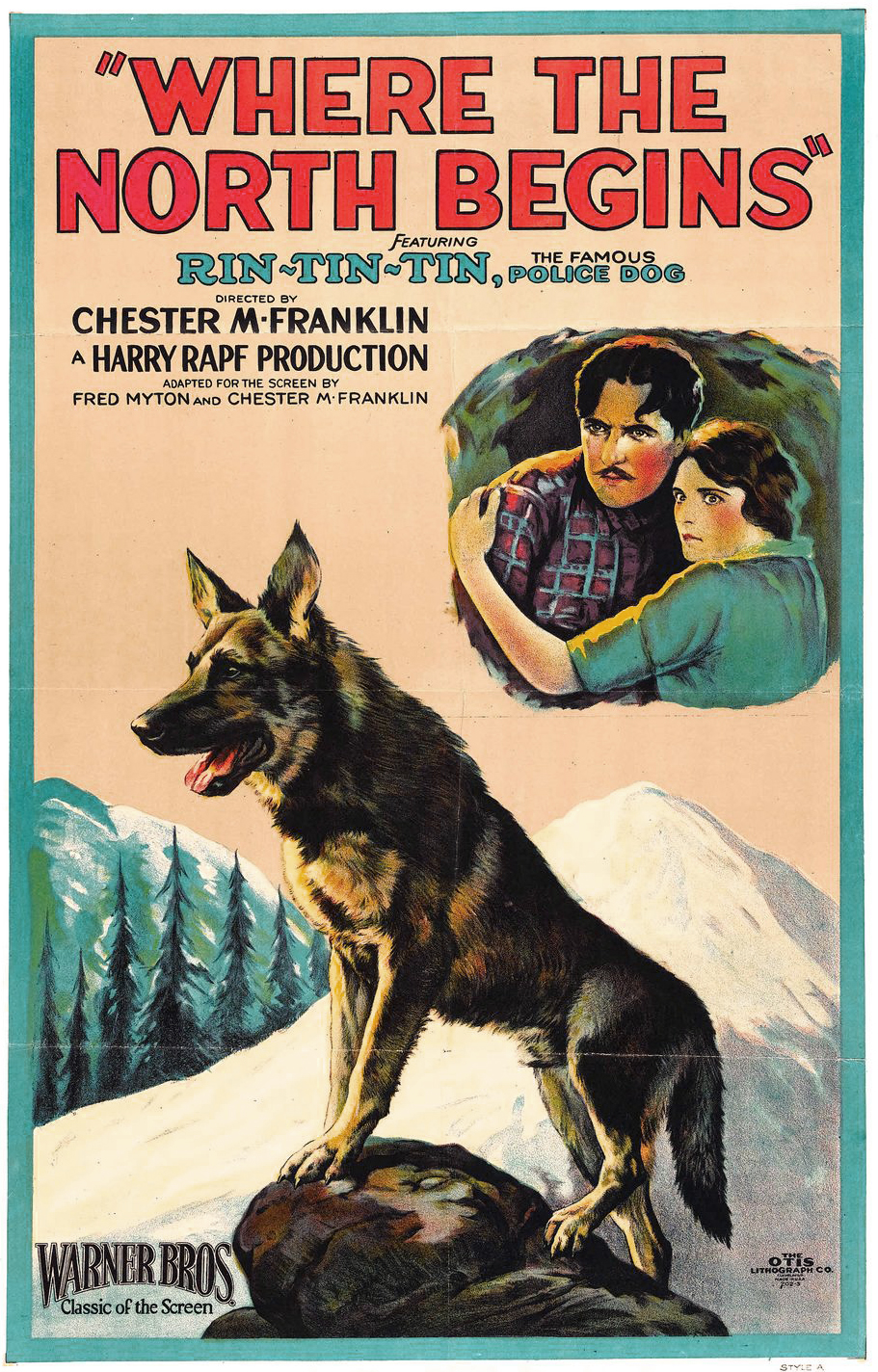
WHERE THE NORTH BEGINS (1923) – Rinty’s first (of twenty-five!) starring feature films also has the distinction of being one of a handful to survive and available on dvd. Note that the human actors continue to appear anonymously in posters:

Rinty’s second starring feature, THE LIGHTHOUSE BY THE SEA (1924) survives in somewhat truncated form but is available on dvd. By now, Warners realized they had their first major box office star. LIGHTHOUSE was followed by the now-lost FIND YOUR MAN (1924):

Above and below, a greatly enlarged “movie herald,” a small flimsy handout used by theaters to promote an upcoming attraction:

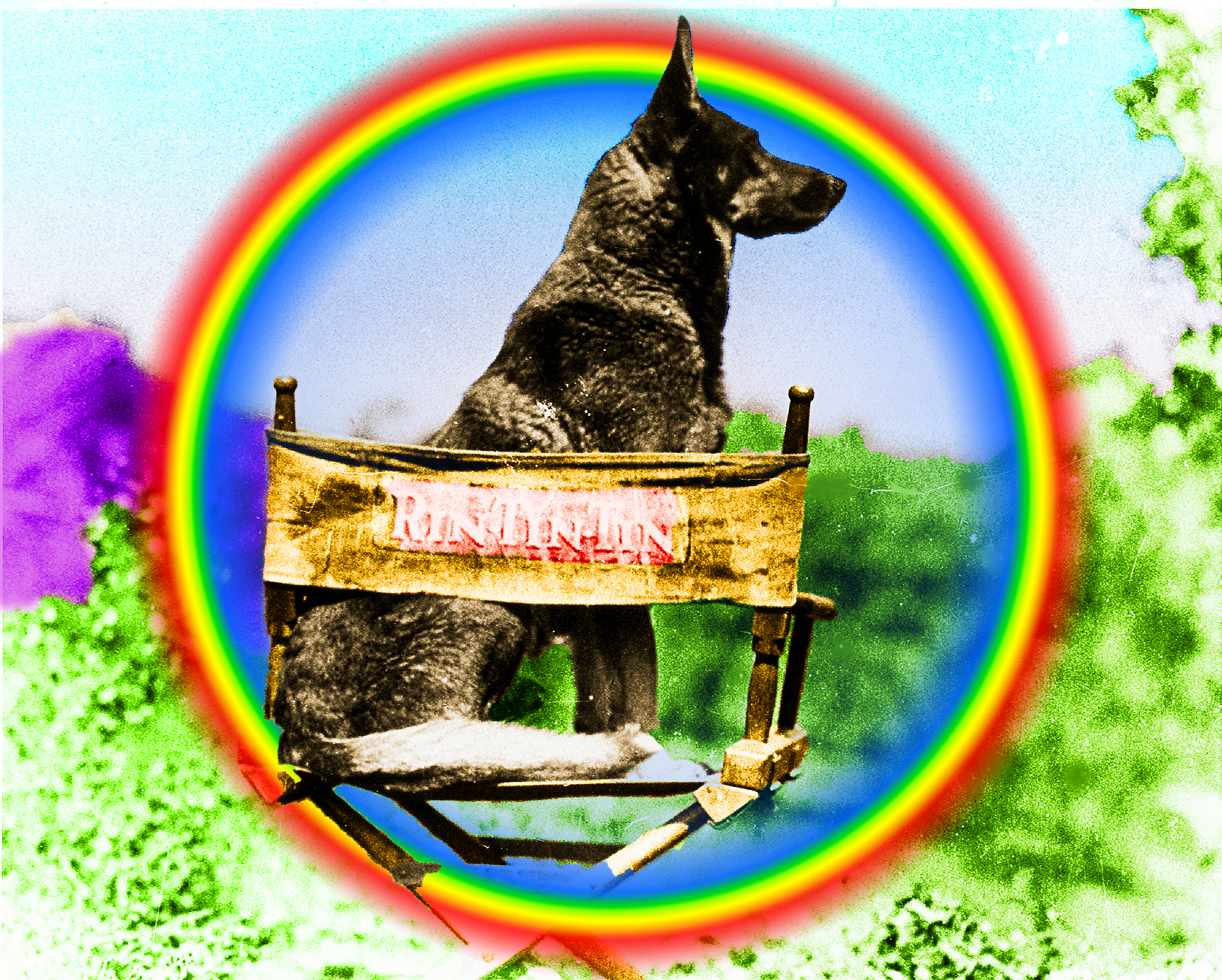
Studios provided their big stars with private bungalows on the lot but Rinty was given more practical housing – a large kennel. Here the silent film camera grinds while Lee Duncan supervises Rinty posing with various awards:

A photo of the same session:

This photo even feels cold. Unlike the Lassie films of the 1940s, the silent Rintys are rugged outdoor adventures as this image suggests from the lost TRACKED IN THE SNOW COUNTRY (1925):

Never count Rinty out – a 35mm print of CLASH OF THE WOLVES (1925) was discovered in South Africa about ten years ago and repatriated to the Library of Congress. Now beautifully restored and on dvd, this film has been named to the National Film Registry of significant motion pictures:

The title role in THE NIGHT CRY (1926) was played by a condor, at the time the only one in captivity. Poor Rinty is blamed for the condor’s attacks on livestock but swings into action when the giant bird kidnaps a baby. One of the most exciting of the surviving Rintys:

A premium card to promote Ken-L-Ration, a dog food still sold today:

Another movie herald for another lost film from 1926:


Human actors are now recognized but strictly in support of the star:

Youngsters were encouraged to read about Rinty’s exploits as well as see them on the screen:

Nanette co-starred in several films with Rinty and in the 1930s appeared in films with Rin Tin Tin Jr. The stories often forced Rinty to choose between saving the heroine or saving Nanette. Of course, he chose his mistress but Nanette fended for herself just fine:

Rinty helps the police track down a killer in the Limehouse district of London in this lost film. By now in 1927 Rinty’s silouette alone identified him:

Dorothy Gulliver and Rinty spend an idyllic day as the clouds of World War I gather in the lost A DOG OF THE REGIMENT (1927):

Rinty on the western front where all is far from quiet. During World War II, Duncan and Rin Tin Tin III organized the K-9 Corps for the U.S. Army where they trained over 5,000 dogs for military service:

A surviving Rinty, though somewhat truncated, TRACKED BY THE POLICE (1927) provides non-stop action:

Al Jolson takes time out at Warners from revolutionizing silent films into talkies with THE JAZZ SINGER (1927) by paying a call on Rinty:

With the talkie revolution now underway, Rinty makes his first “barkie” with LAND OF THE SILVER FOX (1928):

Rinty seemed to be born to keep kids out of trouble:

Rin Tin Tin in Palestine. The title in this Hebrew ad is BETWEEN THE SNOWY MOUNTAINS, which may be A HERO OF THE SNOWS or possibly TRACKED IN SNOW COUNTRY. In any event, this Rinty played the Ophir Cinema in Tel Aviv on January 12, 1930:

An enlarged postcard from TIGER ROSE (1929):

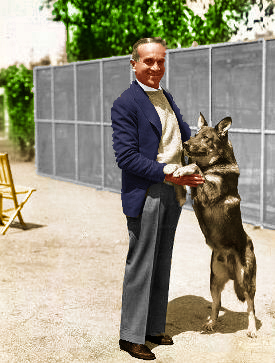
Rinty continued making three to four features per year in the 1929-30 sound film era. However, in December 1929 a Warners executive notified Lee Duncan that due to the advent of sound films, Warners would no longer produce the Rin Tin Tin films “because dogs don’t talk.” Here’s a nice portrait of Duncan and what’s-his-name:

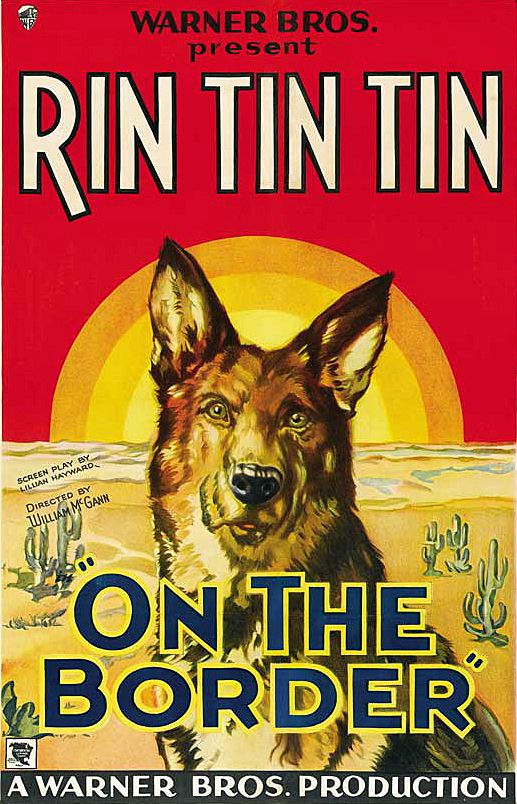
It also seems likely that two other factors were involved: first, Warners now had an impressive roster of stars of the stage and screen, and Rinty may have been an embarrassing reminder of earlier days when a dog kept the studio solvent. Second, by 1930, Rinty was twelve years old, rather elderly for a German Shepherd, and the studio felt it was time for him to retire. A poster from the lost talkie, ON THE BORDER (1930):

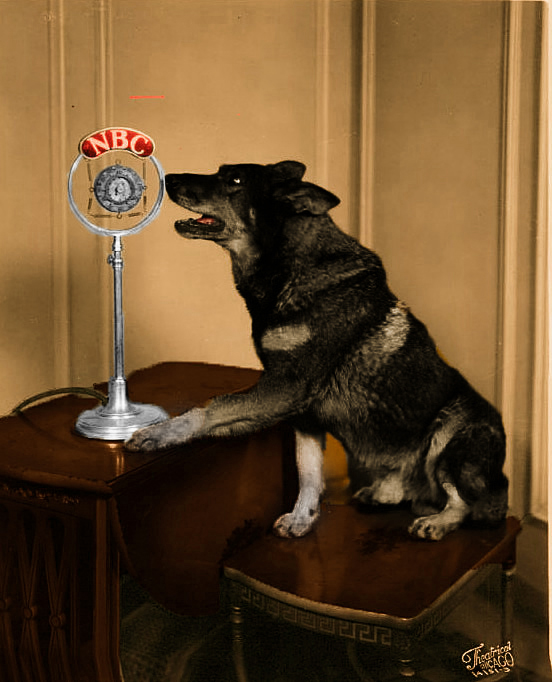
But Rinty kept busy by starring in a twelve chapter serial in 1930, THE LONE DEFENDER, and had his own radio show over NBC called “The Wonder Dog:”

Rinty’s final film was THE LIGHTNING WARRIOR (1931), another twelve chapter serial. Just one month shy of turning 14 (about 90 in German Shepherd years), Rinty died suddenly on the front lawn of his home on August 10, 1932. Legend says that neighbor Jean Harlow (whom Duncan had given one of Rinty’s pups) came running over and cradled Rinty’s head in her arms as he died. But Rinty’s progeny continues to this day, the current heir in a direct line is Rin Tin Tin XII. Meanwhile, the original Rin Tin Tin rests in an honored grave site at the Lile aux Chiens (Cimetiere Des Chiens), Asnieres-sur-seine, Ile-de-France Region, France:

But thanks to films, the original Rin Tin Tin’s exploits can be enjoyed in the 21st century:

On the Set with …

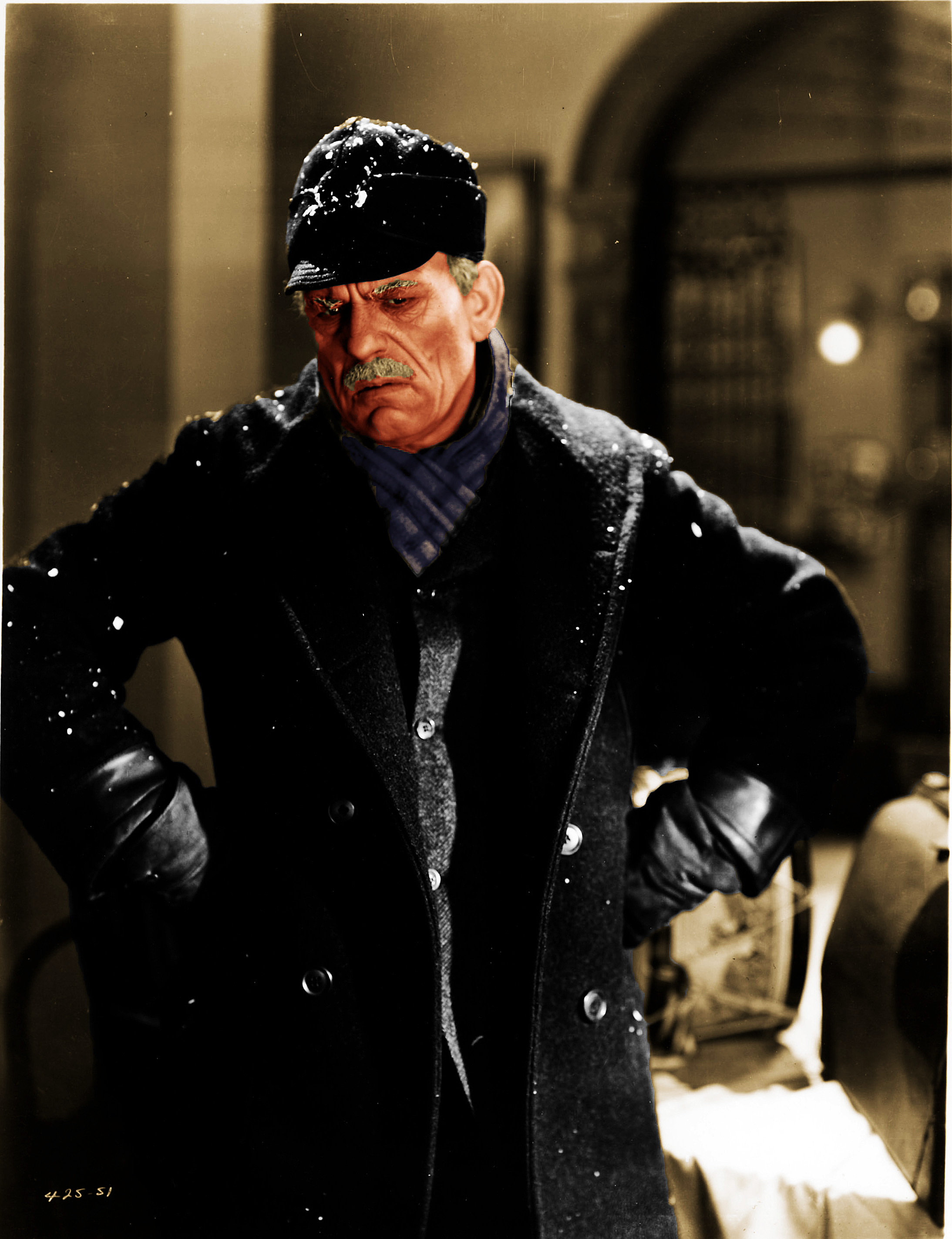
Lon Chaney Sr. was the granddaddy of the Character Actor-Star in American films, and in many ways he single-handedly created the horror film genre. Lon is remembered mainly for two films where he played the grotesques of the title: THE HUNCHBACK OF NOTRE DAME (1923) and THE PHANTOM OF THE OPERA (1925). In fact, almost all his other films were melodramas, bizarre to be sure, but not exactly horror films. Reclusive by nature, the studios publicized him as the “man of mystery.” Chaney worked in silent films before makeup artists entered the field and developed his own makeup so skillfully and could appear so different from film to film that he was eventually dubbed “The Man of A Thousand Faces.”

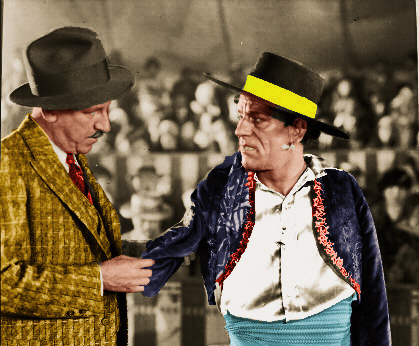
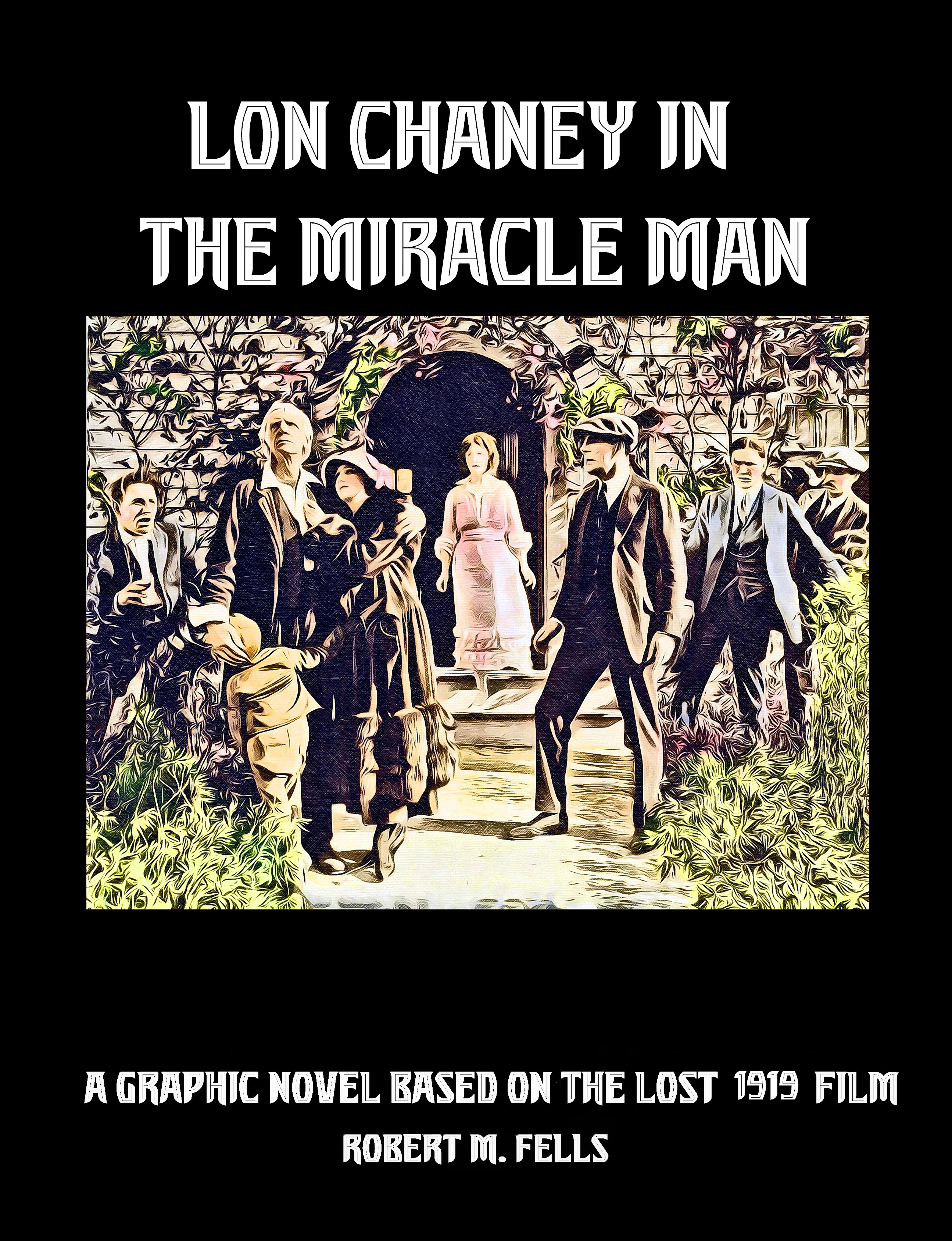
Lon labored in the vineyards of film-making from 1914 on playing in support of some well-remembered stars such as William S. Hart and many forgotten ones. Many of these early works are now lost including his breakthrough film, THE MIRACLE MAN (1919), where he played a phoney paralytic. Here is Chaney as himself (more or less) and in character:

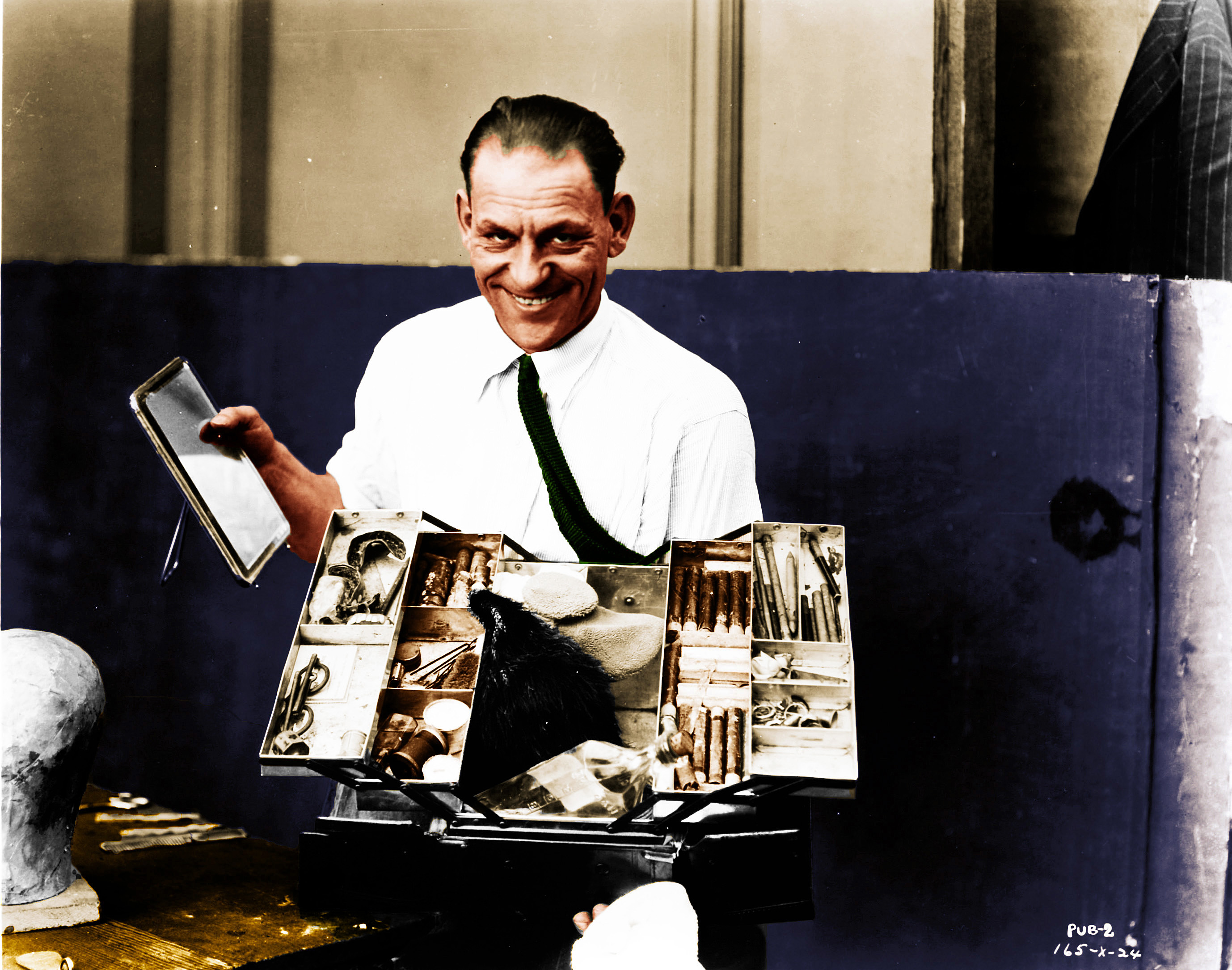
In 1922, Lon appeared in a photo spread displaying his craft in conjunction with the film A BLIND BARGAIN (another lost one). Here he displays his makeup case that can be seen today at the Los Angeles Museum of Natural History:

Lon tries out some fangs in planning the appearance of his “apeman” character in the film. Enlarging this photo shows the time on Chaney’s wrist watch as 2:50:

Lon combs out his apeman wig (the time is now almost 2:55):

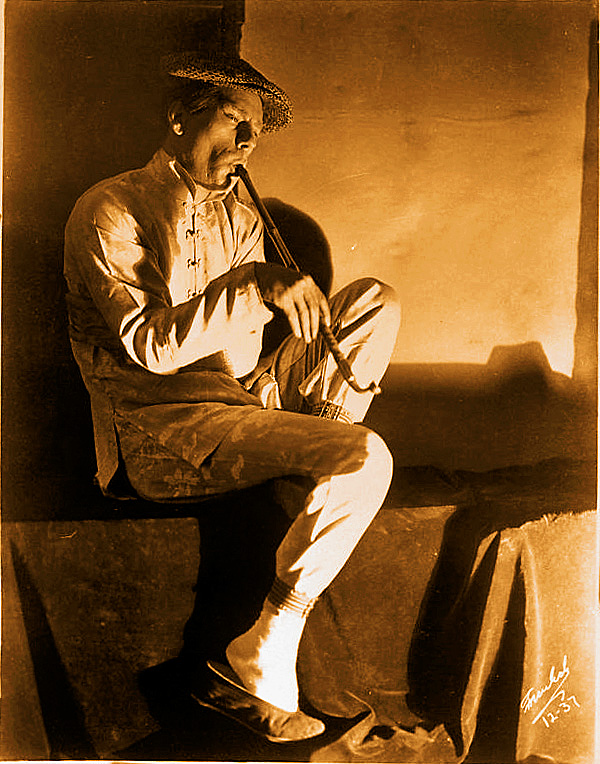
Lon’s Asian characterizations are remarkable. This portrait, scanned directly from a negative, is from OUTSIDE THE LAW (1923), a film that not only survives but is available on dvd. This photo is striking in black & white but if color film were available, the photographer might have attempted a lantern-light effect such as this:

At a time when movie villains were typically handsome and well-dressed, Chaney displayed evil in characters usually portrayed sympathetically such as the disabled. Another photo scanned directly from a negative, here Lon plays a malevolent cripple in THE SHOCK (1923), another film available on dvd:

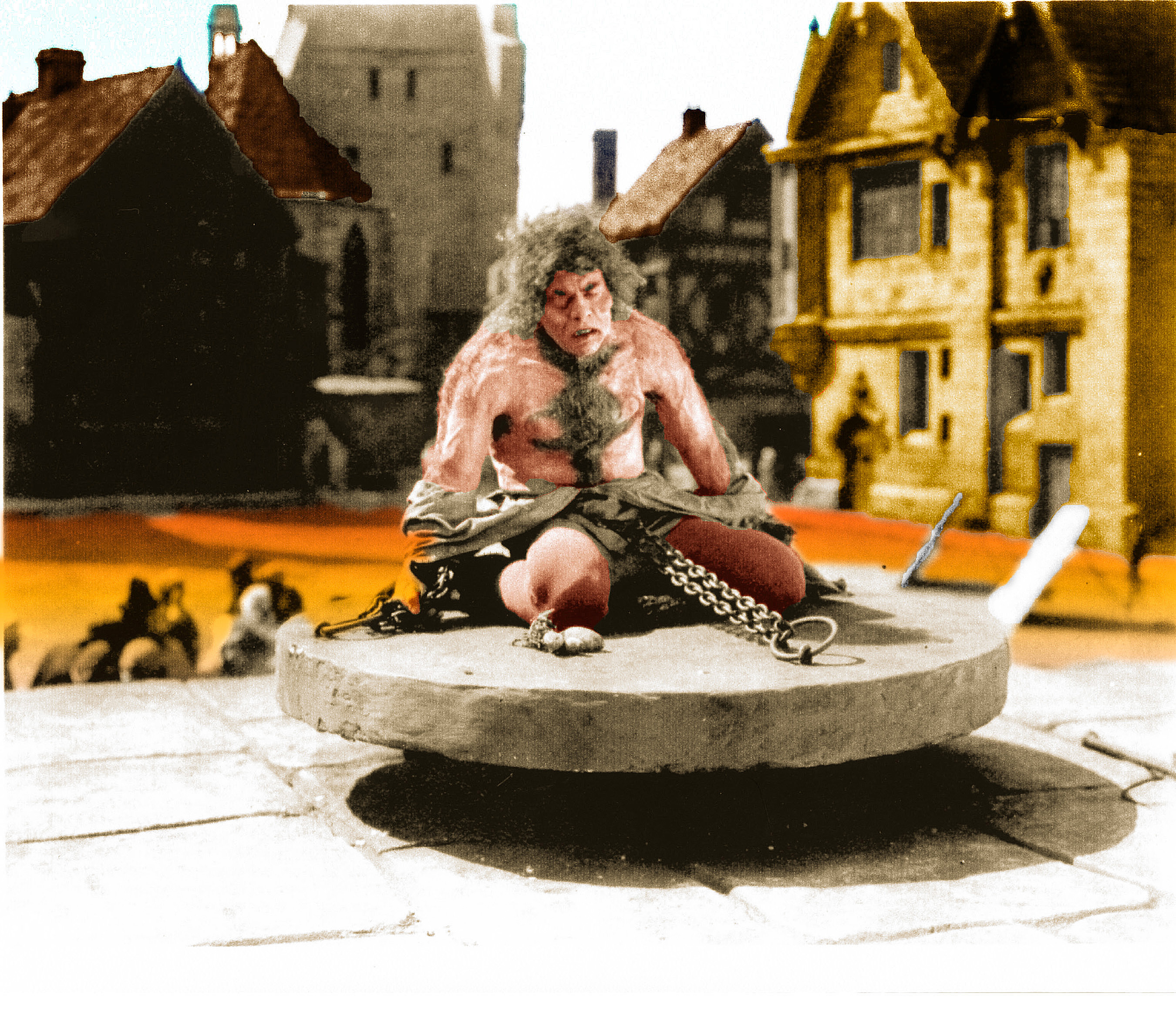
Chaney waits between camera setups in perhaps the most famous scene in THE HUNCHBACK OF NOTRE DAME (1923). Note the two reflectors on the right used to redirect the sunlight to brighten up shadows on the buildings across the plaza:

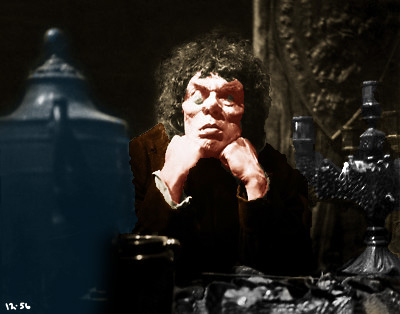
A fine study of Quasimodo from THE HUNCHBACK. In the film Chaney seems unrecognizable under his makeup, but here you can almost see Lon’s face:

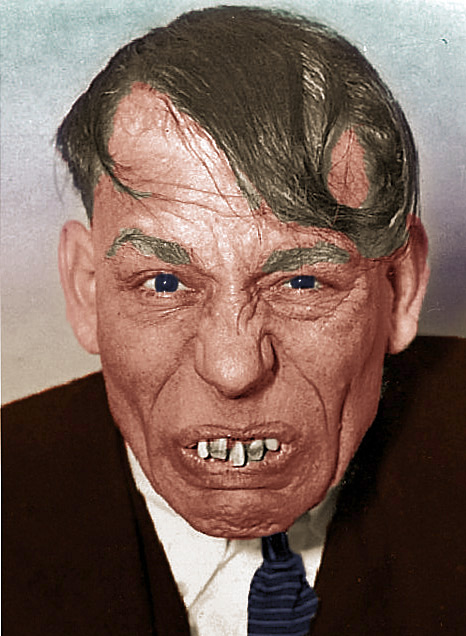
Circa 1923, Lon poses for some “mug shots” to demonstrate how he arranges his features and uses dental appliances to suggest a character:

Lon would apply adhesives to pull his skin taut but here he demonstrates how he developed his characterizations more informally:
Both photos above are scanned directly from negatives.

Lon wrings out his sleeve after emerging from the underground lagoon beneath the Paris Opera House in THE PHANTOM OF THE OPERA (1925). Chaney’s makeup design for Erik the Phantom was arduous enough but now it also had to be waterproof:

The Unused Ending – preview audiences rejected this finale where Erik dies of a broken heart and the film went back into production to create a new ending:

THE PHANTOM was not the only big hit Lon had in 1925:

Lon frequently teamed up with director Tod Browning to create a number of macabre masterpieces. One of their best collaborations is THE UNKNOWN (1927) where Chaney portrays a murderer posing as a bogus armless circus performer. To escape detection and impress a woman, he has his arms amputated!

In this publicity photo for THE UNKNOWN, Chaney demonstrates his “skill” at writing with his foot for actress Claire Windsor. Actually, Chaney was doubled in the film where he uses his feet as hands:

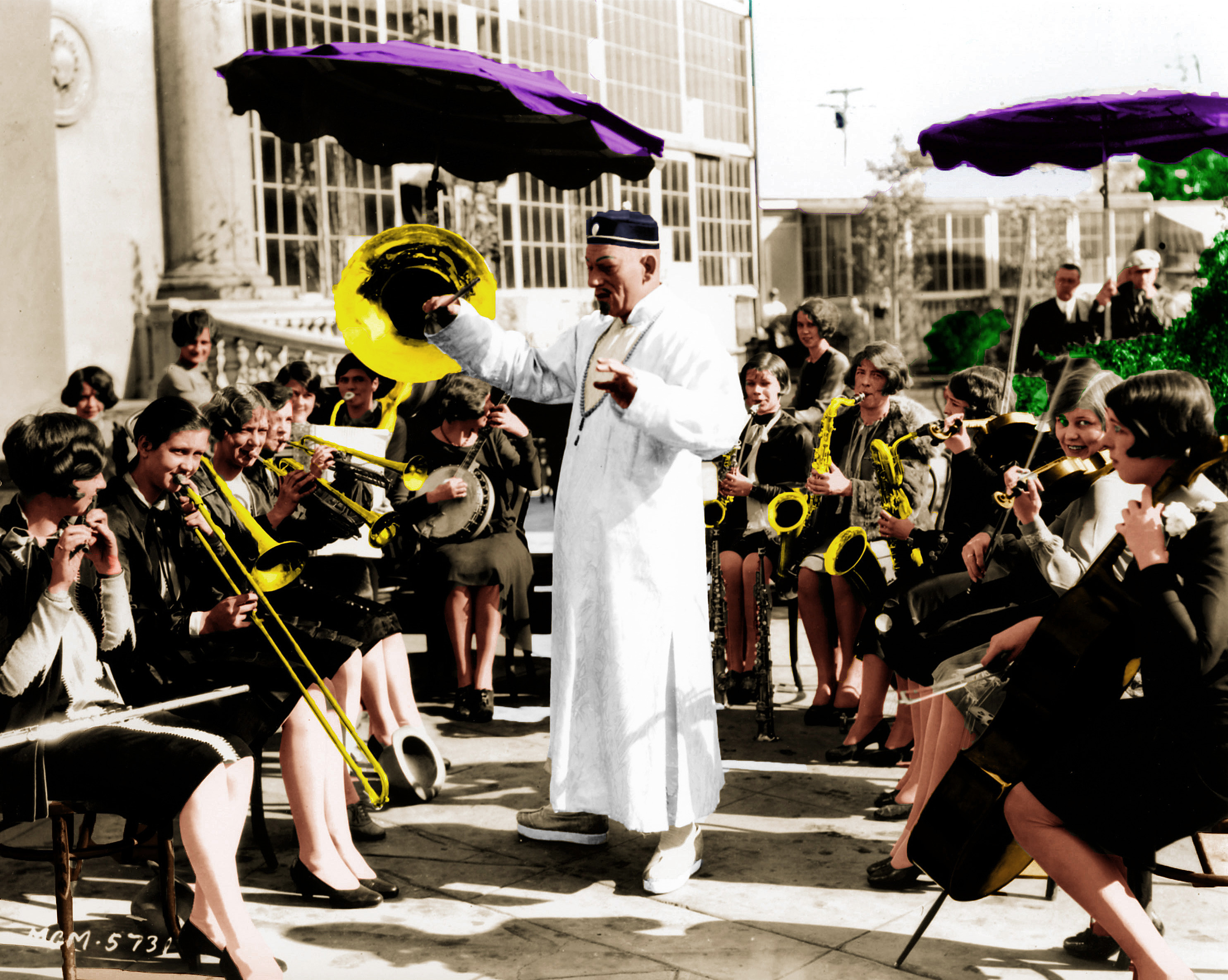
Lon plays three generations of an Asian family in Mr. Wu (1927). Here he takes a break from filming by conducting a student orchestra visiting the MGM studio:

Perhaps the most famous “lost” American film, LONDON AFTER MIDNIGHT (1927) where Lon plays a vampire but only as a ruse (no harm giving away the ending since the film is lost) to expose a murderer:

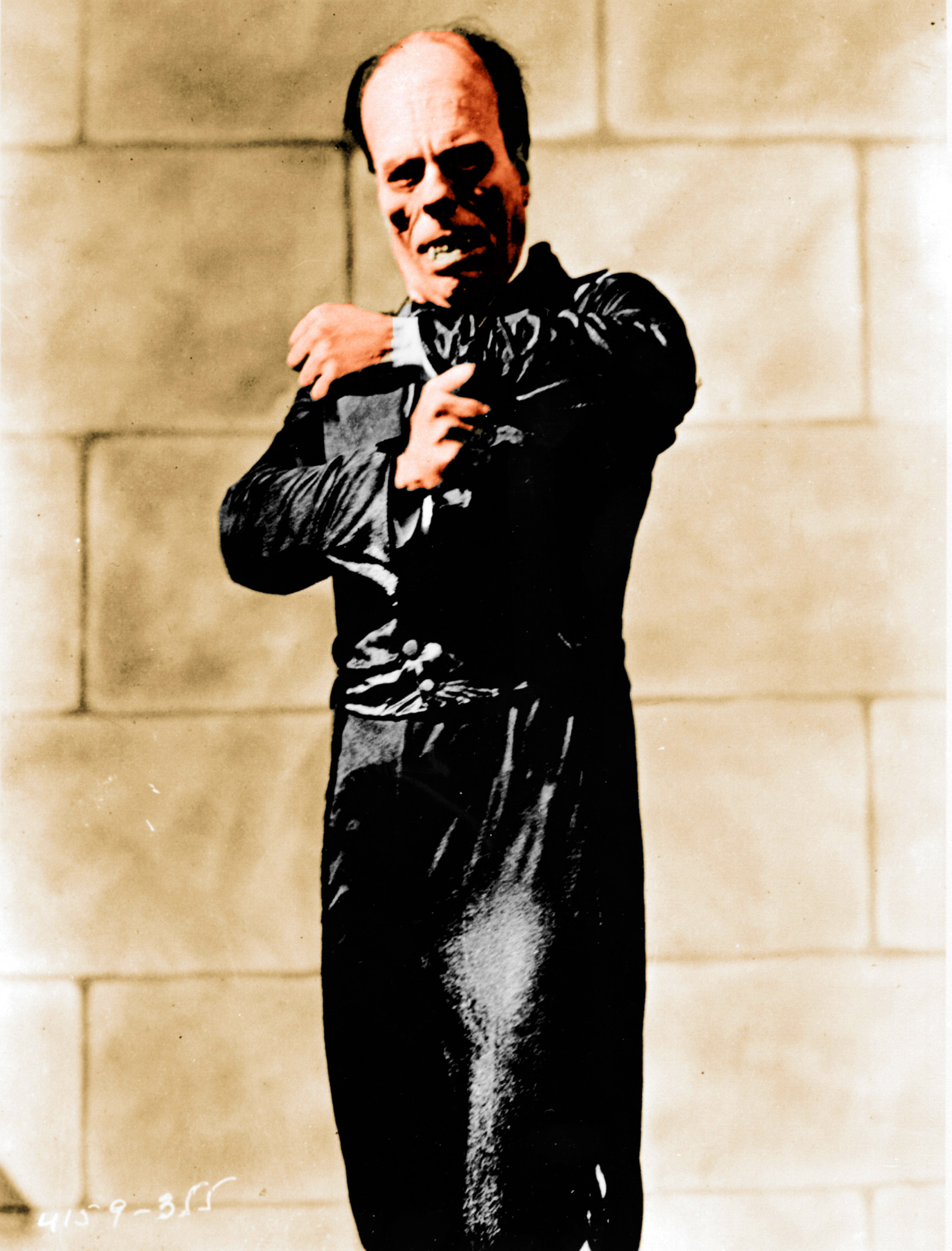
Another direct negative scan, this is one of Lon’s lesser known Thousand Faces from the opening scene in WEST OF ZANZIBAR (1928):

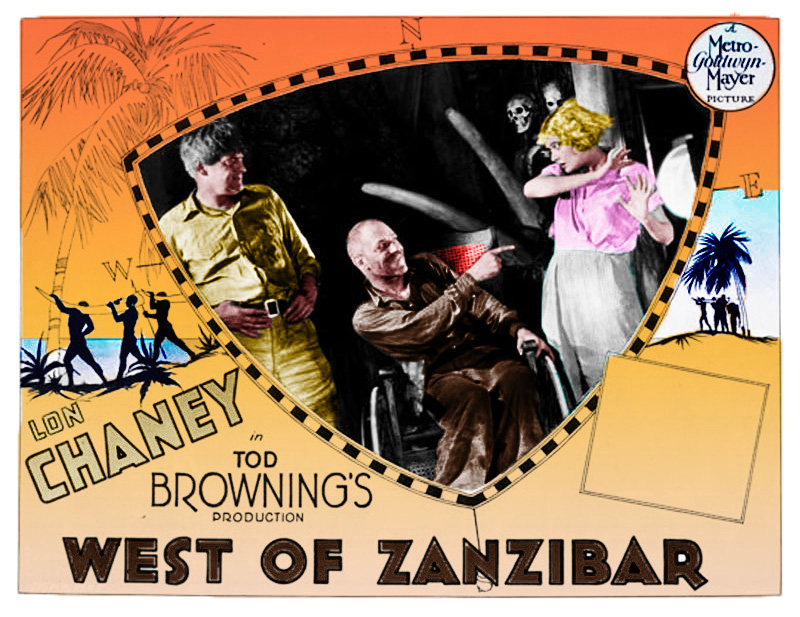
A restored lobby card: pictured are Lionel Barrymore, Lon, and Mary Nolan:

WEST OF ZANZIBAR plays South of the Border:

Another restored lobby card from WHILE THE CITY SLEEPS (1928) where Lon played it straight without resorting to one of his “faces”:

By popular request after we published this post – an original lobby card in original colors:

A detailed study of the subtle makeup used by Chaney to suggest an older character. This photo from LAUGH CLOWN LAUGH (1928) is scanned directly from a negative:

Yet another restored lobby card from 1929, Lon’s next-to-last silent film is the final collaboration between Chaney and director Tod Browning, and featured Lupe Velez and Lloyd Hughes:

A fanciful shot of Chaney as he might have looked in his 60s from his last silent film, a railroad drama titled THUNDER (1929). Alas, only a few minutes survive:

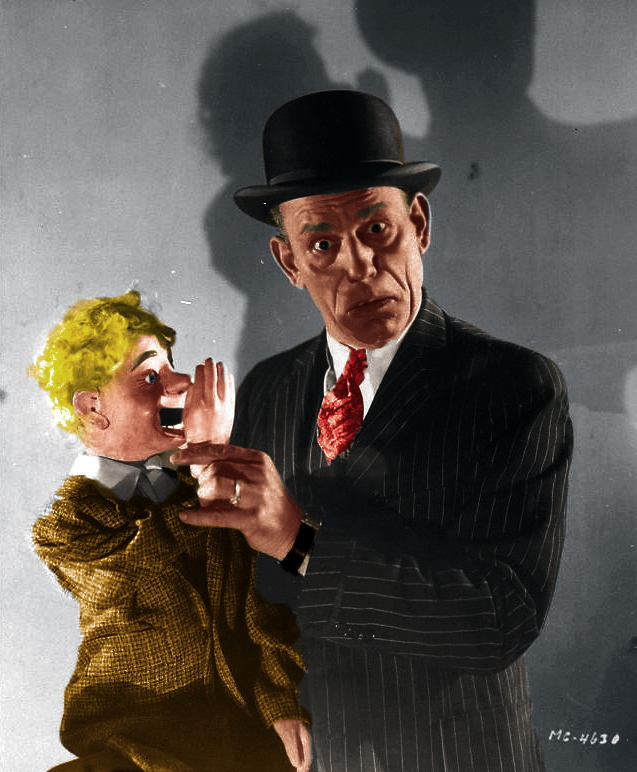
Lon Chaney made only one talkie, the very successful THE UNHOLY THREE (1930), which was a remake of his 1925 hit. Filmed during April 1930, the Man of a Thousand Faces spoke in five different voices, including as an old lady, a parrot, and a ventriloquist’s dummy pictured here in what turned out to be Lon’s final photo session:


Chaney’s death from lung cancer on August 26, 1930, shocked the world. He was only 47. The old story of how Universal wanted Lon for DRACULA (1931) has been discredited but then Universal didn’t want Bela Lugosi either. But that’s another story to be told in our next post (in anticipation of Halloween), On the Set with Bela Lugosi.

DON JUAN – 85th Anniversary of World Premiere – August 6, 1926

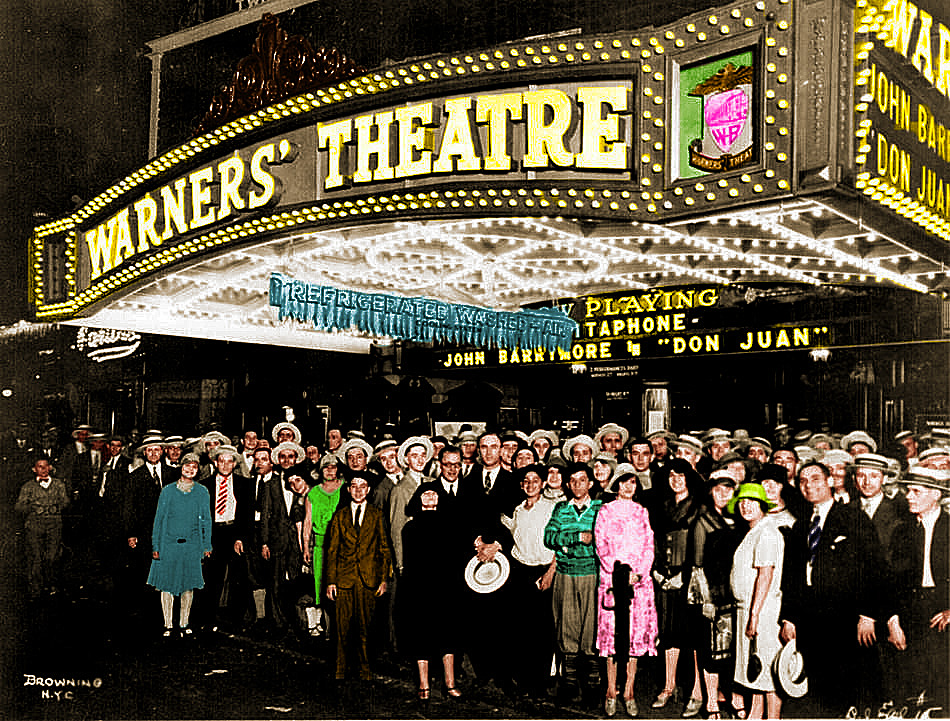
The Dawn of Sound Films arrived, oddly enough, with a silent film on the evening of August 6, 1926, in New York City at the Warner Theater. Musical accompaniment was provided by the 107 members of the New York Philharmonic Orchestra – via recording heard over the theater’s public address system. But a series of short films preceded the main feature in which various performers from the opera, theater, and vaudville spoke, sang, and played instruments. The main feature was DON JUAN, starring a real-life Don Juan – John Barrymore, who had just taken two continents by storm with his modernized version of HAMLET on the stage. The Great Profile, as Barrymore was nicknamed, spoke not an audible word but the audience was captivated by the unerring synchronization of music and action (plus a few sound effects like church bells) through a system called Vitaphone. Nobody suspected it on that night, but the tolling of those church bells turned out to be a funeral dirge for silent film (a beautiful artform, by the way):

It comes as a surprise to 21st century audiences that DON JUAN is one of the best swashbuckler action films EVER – quite apart from its position in film history. In case you’re wondering, DON JUAN can be seen on Turner Classic Movies several times a year and Warners Archives recently issued this film on dvd with all of the Vitaphone shorts from the program on that August 6th, 85 years ago:

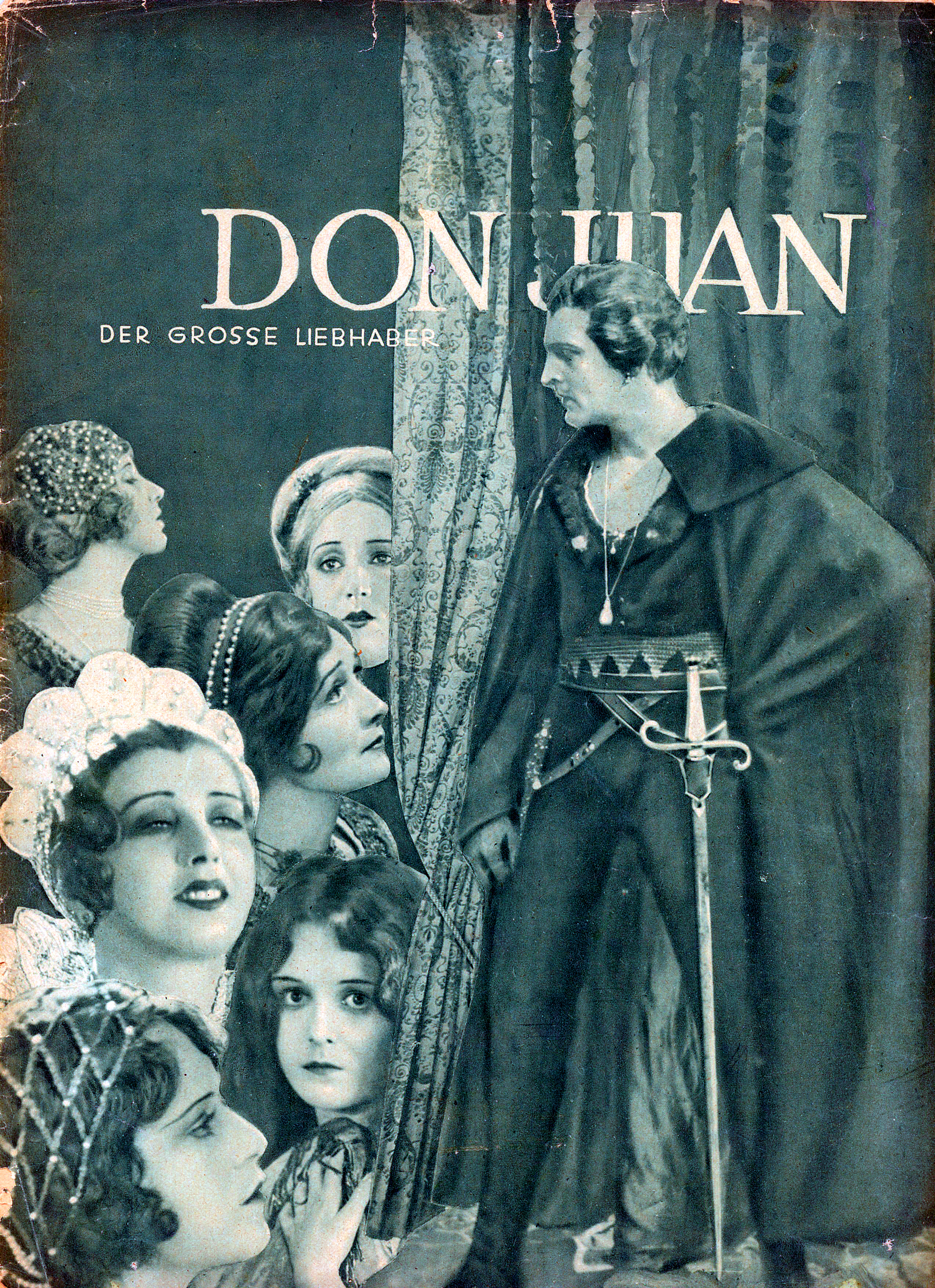
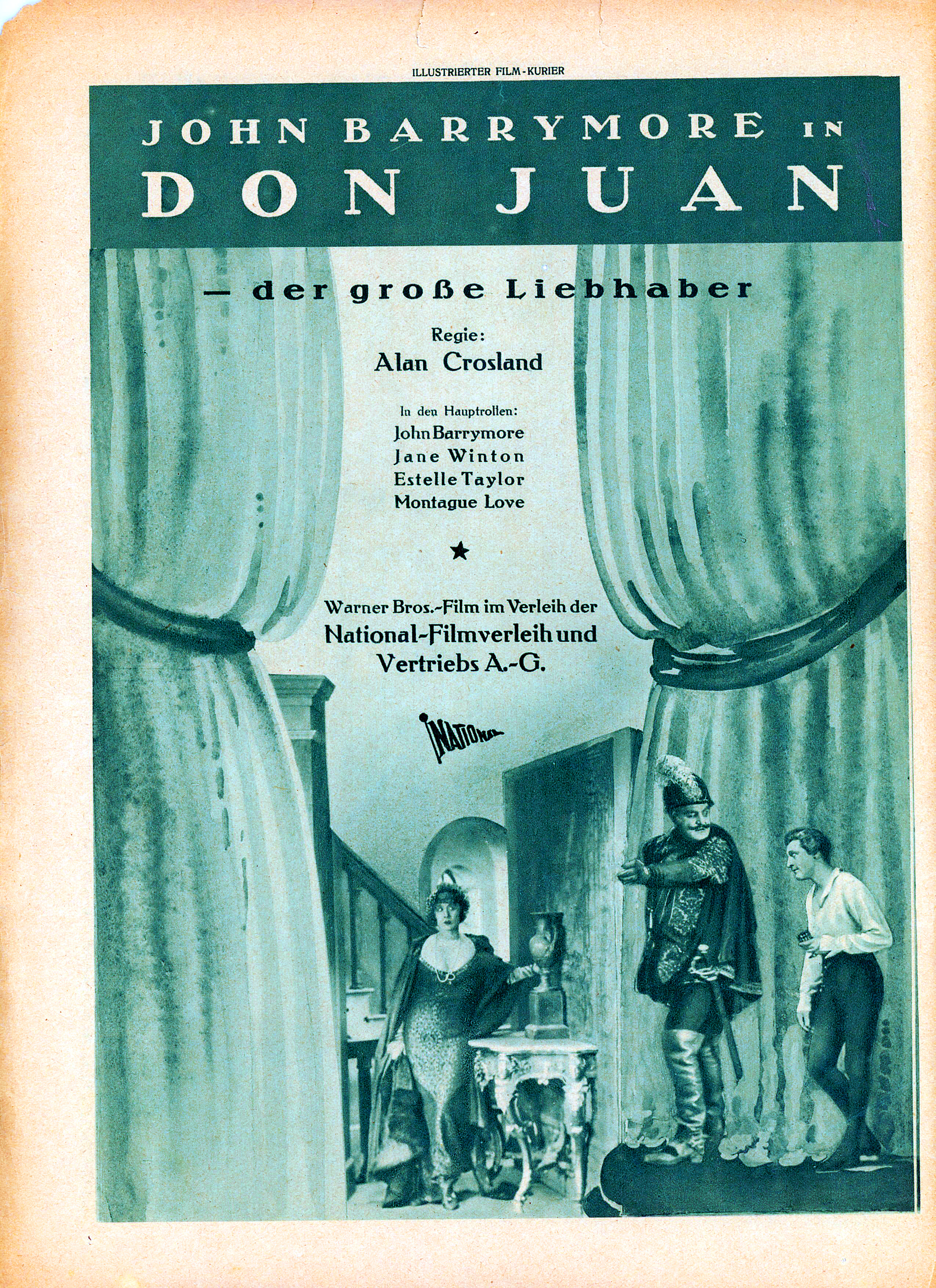
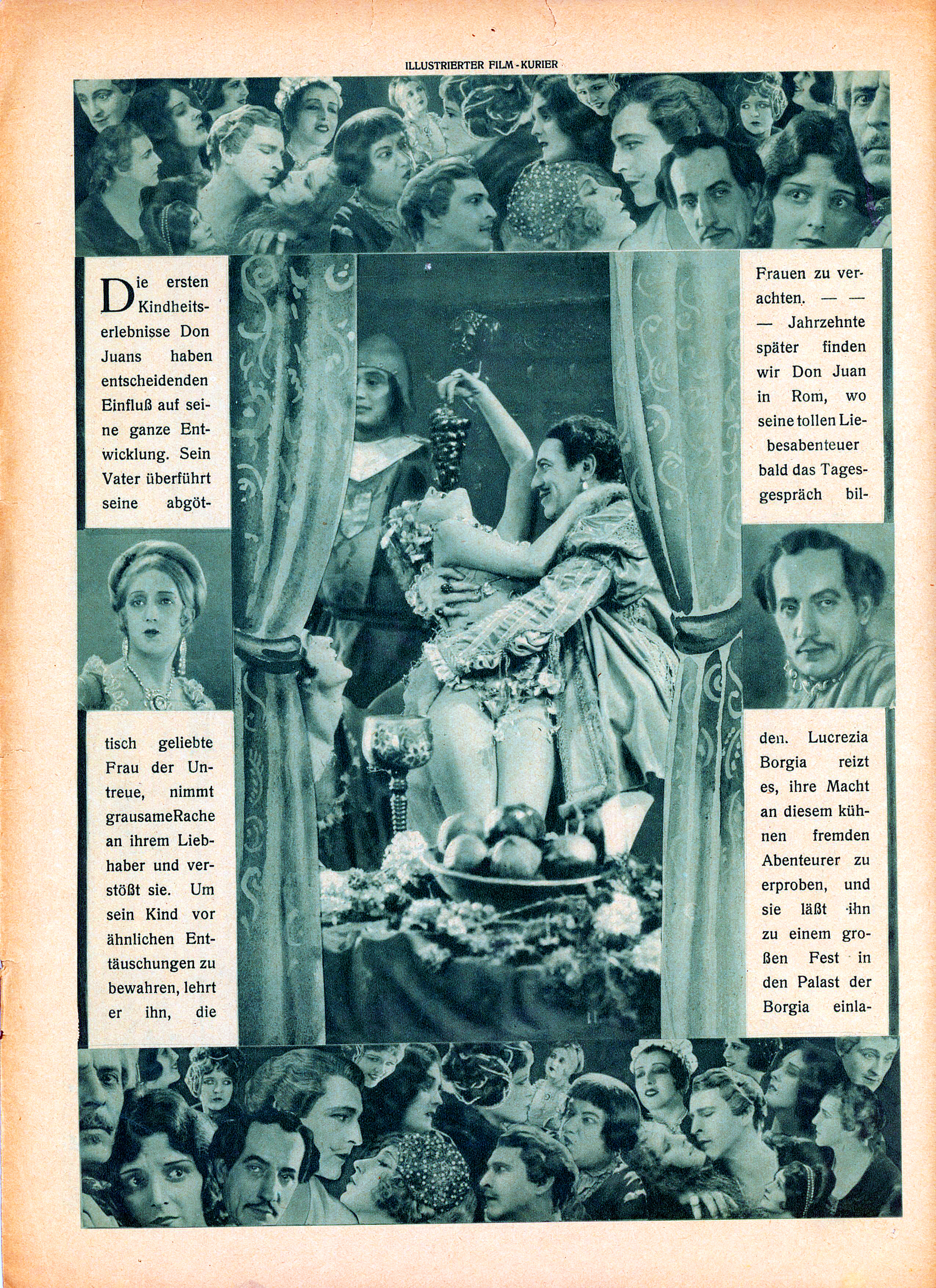
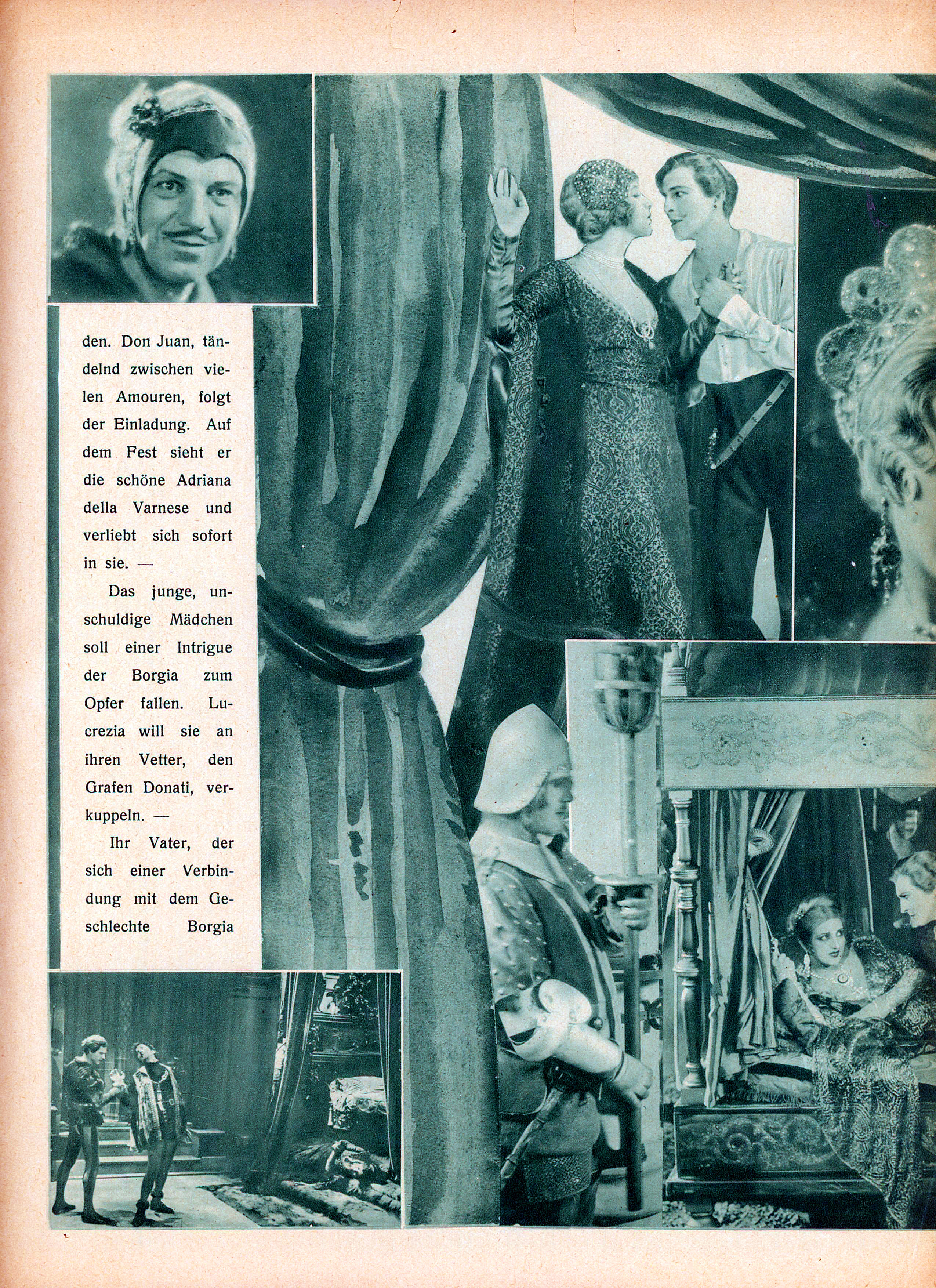
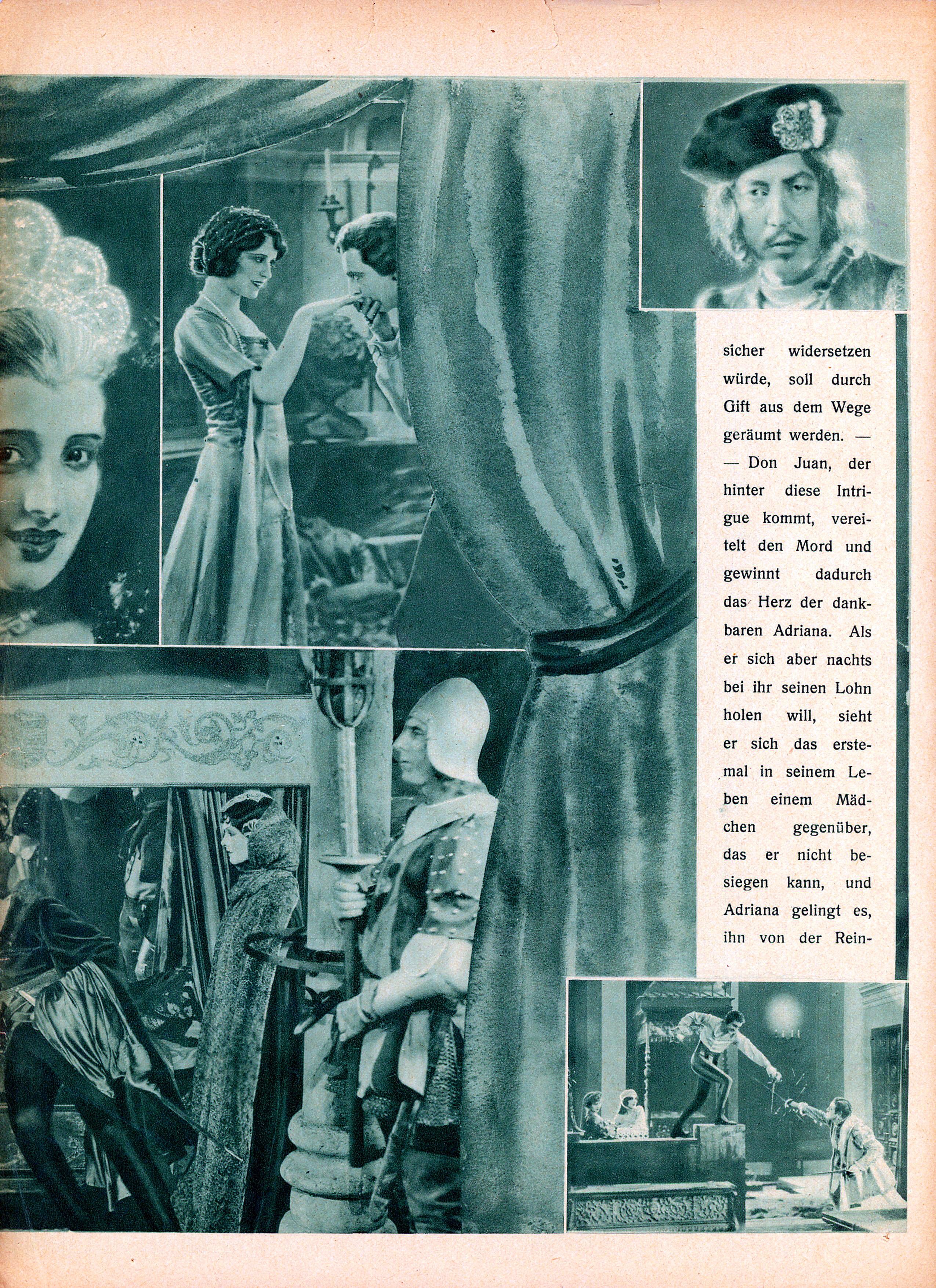
In Germany, this film was known as Don Juan – Der große Liebhaber, and here is the complete German souvenir program as restored by your blogmeister (from a bile green back to cool blue):


Montagu Love, seen below on the upper left, played the villain Count Donati. Love specialized in screen villainy and continued his nefarious schemes well into the sound era as the corrupt Bishop of the Black Cannons in THE ADVENTURES OF ROBIN HOOD (1938) and King Phillip of Spain in THE SEA HAWK (1940), among many other films:

Count Donati was a fictional villain but DON JUAN also featured two historical villains that made Donati look almost like a good guy – Cesare and Lucretia Borgia. Estelle Taylor on the left below played Lucretia and at the time was the wife of boxing champ Jack Dempsey. Warner Oland on the right below played Cesare Borgia but his most enduring role was ahead in the 1930s starring in the popular Charlie Chan detective films:

The film was climaxed by a rousing sword duel between Don Juan and Count Donati. But instead of providing the film’s ending as all Errol Flynn fans would later expect, the sword fight triggers a series of action sequences that have never been equaled these many years:


The back cover of the souvenir program features this rather seductive portrait of Mary Astor, the film’s heroine. Astor and Barrymore had enjoyed, uh, a relationship prior to making DON JUAN that had ended some time earlier. Their pairing in this film proved awkward for both of them. They would not be reteamed until 1939 in the classic romantic comedy, MIDNIGHT – but that’s another story:

On the Set with Rudolph Valentino

This August 23rd marks the 94th anniversary of the passing of Rudolph Valentino at the age of 31, an event that has been commemorated without fail each year since 1926. Extremely popular during his brief lifetime, Rudy became even more of an icon following his death. He was the first movie star to maintain a fascinating hold on the public long after his passing and he has since been joined by Marilyn Monroe, James Dean and Elvis Presley, among other others, whose early deaths became part of their legend.

Rudolph Valentino immigrated to America in 1913 and began appearing in films by 1918. Many of his early roles were thankless parts such as this uncredited bit from THE CHEATER (1920):

Rudy’s breakthrough role came in 1921 when he played the ill-fated tango dancer, Julio Desnoyers, in THE FOUR HORSEMEN OF THE APOCALYPSE. Here director Rex Ingram, who was handsome enough to be a leading man himself, discusses the script with the cast. Rudy is seated just to the right in this photo with his ever-present cigarette. The woman seated on the floor below him is screenwriter June Mathis, who was the first woman film executive in Hollywood and basically discovered Valentino, promoting him out of small roles. When Rudy died in August 1926, Mathis provided the crypt for his entombment. Ironically, Mathis died the following year and was placed in the crypt next to Valentino:
A detail from the same photo. June Mathis would write the screenplays for the next few Valentino films and eventually for the monumental BEN-HUR (1925):

Almost single-handed, Rudy started the national craze for the Tango as a result of his sultry rendition in THE FOUR HORSEMEN OF THE APOCALYPSE:

Rudy’s first leading role came next in 1921 with the legendary film, THE SHEIK. More than just a big moneymaker, this film transformed Valentino into an iconic figure whose image defined the era. Here Rudy poses with his leading lady Agnes Ayres on location:

The Lost Ending: Early screenings of THE SHEIK had a final scene between Rudy and Ayres that was deleted and remains lost today. Why? Perhaps because it made certain that the Sheik (garbed in western clothing for the first time) and Diana would marry, thus upsetting the sensibilities of some people at the time:

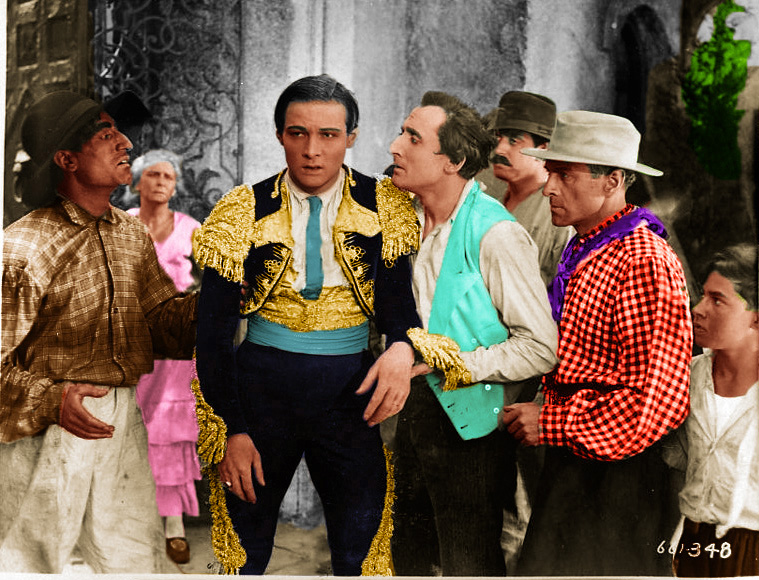
Despite his growing popularity, the studios were reluctant to headline a Latino (actually he was Italian). But Paramount finally gave Rudy star-billing in BLOOD AND SAND (1922), the story of the rise and fall of a bullfighter. Like FOUR HORSEMEN, this story was based on a best seller by Vicente Blasco Ibanez. Here Rudy poses with director Fred Niblo, who pretends to be filming. At the lower right, note the camera box with the cinematographer’s name on the top, Alvin Wyckoff:

A wonderful production shot from BEYOND THE ROCKS (1922), with the unrepeatable teaming of Gloria Swanson (extreme left) and Rudy (to her right checking his makeup). At the time, she was a well-established super star compared to Valentino’s newcomer status. Notice the anxious glances of the crew at La Swanson suggesting that all is not well. The lady violinist in the lower right provides mood music during filming. BEYOND THE ROCKS was considered a lost film for decades but was rediscovered just a few years ago and is now available on dvd:

A detail from the same photo. In those days, actors typically applied their own makeup. Within a few years, makeup artists would assist and then take over this activity:

A nice character study from BEYOND THE ROCKS scanned directly from a negative:

Another lost film (partially recovered and on dvd) is THE YOUNG RAJAH (1922), which featured Rudy in some stunning but controversial costumes designed by his wife:

Rudy on Radio – when Valentino went on “strike” from Paramount to protest the types of films he was given, he made a number of broadcasts during his 1923 tour for Mineralava. Alas, these were the early days of broadcasting when nobody thought to make recordings:

Rudy was a camera enthusiast and made his own home movies on the set of his films. Here Valentino appears to be filming with his 35mm Debrie camera during outdoor work on A SAINTED DEVIL (1924), a lost film:

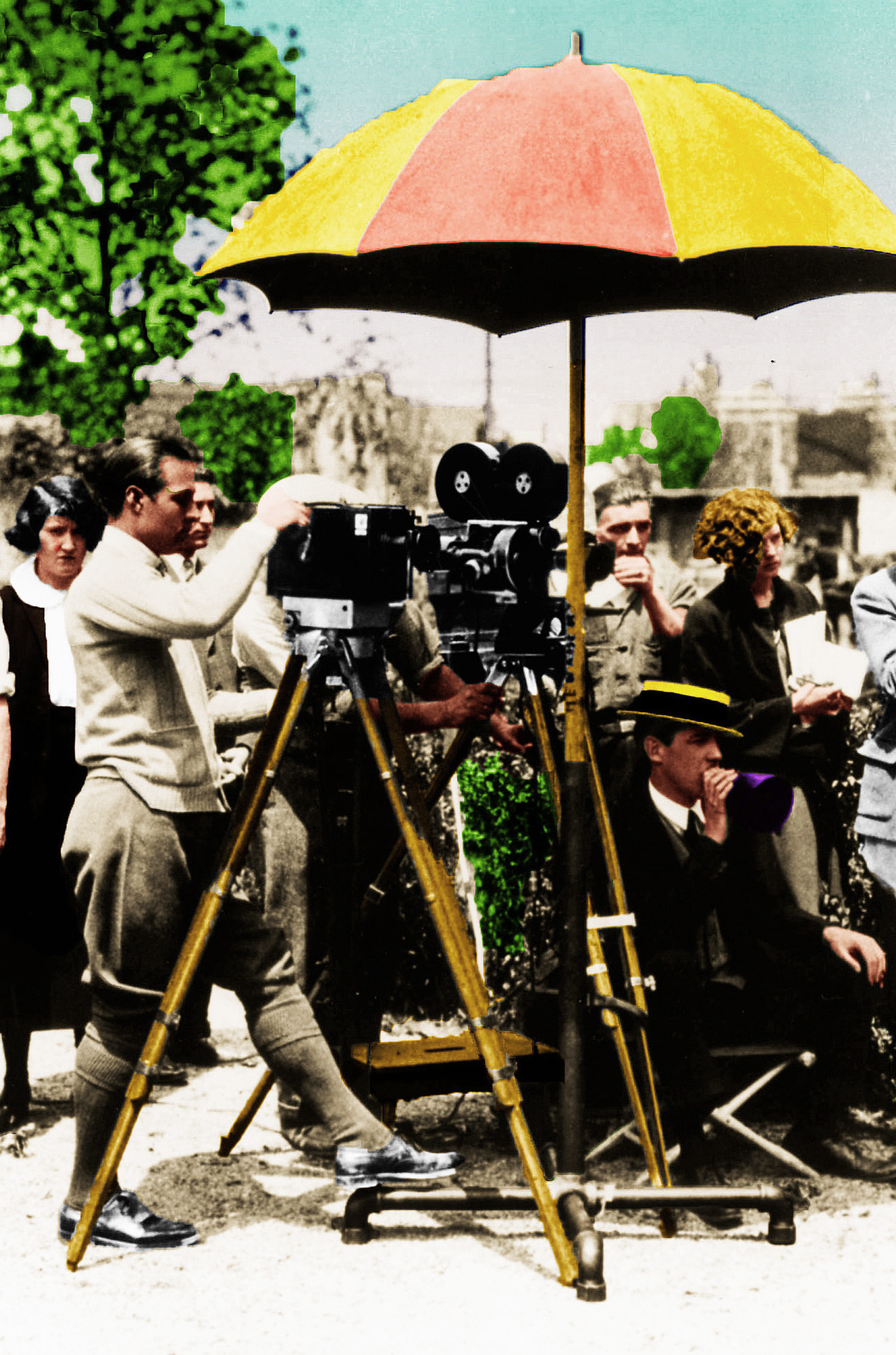
Rudy is just part of the crew as he cranks his Debrie on the SAINTED DEVIL set. The lone umbrella seems just large enough to cover director Joseph Henabery (seated with megaphone) and the cameras, evidently the most important assets on the set:

A Detail from the same photo:

An unglamorous photo of the Paramount backlot again during production of A SAINTED DEVIL. This production was not filmed in Hollywood but in Paramount’s New York facility in Astoria, Long Island. This photo seems to have been taken on the same day as the previous one but this time Rudy is using his still camera to create a portrait of his frequent co-star Nita Naldi:

A detail from the same photo:

A nice production photo from A SAINTED DEVIL scanned from a negative. What’s going on here? Perhaps the best way to find out today is by reading Rex Beach’s short story, “Rope’s End,” upon which this film was based:

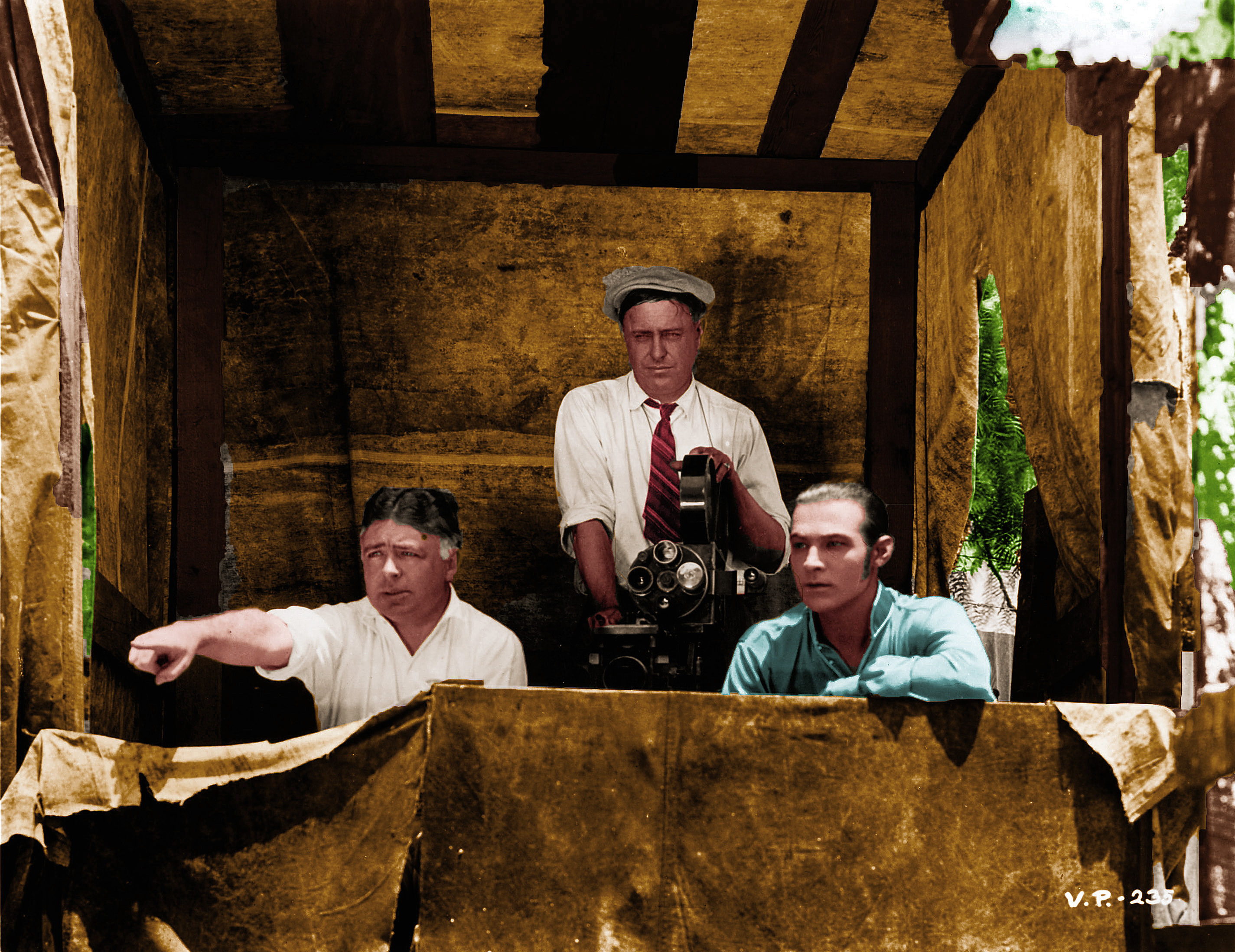
Rudy gets a camera-level view during outdoor filming on THE EAGLE (1925) for his new studio, United Artists. He plays a Russian-style Robin Hood in a witty yarn adopted from a Pushkin short story. To the left of Valentino is Clarence Brown who became one of MGM’s top directors during the 1930s, guiding Greta Garbo’s successful transition to sound films. Could he have done the same for Rudy?

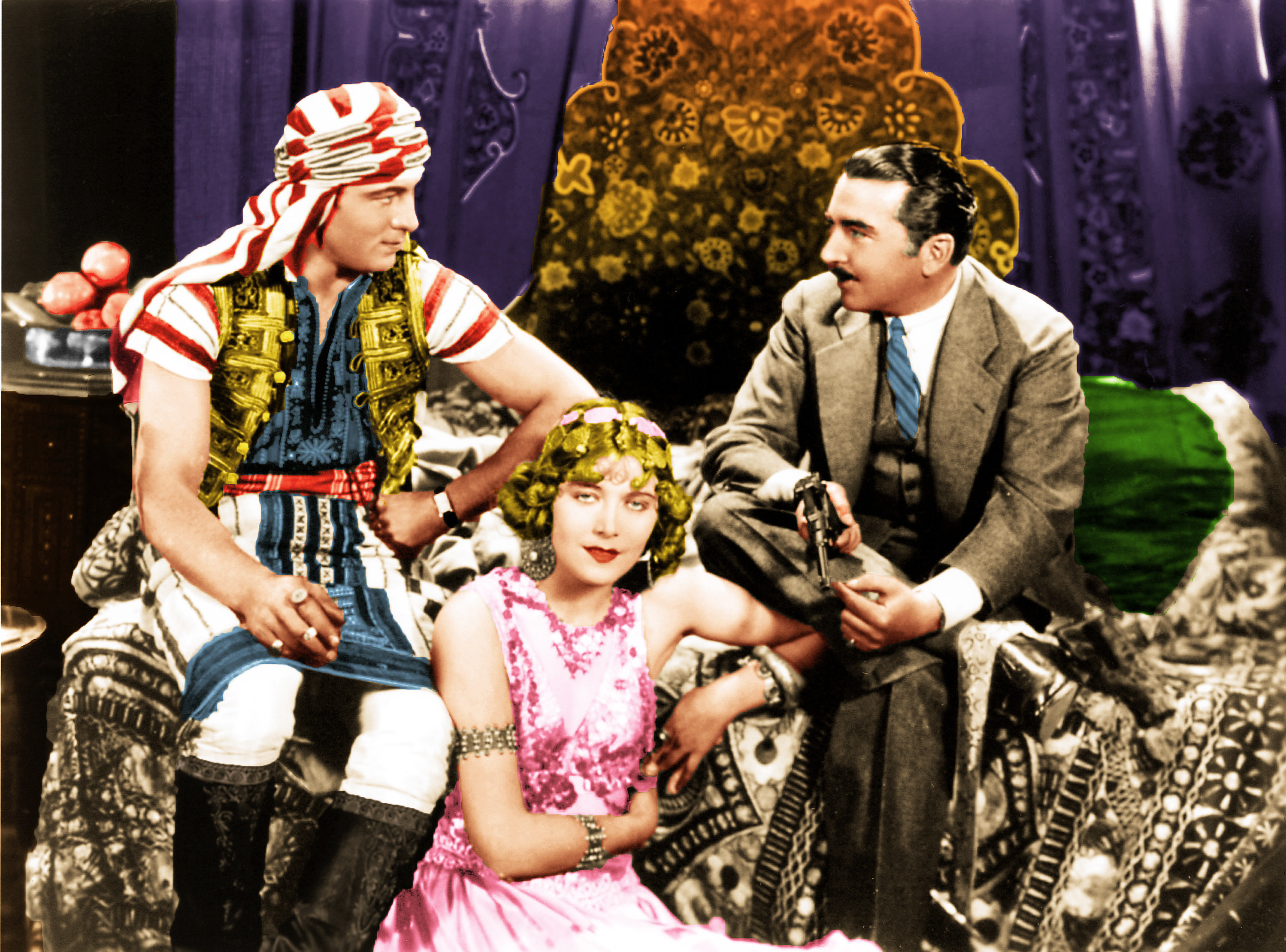
Rudy’s second film for United Artists turned out to be his last, SON OF THE SHEIK (1926). Here he poses with leading lady Vilma Banky and director George Fitzmaurice, who is holding the gun Rudy carries in the film:

Rudy applies eyebrow liner to the world heavyweight boxing champ Gene Tunney on the SON OF THE SHEIK set. Tunney was making his own film at the time, the lost serial, THE FIGHTING MARINE. A Chicago newspaper had recently called Rudy “a pink powder puff,” a remark that genuinely offended him. Perhaps this photo was meant as an ironic rebuttal – NOBODY was going to call Tunney, who was also an ex-Marine veteran of World War I, a pink powder puff!

A fanciful photo of Rudy as he might have looked in his 60s as he plays his own father in SON OF THE SHEIK:

Finally, Rudolph Valentino as he is remembered in legend:
(Photo Courtesy of Paul Seiler)
A wonderful blog filled with rare Valentino collectibles can be found at http://rudolph-valentino.blogspot.com. Highly Recommended!

About this Site

This blog is more or less a companion site to the Arliss Archives, which is a celebration of actor, author, playwright and film maker George Arliss (1868-1946). As the Arliss site evolved, I found that adding digital color to original black & white photographs sometimes produced startlingly good results. More importantly, the “cinemagraphic painting process” as I call it, brought a contemporary quality to these visions of long ago. Some black and white photos were obviously designed to exploit the beauty of light and shadows and those works I have preserved in their original greytones as the photographer intended.

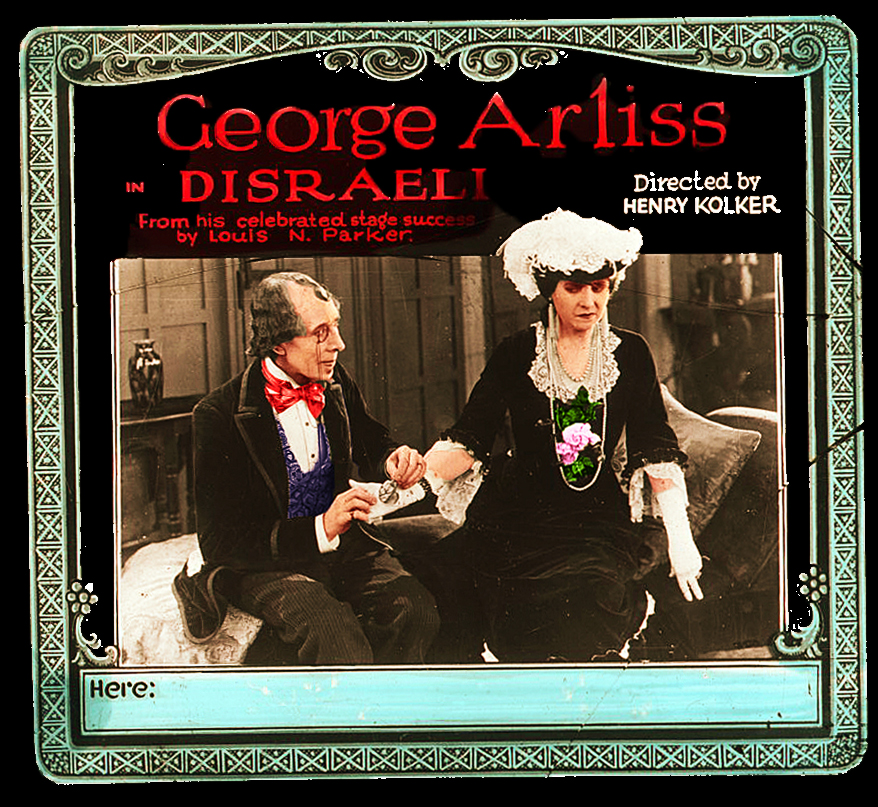
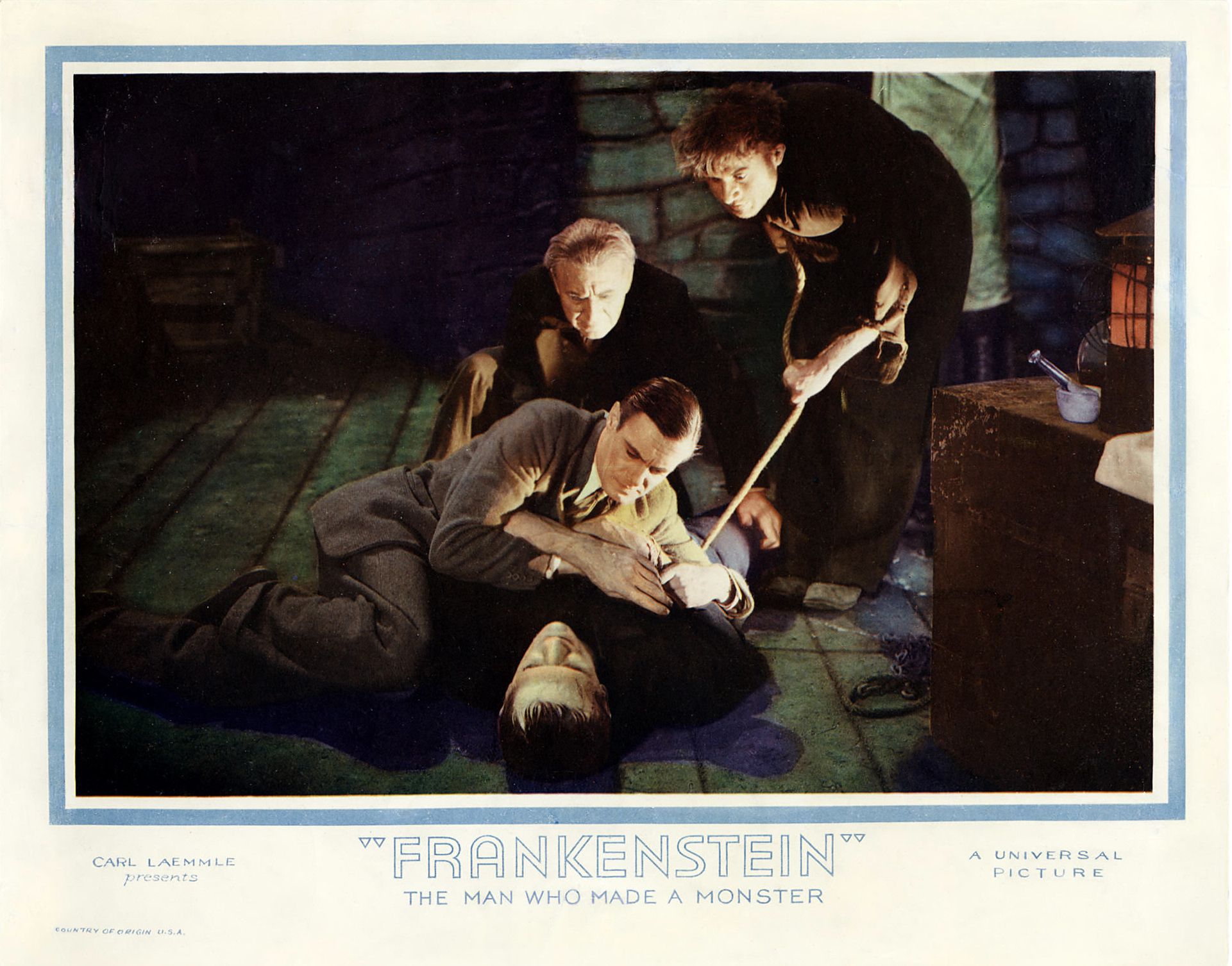
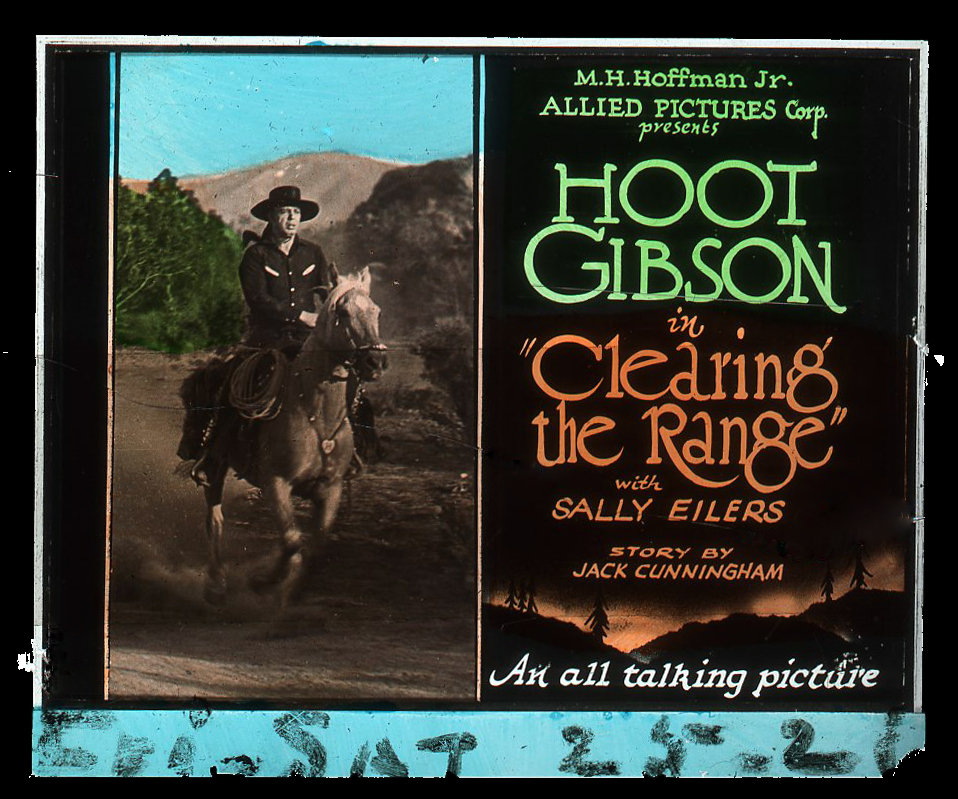
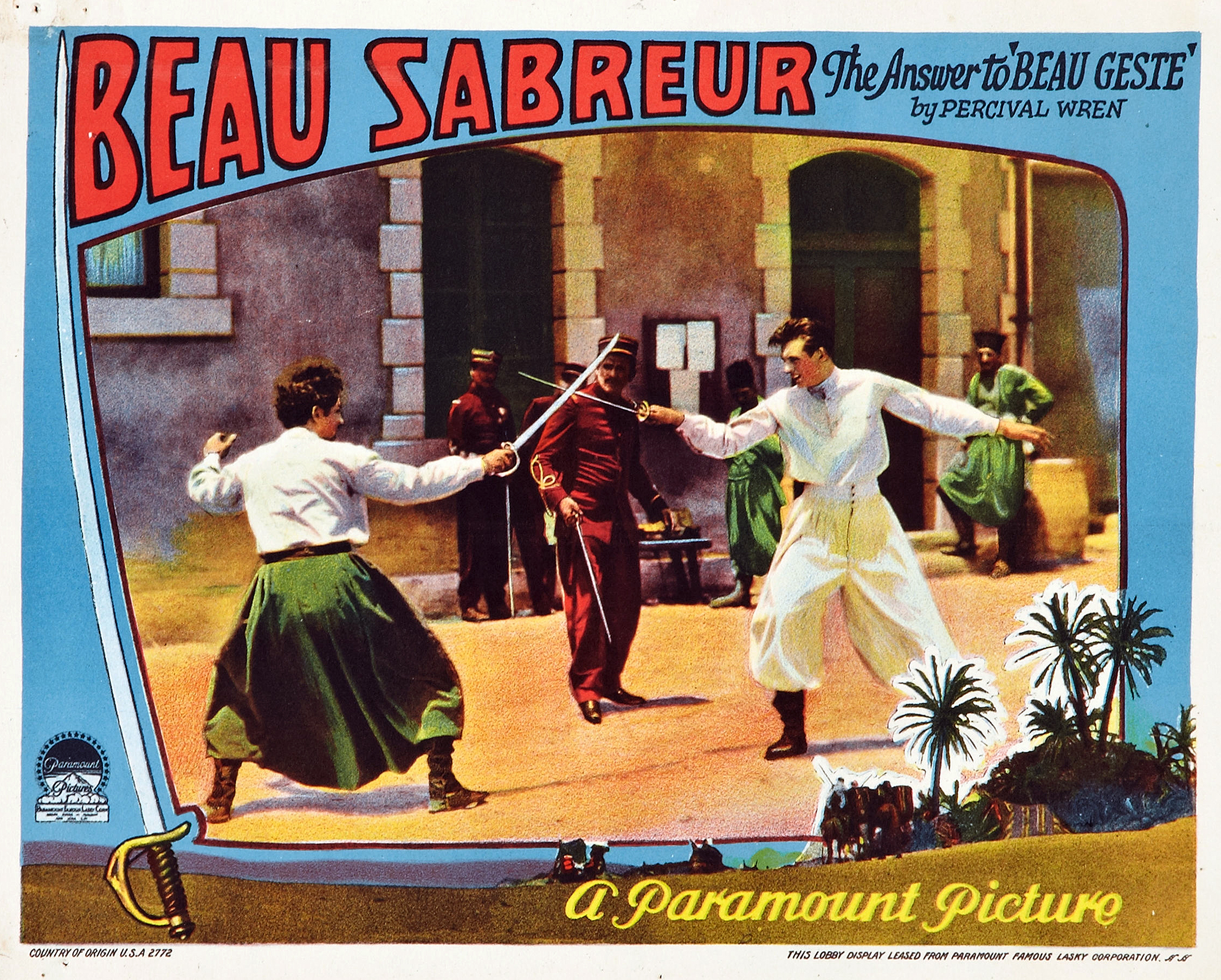
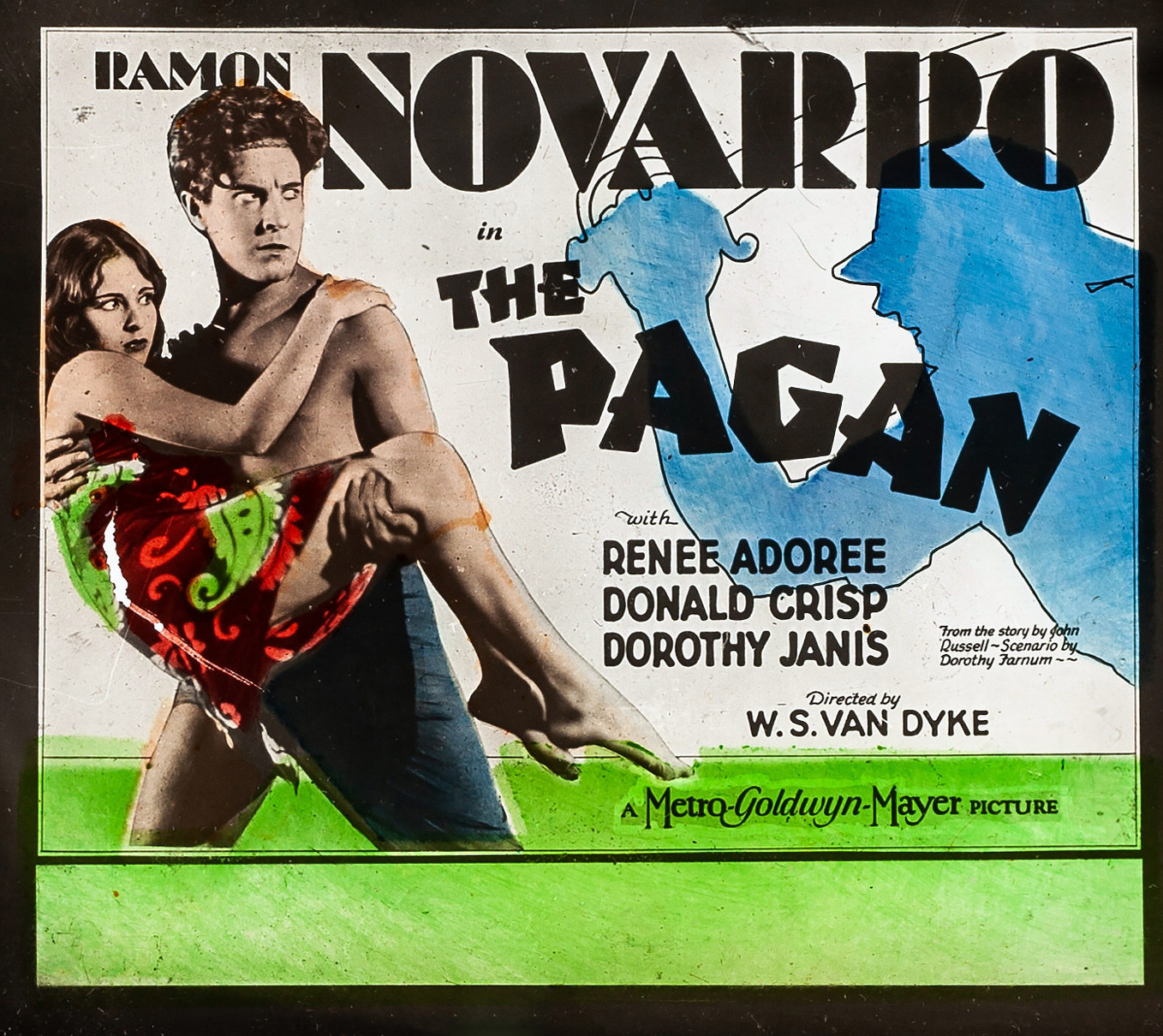
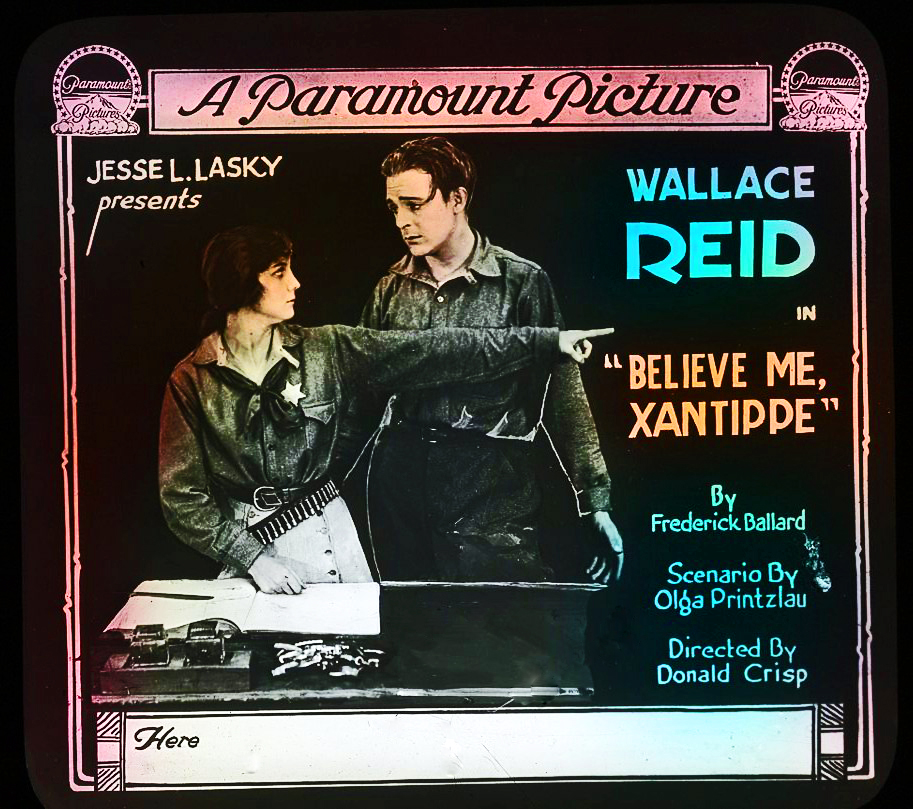
Purists may contest this point, but the fact is that most studio photographs from old Hollywood used black and white film in a utilitarian manner because color film was either too expensive or unavailable. The studios themselves routinely converted B&W photos into color posters, lobby cards, and even colorized glass slides projected onto movie screens. So historically there is a long tradition of adding color to these images and we lose nothing by using 21st century processing techniques to render these wonderful vintage photographs into the spectrum. Instead, we gain an insight into that Golden Age to see the world just as the people who lived back then saw it. For example…..

One of my favorites – Al Jolson. Here is an original photo taken during his 1930 film, MAMMY. The black and white photography is not especially artistic:

Turning this photo into color involves a number of judgment calls. Not only the choice of colors to apply, but their shade and intensity. Another judgment call: what not to color, which can be as important as deciding what to color. The point is this: if we were standing next to the camera, which of these two photos comes closer to what we would have seen?

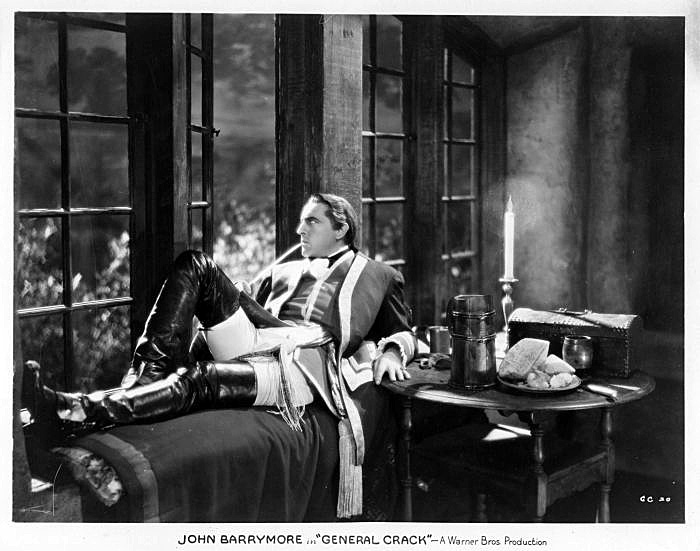
Another favorite – John Barrymore. This portrait from his first talkie, GENERAL CRACK (1930), is carefully composed after the style of late 18th century paintings. The most obvious difference is that this photo is black and white:

Whereas the portraits that inspired the photo were painted in color:

At any rate, this explains the rationale behind this site. Of course, we will be including original color material as well as our digital creations. If you’d like to see more, then please subscribe at the link on the right column here. Our first post is planned for launch in late July as an anniversary tribute to the legendary Rudolph Valentino so please don’t miss it. Thanks.

Published in: on July 15, 2011 at 7:20 PM  Comments (7)